Regulation of Coaching Centers and Structural Education Flaws
Source:Indian Express ↗
Why It Matters
The unregulated proliferation of coaching centers and the associated tragedies (like those in Old Rajinder Nagar) have brought this issue into sharp focus. For UPSC aspirants, it is crucial to analyze this topic not just as a failure of regulation, but as a symptom of deeper systemic challenges in India's education system and employment generation that directly impact the demographic dividend.
Summary
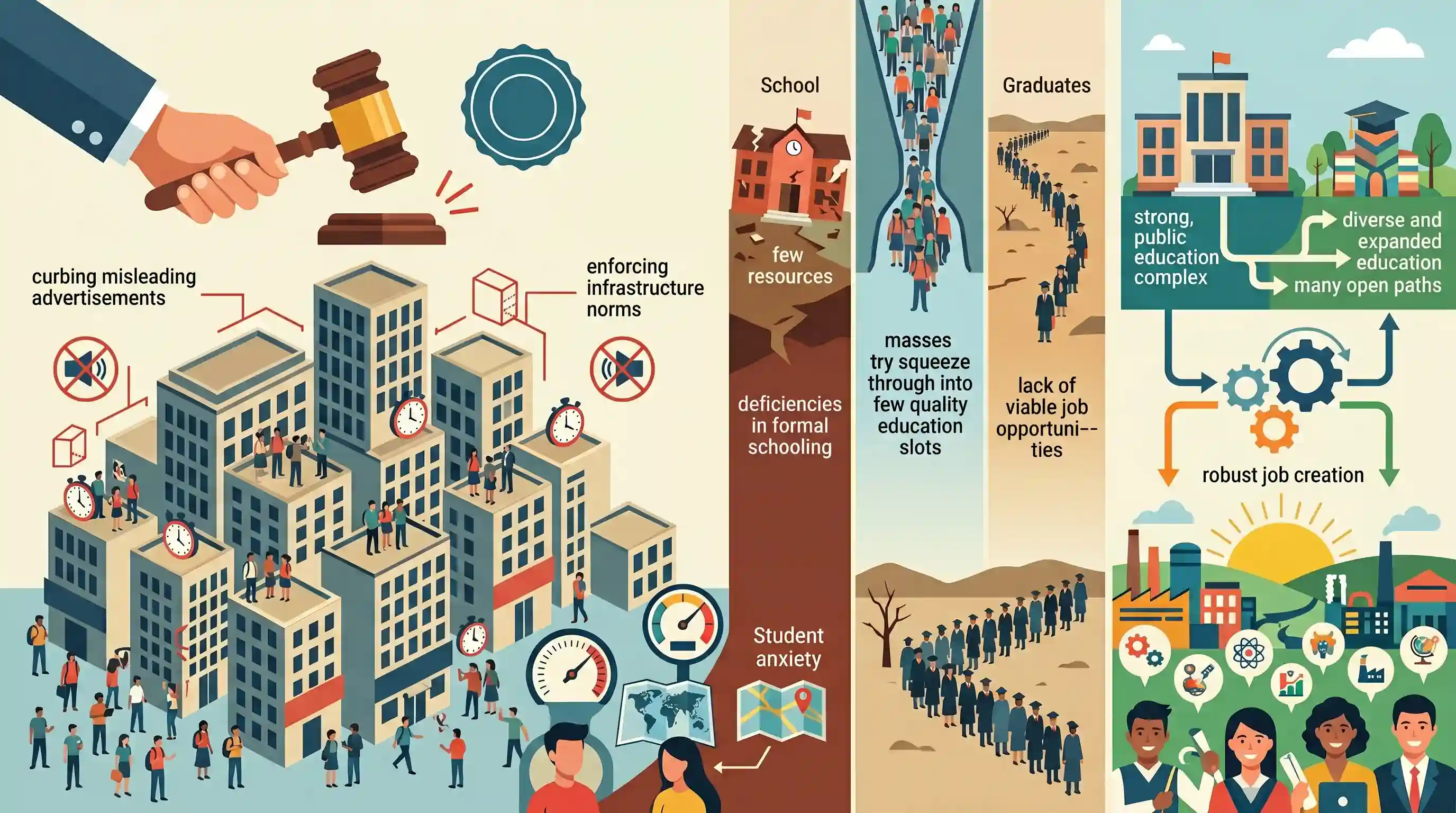
The article evaluates the government's recent regulatory warnings and guidelines targeted at the booming coaching institute sector. It argues that while curbing misleading advertisements and enforcing infrastructural norms are necessary steps to protect students, these measures are ultimately insufficient. The disproportionate reliance on 'coaching factories' stems from deeper structural flaws in India's education and employment landscape—namely, a critical shortage of quality higher education seats, deficiencies in formal schooling, and a lack of viable job opportunities. The piece concludes that solving this issue requires a holistic approach, encompassing significant educational reforms and robust job creation to truly address the anxieties driving youth toward these parallel educational systems.
Key Points
- The government has intensified regulatory scrutiny on coaching institutes through guidelines aimed at curbing misleading advertisements and ensuring basic infrastructure standards.
- While regulatory measures are necessary to prevent exploitation, they merely treat the symptoms rather than the root cause of the coaching boom.
- The massive demand for coaching is driven by systemic issues: a severe shortage of quality higher education institutions, a highly competitive examination ecosystem, and inadequate employment opportunities.
- Meaningful change requires structural reforms in the formal education system, robust implementation of the National Education Policy (NEP) 2020, and significant job creation to reduce aspirant anxiety and reliance on parallel coaching factories.
Important Terms
Guidelines for Regulation of Coaching Centers 2024

A 2024 framework mandating coaching centers to register with local authorities, restrict enrollment to students over 16, ensure mental health support, and follow fair fee-refund policies.
UPSC context
GS Paper II: Governance and Education. Tests understanding of government interventions to regulate the shadow education industry.
Guidelines for Prevention of Misleading Advertisement in Coaching Sector 2024
CCPA regulations introduced in November 2024 prohibiting coaching institutes from making false claims about ranks, success rates, and guaranteed outcomes to protect student-consumers from deceptive marketing.
UPSC context
GS Paper II & III: Regulatory bodies and Consumer Protection. Relevant for ethics in business and education governance.
Central Consumer Protection Authority (CCPA)
A statutory body under the Consumer Protection Act 2019, empowered to protect consumer rights, prevent unfair trade practices, and penalize misleading advertisements across sectors, including coaching.
UPSC context
GS Paper II: Statutory, regulatory and quasi-judicial bodies. Focuses on the executive's role in safeguarding consumer interests.
National Education Policy (NEP) 2020
India's comprehensive education framework aiming to transform learning by reducing "coaching culture" through competency-based assessments and reforming board exams to focus on holistic development rather than rote learning.
UPSC context
GS Paper II: Social Sector/Services relating to Education. Core policy for long-term structural reforms in the Indian schooling system.
Ministry of Education
The nodal central ministry responsible for formulating national education policies, overseeing school and higher education, and issuing regulatory guidelines for educational institutions and coaching centers.
UPSC context
GS Paper II: Important aspects of governance. Tests knowledge of the institutional framework for human resource development.
Prelims Trap
"The Guidelines for Regulation of Coaching Centers 2024 are legally binding statutory rules issued under the RTE Act."
Education is in the Concurrent List. The 2024 Guidelines by the Ministry of Education are an advisory framework for States/UTs to adapt, not statutory rules under any Act.
Static Concepts Connected
What is the mandate and statutory backing of the CCPA?
- Statutory Origin: It was established under the Consumer Protection Act, 2019 to promote, protect, and enforce consumer rights.
- Core Mandate: Regulating matters relating to violation of consumer rights, unfair trade practices, and misleading advertisements (like false coaching success rates).
- Regulatory Powers: It can impose penalties, order recalls, and issue binding directions to discontinue false or misleading advertisements.
How does India's higher education GER impact the demographic dividend?
- Low Enrollment: AISHE 2021-22 puts India's Gross Enrolment Ratio at just 28.4%, meaning a vast majority of youth are excluded from formal higher education.
- Coaching Dependency: The severe shortage of quality higher education seats forces millions into an unproductive parallel coaching ecosystem instead of real skill-building.
- Demographic Disaster: A low GER combined with inadequate job creation threatens to turn India's demographic dividend into a demographic disaster.
Cross-Topic Patterns
Education as a Consumer Service
The CCPA's intervention in the coaching sector firmly frames students as consumers, bridging GS2 educational policies with statutory consumer protection mechanisms against unfair trade practices.
NEP Assessment Reforms vs Coaching Economy
NEP 2020 advocates for formative, competency-based assessments (via PARAKH) precisely to eliminate the high-stakes summative exams that fuel the parallel coaching economy.

A GS2 Mains question in 2026 will likely ask if regulating the coaching industry merely treats the symptom of India's low higher-ed GER.
Linked PYQs · 4
Linked PYQs · 4
- 2023MainsGS2
Skill development programmes have succeeded in increasing human resources supply to various sectors. In the context of the statement analyse the linkages between education, skill and employment.
- 2014MainsGS3
While we flaunt India's demographic dividend, we ignore the dropping rates of employability. What are we missing while doing so? Where will the jobs that India desperately needs come from? Explain.
- 2020MainsGS2
National Education Policy 2020 is in conformity with the Sustainable Development Goal-4 (2030). It intends to restructure and reorient education system in India. Critically examine the statement.
- 2015MainsGS2
The quality of higher education in India requires major improvements to make it internationally competitive. Do you think that the entry of foreign educational institutions would help improve the quality of higher and technical education in the country? Discuss.
