Share Buyback Taxation Reform as Capital Gains in Budget
Source:The Hindu ↗
Why It Matters
Taxation of capital markets and corporate tax loopholes are frequent themes in UPSC (e.g., questions on Dividend Distribution Tax, Long-term Capital Gains Tax). This budget reform closes a significant tax arbitrage gap, reflecting the government\'s strategy to rationalize direct taxes, making it highly relevant for GS3 Economy and Prelims conceptual questions.
Summary
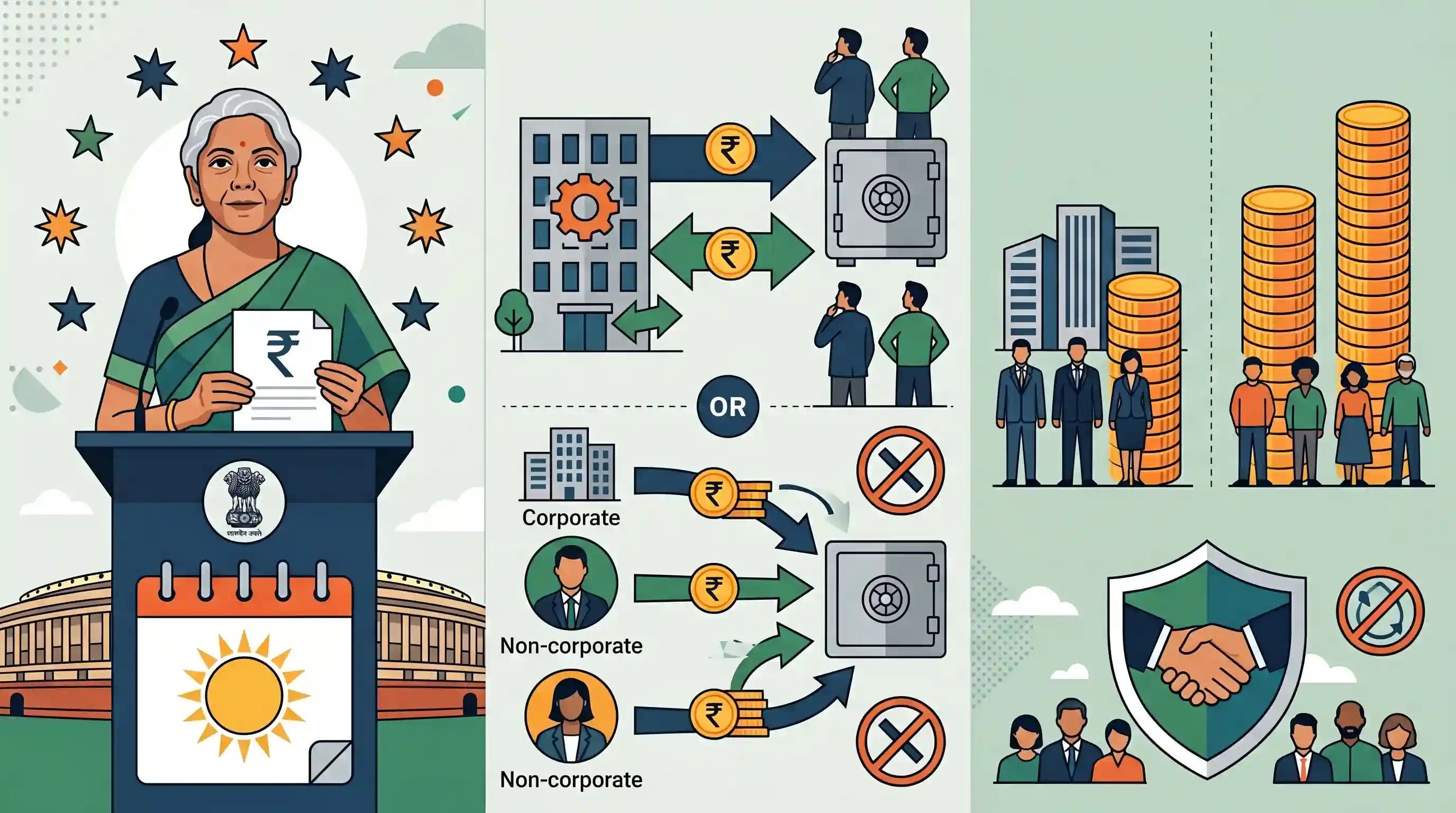
During the Union Budget 2026-27 presentation, Finance Minister Nirmala Sitharaman announced a major direct tax reform: share buybacks will now be taxed as capital gains for all shareholders. The shift intends to address the misuse of the "buyback route" by promoters for tax arbitrage and to safeguard minority shareholders. Previously, the company bore the tax burden on buybacks, enabling investors to exit without incurring direct tax liabilities. Under the new policy, the effective tax rate will be 22% for corporate promoters and 30% for non-corporate promoters. Notably, this budget marked Sitharaman\'s ninth presentation and the first-ever Union Budget to be presented on a Sunday.
Key Points
- The Union Budget 2026-27 mandates that share buyback proceeds will be taxed as capital gains for all types of shareholders.
- The reform aims to curb the improper use of the buyback route by promoters who previously used it for tax arbitrage.
- The new regime imposes an effective tax rate of 22% for corporate promoters and 30% for non-corporate promoters.
- Historically, companies paid the buyback tax, allowing investors to exit tax-free; the incidence of tax now shifts to the investor.
- This marked the first time in India\'s history that the Union Budget was presented on a Sunday, which was also FM Nirmala Sitharaman\'s ninth budget.
Important Terms
Union Budget

The annual financial statement of the Government’s estimated receipts and expenditure for a financial year, mandated under Article 112 of the Indian Constitution.
UPSC context
GS Paper 2/3: Tests constitutional provisions, fiscal policy, and parliamentary procedures related to financial legislation.
Share Buyback
A corporate action where a company repurchases its own shares from existing shareholders, often to reward investors or optimize its capital structure.
UPSC context
GS Paper 3: Relevant for corporate governance, market dynamics, and direct taxation reforms in the Indian economy.
Capital Gains Tax
Tax levied on the profit earned from the sale or transfer of a capital asset, such as shares or property.
UPSC context
GS Paper 3: Core topic for direct taxation, revenue mobilization, and economic growth strategies.
Tax Arbitrage
The practice of exploiting loopholes or discrepancies in tax laws and rates to reduce total tax liability or earn profits.
UPSC context
GS Paper 3: Tested within tax reforms, addressing tax avoidance, and ensuring "tax neutrality" in the financial system.
Minority Shareholders
Investors who own a small proportion of a company's shares and do not have the power to control its management.
UPSC context
GS Paper 3: Important for corporate ethics, SEBI regulations, and the protection of small investor rights.
Direct Tax
A tax paid by an individual or organization directly to the entity that imposed it, such as income tax or capital gains tax.
UPSC context
GS Paper 3: Essential for understanding the Indian tax structure, fiscal consolidation, and progressive taxation.
Prelims Trap
"The incidence of tax on share buybacks falls entirely on the corporate entity conducting the buyback."
The 2026-27 Budget shifted this burden. Previously, companies paid a flat buyback tax, but now the tax incidence falls directly on the investor as capital gains.
Static Concepts Connected
What is a share buyback and what are its primary objectives?
- Definition: A corporate action where a company purchases its own outstanding shares from the open market or directly from existing shareholders.
- Financial Impact: Reduces the number of outstanding shares on the market, thereby improving financial metrics like earnings per share (EPS) and return on equity (ROE).
- Objectives: Used to return surplus cash to shareholders, consolidate promoter ownership, or signal to the market that the company's stock is undervalued.
How does Capital Gains Tax differ from Dividend income taxation?
- Capital Gains: Tax levied on the profit realized from the sale or transfer of a capital asset (like shares), varying by holding period (short-term vs long-term).
- Dividends: A direct distribution of corporate earnings to shareholders. It is generally added to the investor's total income and taxed at their applicable income slab rates.
- Tax Arbitrage: The practice of structuring corporate payouts (e.g., choosing buybacks over dividends) purely to exploit differing tax frameworks and minimize overall tax liability.
Cross-Topic Patterns
SEBI governance & minority shareholder rights
Taxing buybacks as capital gains aligns with SEBI's corporate governance reforms, preventing promoters from using buyback routes exclusively for their own tax arbitrage at the expense of minority investors.
Direct tax rationalization trend
This reform reflects the continuous evolution of India's tax policy, moving toward neutral taxation frameworks that eliminate loopholes between different corporate payout methods (dividends vs. buybacks).

Expect a multi-statement Prelims question contrasting the incidence of tax in share buybacks versus dividends, focusing on tax arbitrage.
Linked PYQs · 3
Linked PYQs · 3
- 2018MainsGS3
Comment on the important changes introduced in respect of the Long-term Capital Gains Tax (LCGT) and Dividend Distribution Tax (DDT) in the Union Budget for 2018-2019.
- 2022PrelimsGS1
Which one of the following situations best reflects "Indirect Transfers" often talked about in media recently with reference to India?
- 2022PrelimsGS1
With reference to the expenditure made by an organisation or a company, which of the following statements is/are correct? 1. Acquiring new technology is capital expenditure. 2. Debt financing is considered capital expenditure, while equity financing is considered revenue expenditure. Select the correct answer using the code given below:
