Banking Sector Reforms and Financial Inclusion Committee Setup
Source:The Hindu ↗
આ શા માટે મહત્વનું છે
A robust, well-regulated, and inclusive banking system is crucial for capital mobilization and sustaining economic growth in India. This high-level committee marks the next major milestone in public sector banking reforms, aligning structural banking policies with long-term development targets (Viksit Bharat 2047). This is highly relevant for GS3 core economy sections on growth, resource mobilization, and financial sector governance.
સારાંશ
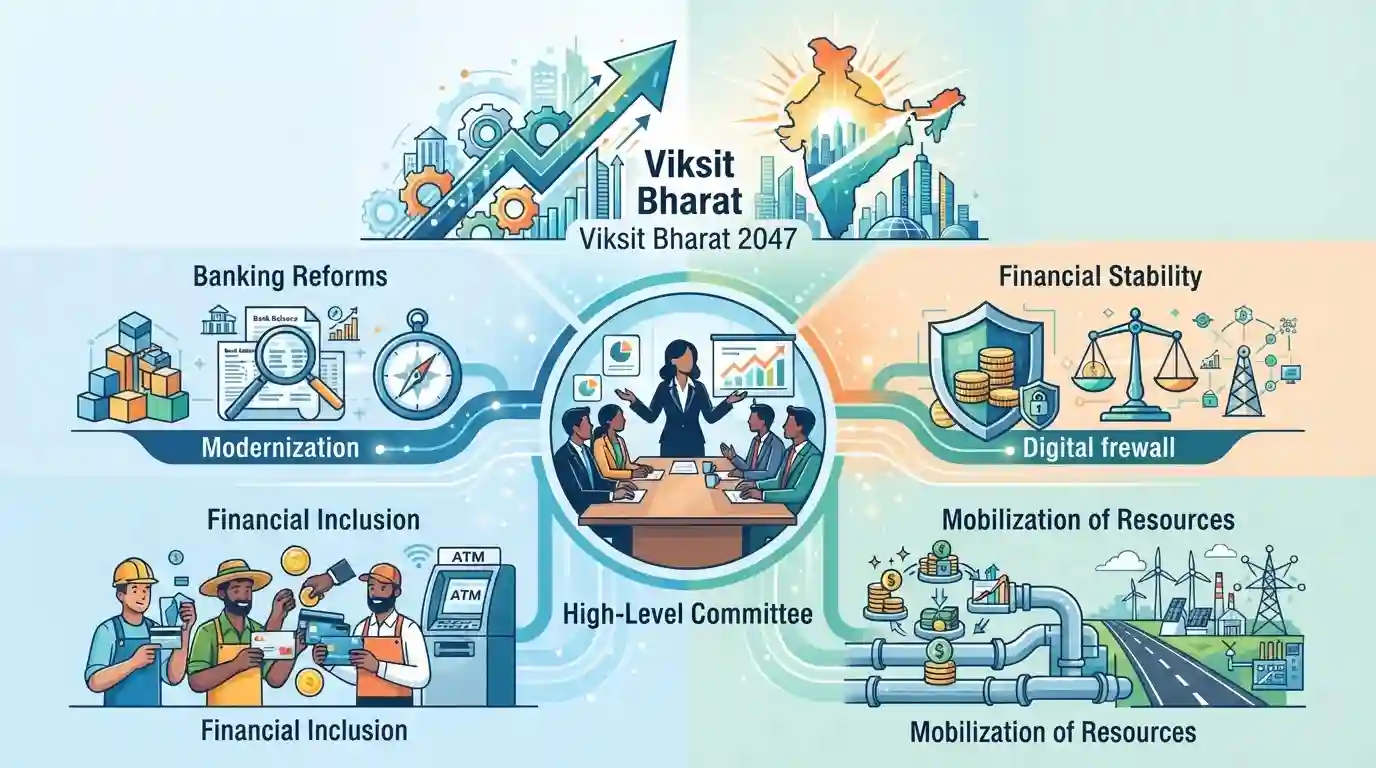
Union Finance Minister Nirmala Sitharaman announced that the central government will soon set up a high-level committee on 'Banking for Viksit Bharat'. First proposed in the Union Budget 2026, the panel's goal is to comprehensively review the banking sector and align it with India's long-term growth trajectory towards becoming a developed nation by 2047, while protecting consumers and maintaining robust financial stability.
મુખ્ય મુદ્દા
- The government will soon announce a high-powered committee on 'Banking for Viksit Bharat' to comprehensively review and reform the banking sector.
- The committee's mandate was originally proposed in the Union Budget speech on February 1, 2026.
- The panel will focus on aligning the banking sector with India's next phase of economic growth while simultaneously safeguarding financial stability, deep financial inclusion, and consumer protection.
- The announcement was delivered by Finance Minister Nirmala Sitharaman at the 'PSB Confluence' (PSB Manthan), a two-day ideation conclave organized by the Department of Financial Services (DFS) in New Delhi.
મહત્વપૂર્ણ શબ્દો
Union Budget 2026-27

The annual financial statement of the Government of India for the 2026-27 fiscal year, detailing anticipated revenues and expenditures. It formally proposed the high-level committee on 'Banking for Viksit Bharat'.
UPSC context
GS Paper 3 (Indian Economy). Fundamental for tracking national fiscal policies, resource mobilization, and targeted economic reforms.
Viksit Bharat
The Government of India's long-term vision to transform the country into a developed, high-income economy by 2047, focusing on inclusive growth, infrastructure, and technology for its 100th year of independence.
UPSC context
GS Paper 3 (Growth & Development). An essential framework for evaluating India's developmental milestones and macroeconomic aspirations.
Department of Financial Services
A department under the Ministry of Finance that oversees banking, insurance, and pension reforms. It manages public sector financial institutions and implements major financial inclusion schemes.
UPSC context
GS Paper 3 (Indian Economy). Tests knowledge of financial governance, regulatory oversight, and the implementation of welfare policies.
Public Sector Banks
Commercial banks where the Government of India holds a majority stake (over 50%). They serve as primary instruments for driving financial inclusion and executing state socio-economic policies.
UPSC context
GS Paper 3 (Indian Economy). Vital for understanding banking reforms, market stability, and government intervention in credit markets.
પ્રિલિમ્સ ટ્રેપ
The High-Level Committee on 'Banking for Viksit Bharat' is a statutory body constituted under the Reserve Bank of India Act, 1934.
The committee is an executive advisory panel announced in the Union Budget under the Ministry of Finance (DFS), not a statutory RBI body.
સંલગ્ન સ્થિર ખ્યાલો
What is Priority Sector Lending (PSL) and its key targets for domestic banks?
- Overall Target: Domestic commercial banks must allocate 40% of Adjusted Net Bank Credit (ANBC) or Credit Equivalent of Off-Balance Sheet Exposure to priority sectors.
- Agricultural Sub-target: Within the PSL quota, a sub-target of 18% of ANBC is mandated for agriculture, with 10% earmarked for small and marginal farmers.
- PSL Certificates: Banks with shortfalls can purchase PSLCs from surplus banks on a dedicated RBI platform to meet targets without transferring underlying assets.
આંતર-વિષય પેટર્ન
Infrastructure Funding vs. Asset Liability Mismatch
Transitioning commercial banks into mega-lenders for long-term infrastructure risks classic maturity mismatches, requiring coordination with specialized Development Financial Institutions (DFIs) like NaBFID.
Financial Inclusion vs. Cyber Security
Expanding digital banking to Gen Z and remote areas increases systemic vulnerability, necessitating robust digital public infrastructure (DPI) security alongside basic financial literacy.

Mains questions will likely contrast commercial bank infrastructure funding with specialized DFIs under the Viksit Bharat 2047 roadmap.
સંલગ્ન PYQ · 3
સંલગ્ન PYQ · 3
- 2022MainsGS3
Is inclusive growth possible under market economy ? State the significance of financial inclusion in achieving economic growth in India.
- 2026PrelimsGS1
Which one of the following correctly represents the three key sub-indices of the Financial Inclusion Index (FI-Index) of the Reserve Bank of India (RBI) ?
- 2026PrelimsGS1
With reference to different Committees in India, consider the following details : | Sl. No. | Committee | Objective | Organization under which it was formed | | :--- | :--- | :--- | :--- | | 1. | R.N. Malhotra Committee | Comprehensive reforms of Insurance sector in India | Insurance Regulatory and Development Authority of India | | 2. | L.C. Gupta Committee | Preparing a roadmap for the introduction of derivatives trading in India | Securities and Exchange Board of India | | 3. | Urjit R. Patel Committee | Preparing a roadmap for reforming bank lending to the Housing sector | Reserve Bank of India | | 4. | Y.H. Malegam Committee | Preparing a roadmap for reforms in Microfinance sector in India | Reserve Bank of India | In which of the above rows are all the details correctly matched ?
