Vande Mataram Insult Bill Proposed to Criminalize Disrespect
Source:The Hindu ↗
কেন এটি গুরুত্বপূর্ণ
The legal status of national symbols is a recurring theme in UPSC Prelims (e.g., Fundamental Duties, Flag Code). The distinction between the National Anthem and National Song, along with the Constituent Assembly debates on their status, offers deep conceptual material for Polity questions. Furthermore, Parliament's power to alter the number of Supreme Court judges is a classic Prelims fact.
সারসংক্ষেপ
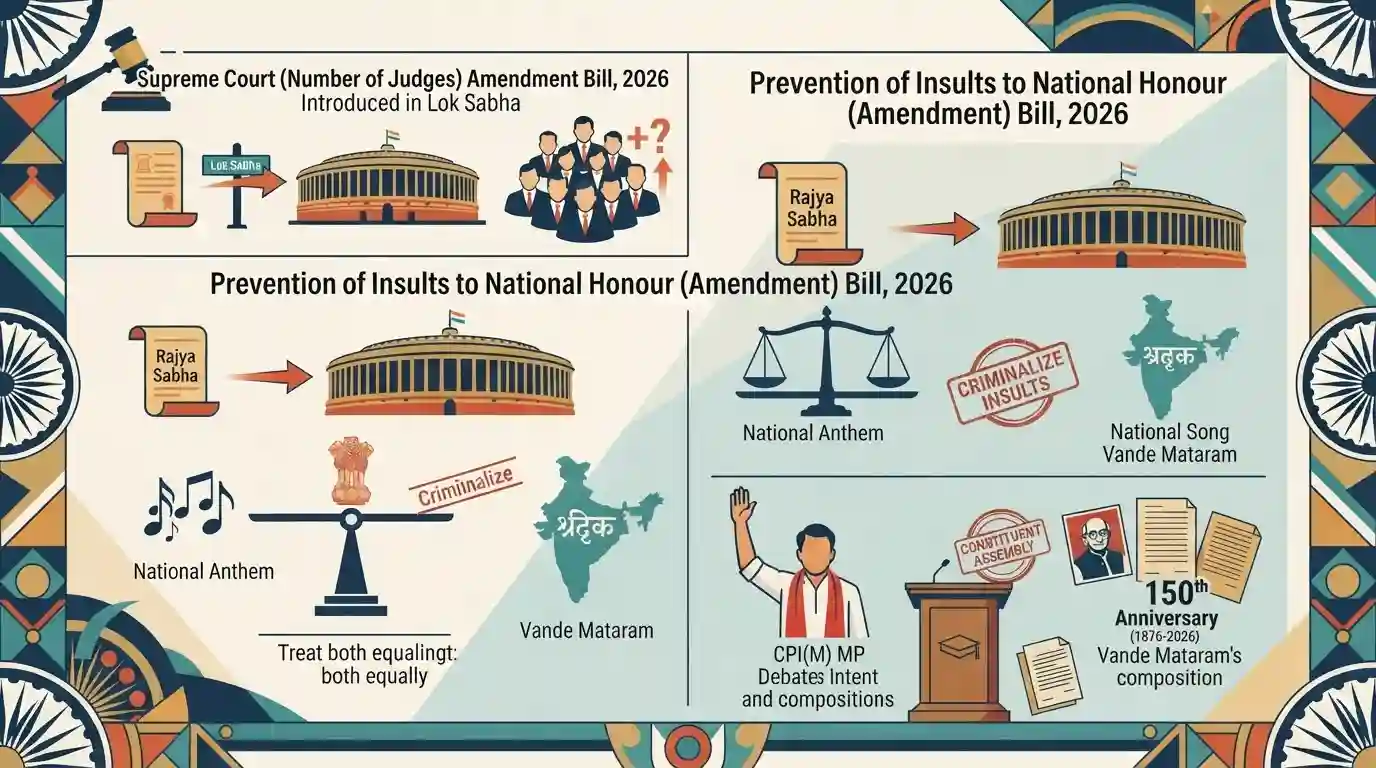
The Union Government is set to introduce the Prevention of Insults to National Honour (Amendment) Bill, 2026 in the Rajya Sabha, seeking to criminalise insults to the National Song, Vande Mataram, in the same manner as the National Anthem. Opposed by CPI(M) MP John Brittas on the grounds that it deviates from the Constituent Assembly's intent, the amendment is timed with the 150th anniversary of the song's composition. Additionally, the government plans to introduce the Supreme Court (Number of Judges) Amendment Bill, 2026 in the Lok Sabha.
মূল বিষয়
- The Central Government is slated to introduce the Prevention of Insults to National Honour (Amendment) Bill, 2026 in the Rajya Sabha to protect the National Song.
- The amendment proposes to penalise intentional prevention of or disturbance to the singing of Vande Mataram with imprisonment of up to three years, on par with the National Anthem.
- The legislative move coincides with the 150th anniversary of the composition of Vande Mataram by Bankim Chandra Chatterjee.
- CPI(M) MP John Brittas opposed the Bill, noting that the Constituent Assembly and the original 1971 Act deliberately avoided placing the National Anthem and National Song on identical statutory/penal footing.
- Separately, the Centre listed the Supreme Court (Number of Judges) Amendment Bill, 2026 for introduction in the Lok Sabha.
গুরুত্বপূর্ণ শব্দ
Prevention of Insults to National Honour (Amendment) Bill, 2026

A proposed legislation seeking to amend the 1971 Act to criminalize insults, desecration, or obstruction of the singing of India's National Song, Vande Mataram, placing it on par with the National Anthem.
UPSC context
GS Paper II: Polity and Governance; tests understanding of legislative bills, national symbols, and fundamental duties.
Prevention of Insults to National Honour Act, 1971
An Act of the Parliament of India that criminalizes the desecration of, or insult to, the country’s national symbols, including the National Flag, the Constitution of India, and the National Anthem.
UPSC context
GS Paper II: Polity and Constitution; tests knowledge of legal protections for national symbols and fundamental duties under Article 51A(a).
Supreme Court (Number of Judges) Amendment Bill, 2026
A legislative proposal seeking to increase the sanctioned strength of Supreme Court judges (excluding the Chief Justice of India) from 33 to 37 to address case pendency and ensure speedier justice.
UPSC context
GS Paper II: Judiciary; tests knowledge of judicial structure, pending cases, and Parliament’s constitutional power under Article 124(1).
Constituent Assembly
The body of elected representatives tasked with drafting the Constitution of India, which functioned from 1946 to 1950 and also served as India's first provisional parliament.
UPSC context
GS Paper II: Constitutional Underpinnings; tests knowledge of the historical evolution, debates, and drafting process of India's Constitution.
Rajya Sabha
The upper house of India's bicameral Parliament, representing the states and union territories, with members elected indirectly by state legislative assemblies alongside presidential nominees.
UPSC context
GS Paper II: Parliament; tests understanding of the bicameral legislature, federal representation, and parliamentary procedures.
Lok Sabha
The lower house of India’s bicameral Parliament, consisting of directly elected representatives of the people, holding primary legislative power and financial control over the executive.
UPSC context
GS Paper II: Parliament; tests understanding of democratic representation, parliamentary processes, and legislative functioning.
প্রিলিমস ফাঁদ
Article 51A(a) of the Constitution mandates that citizens must respect the National Flag, the National Anthem, and the National Song.
Article 51A(a) explicitly mandates respect only for the Constitution, the National Flag, and the National Anthem. The National Song is entirely absent from the text.
সংযুক্ত স্থির ধারণা
Constitutional and statutory distinction between the National Anthem and the National Song.
- Constitutional Status: Article 51A(a) explicitly requires citizens to respect the National Flag and Anthem, with no mention of the National Song.
- Presidential Declaration: Dr. Rajendra Prasad declared Vande Mataram equal to the National Anthem in 1950, but this was a statement, not a constitutional amendment.
- Statutory Protection: The 1971 Act historically penalizes insults to the Anthem, Flag, and Constitution, leaving the National Song without statutory penal backing until now.
What is the historical context of Vande Mataram and Anandamath?
- Literary Origin: Composed in Sanskritised Bengali by Bankim Chandra Chatterjee in 1875, it was later published in his 1882 novel Anandamath.
- Historical Setting: Set during the Sannyasi Rebellion (1763–1800) against the East India Company and the devastating Bengal Famine of 1770.
- Political Role: It became the definitive political rallying cry during the 1905 Swadeshi Movement protests against the partition of Bengal.
আন্তঃবিষয় প্যাটার্ন
Fundamental Duties vs. Article 25 Rights
Legislative efforts to enforce respect for national symbols often intersect with judicial rulings on freedom of speech and religious objections under Article 25.
Peasant Resistance + Swadeshi Nationalism
Connecting Bankim’s Anandamath to the 1770 Bengal Famine highlights how late 19th-century cultural nationalism repurposed 18th-century anti-colonial agrarian resistance.

UPSC may couple modern statutory updates to the 1971 Act with historical Sannyasi Rebellion facts in a hybrid History-Polity question.
সংযুক্ত PYQ · 5
সংযুক্ত PYQ · 5
- 2018PrelimsGS1
Which among the following events happened earliest ?
- 2014PrelimsGS1
The power to increase the number of judges in the Supreme Court of India is vested in
- 2015PrelimsGS1
"To uphold and protect the Sovereignty, Unity and Integrity of India" is a provision made in the
- 2017PrelimsGS1
Which of the following statements is/are true of the Fundamental Duties of an Indian citizen? 1. A legislative process has been provided to enforce these duties. 2. They are correlative to legal duties. Select the correct answer using the code given below:
- 2025MainsGS2
Discuss the evolution of collegium system in India. Critically examine the advantages and disadvantages of the system of appointment of the Judges of the Supreme Court of India and that of the USA.
