Government to Modify Labour Survey for Gig Economy and Care Work
Source:The Hindu ↗
આ શા માટે મહત્વનું છે
Understanding how data collection frameworks adapt to the changing nature of work (gig economy and unpaid care work) is crucial for GS3 (Indian Economy and issues relating to employment, growth, and inclusive development).
સારાંશ
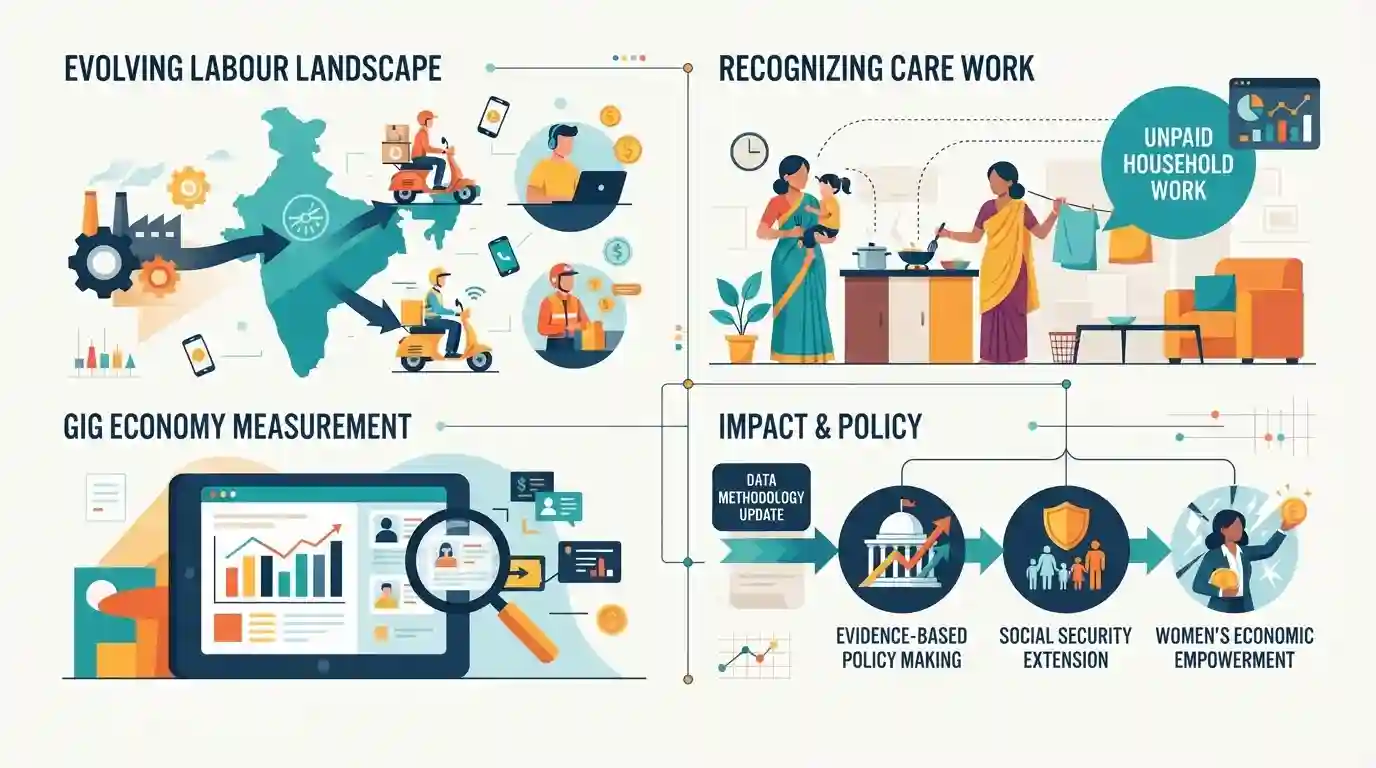
The Indian government is updating its labour surveys to accurately measure the evolving gig economy and the massive contribution of unpaid household workers. This policy shift addresses critical gaps in employment measurement, ensuring better data for policy-making, social security extension, and women's economic empowerment.
મુખ્ય મુદ્દા
- The Indian government is planning to modify its flagship labour surveys, such as the Periodic Labour Force Survey (PLFS), to better capture emerging employment structures like the gig and platform economy.
- The revision aims to account for unpaid household work, addressing statistical invisibility of women and domestic workers within traditional GDP and employment metrics.
- Capturing gig and platform workers accurately is critical for extending social security benefits and policy interventions as envisioned under modern labour reforms.
- Refining employment methodology helps tackle structural issues of underemployment and unmeasured economic contributions.
મહત્વપૂર્ણ શબ્દો
Periodic Labour Force Survey (PLFS)

A nationwide survey conducted by the National Sample Survey Office (NSSO) under MoSPI to estimate key employment and unemployment indicators in India, slated for modifications to capture the gig economy and unpaid household work.
UPSC context
Important for UPSC CSE GS Paper III (Indian Economy - Employment, Data & Methodology). Tests understanding of official labor statistics and reform measures.
Gig Economy
A labor market segment comprising workers engaged in flexible, task-based, or digital platform-based jobs outside traditional employer-employee relationships, requiring updated survey methodologies to measure accurately.
UPSC context
Important for UPSC CSE GS Paper III (Inclusive Growth, Labour Markets, Social Security). Tests knowledge of modern working arrangements and policy responses.
Unpaid Household Workers
Non-remunerated domestic duties and caregiving tasks—such as cooking, cleaning, and family care—predominantly performed by women, which remain uncounted in traditional GDP and employment metrics.
UPSC context
Important for UPSC CSE GS Paper I & III (Women Empowerment, Care Economy, National Income Accounting). Tests issues related to gender-based economic invisibility.
પ્રિલિમ્સ ટ્રેપ
Unpaid household work is currently factored into standard GDP and formal employment metrics under PLFS.
Aspirants often assume GDP directly includes the imputed value of unpaid household domestic services; while measured in satellite accounts, it is excluded from standard headline GDP.
સંલગ્ન સ્થિર ખ્યાલો
What are the key institutional indicators and methodologies used for measuring employment and unemployment in India?
- Periodic Labour Force Survey (PLFS):: Launched in 2017 by NSO, it provides quarterly urban and annual rural-urban estimates of key employment indicators like Worker Population Ratio (WPR) and Unemployment Rate (UR).
- Activity Status:: Employment status is assessed using Usual Status (principal + subsidiary activity status) and Current Weekly Status (CWS) approaches to capture chronic and seasonal unemployment.
- SNA Boundary:: System of National Accounts (SNA) production boundary excludes purely non-market household domestic and care services performed by family members, leading to statistical invisibility.
આંતર-વિષય પેટર્ન
Care Economy + Gender Inequality + PLFS Data
Unpaid care work limits women's labour force participation (PLFS data), creating a multi-faceted policy challenge spanning GDP measurement, social protection, and gender parity.
Gig Economy + e-Shram + Labour Codes
Extending social security to gig workers requires robust registry systems (e.g., e-Shram), linking data methodology with welfare delivery and fiscal federalism.

Expect a statement-based prelims question linking PLFS methodological updates to SDG indicators or Code on Social Security 2020 definitions.
સંલગ્ન PYQ · 3
સંલગ્ન PYQ · 3
- 2023MainsGS3
Most of the unemployment in India is structural in nature. Examine the methodology adopted to compute unemployment in the country and suggest improvements.
- 2023MainsGS3
Distinguish between 'care economy' and 'monetized economy'. How can care economy be brought into monetized economy through women empowerment?
- 2024MainsGS3
Discuss the merits and demerits of the four 'Labour Codes' in the context of labour market reforms in India. What has been the progress so far in this regard?
