Open Schooling Reforms and AI Integration in Teacher Training
Source:The Hindu ↗
Why It Matters
The VBSA Bill represents a major legislative overhaul of India's higher education regulatory framework, a frequent topic in UPSC governance and social justice sections. Furthermore, the integration of open schooling with vocational training (ITIs) and the adoption of AI in education address critical gaps in employability, skill development, and the utilization of India's demographic dividend.
Summary
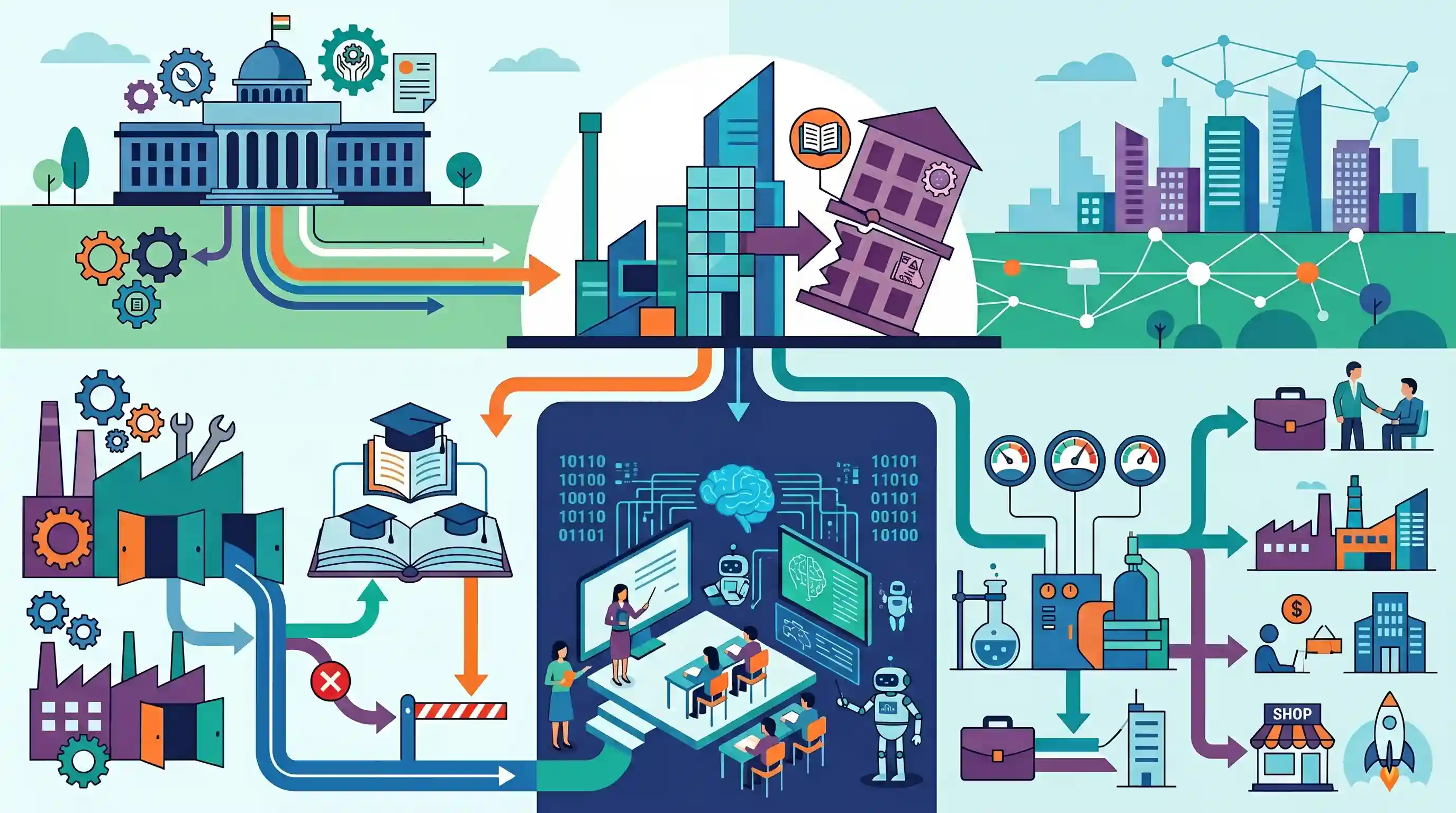
The Union Government is preparing to implement significant educational reforms, largely driven by the proposed Viksit Bharat Shiksha Adhishthan (VBSA) Bill, 2025. This legislation aims to overhaul the regulatory framework for higher education and will subsume the National Council for Teacher Education. In tandem, the Education Ministry plans to liberalise the National Institute for Open Schooling (NIOS) by permitting vocational institutions like ITIs to offer open schooling programmes, a move intended to curb school dropout rates. Furthermore, the government will issue guidelines for integrating Artificial Intelligence (AI) into teaching and revise technical education standards to better align with employment and entrepreneurship outcomes.
Key Points
- The Union Government plans to liberalise the open schooling framework by expanding the National Institute for Open Schooling (NIOS) system.
- Non-school institutions, such as Industrial Training Institutes (ITIs), may soon be allowed to offer open schooling programmes to help reduce school dropout rates.
- Guidelines will be introduced to encourage the integration of Artificial Intelligence (AI) in teacher education and teaching methodologies.
- Technical education standards will be re-drafted with a core focus on equipping graduates for employment and entrepreneurship.
- The Viksit Bharat Shiksha Adhishthan (VBSA) Bill, 2025 aims to overhaul higher education regulation and will subsume the functions of the National Council for Teacher Education (NCTE).
Important Terms
Viksit Bharat Shiksha Adhishthan Bill, 2025

Proposed legislation to create a unified regulatory authority (VBSA) for higher education, replacing the UGC, AICTE, and NCTE to implement the National Education Policy 2020.
UPSC context
GS Paper II: Statutory/Regulatory Bodies. Tests knowledge of educational reforms and the proposed shift to a 'light but tight' regulatory framework.
National Institute for Open Schooling (NIOS)
An autonomous organization under the Ministry of Education that provides flexible, open-distance learning and certification for secondary and senior secondary levels, particularly targeting dropouts and marginalized groups.
UPSC context
GS Paper II: Social Sector (Education). Tests understanding of alternative schooling and initiatives to improve the Gross Enrolment Ratio.
National Council for Teacher Education (NCTE)
A statutory body established to achieve planned and coordinated development of the teacher education system and to maintain standards in teacher training across India.
UPSC context
GS Paper II: Regulatory Bodies. Relevant due to its proposed merger under the Viksit Bharat Shiksha Adhishthan Bill.
Industrial Training Institute (ITI)
Government-run post-secondary schools in India constituted under the Directorate General of Training to provide vocational training and technical skills in various trades.
UPSC context
GS Paper III: Skill Development. Tests awareness of vocational education's integration with formal academic certification to enhance employability.
Artificial Intelligence (AI) in Pedagogy
The integration of automated tools and machine learning into classroom instruction to personalize learning, assist in lesson planning, and automate administrative tasks for educators.
UPSC context
GS Paper III: IT & Computers. Tests knowledge of emerging technologies' role in social sector development and teacher empowerment.
Prelims Trap
NIOS open schooling programmes can exclusively be offered by registered traditional schools.
The government is explicitly liberalising NIOS to permit non-school vocational institutions like ITIs to offer open schooling programmes to curb dropouts.
Static Concepts Connected
What are the primary statutory bodies governing higher education and training in India?
- UGC: Established in 1956, it coordinates, determines, and maintains standards of university education across India.
- AICTE: Made a statutory body in 1987, it plans and coordinates technical, management, and pharmacy education.
- NCTE: Established in 1995 to oversee teacher education, it is now slated to be subsumed under the new VBSA framework.
What is the mandate of the National Institute for Open Schooling (NIOS)?
- Autonomous Body: Setup by the Ministry of Education in 1989 to provide distance learning up to the pre-degree level.
- Universalization Objective: Acts as a safety net for dropouts, marginalized groups, and rural youth by offering flexible academic and vocational streams.
Cross-Topic Patterns
AI + DPI in Education
Integrating AI in teacher methodologies complements the National Education Policy's push for Digital Public Infrastructure (DPI) via platforms like DIKSHA and NDEAR.
Demographic Dividend & Skilling
Allowing ITIs to grant open schooling credits merges formal education with vocational skilling, directly addressing the 'educated but unemployable' youth demographic challenge.

VBSA Bill's subsumption of NCTE and the integration of NIOS with ITIs will likely feature as a multi-statement Prelims question in 2026.
Linked PYQs · 4
Linked PYQs · 4
- 2020MainsGS2
National Education Policy 2020 is in conformity with the Sustainable Development Goal-4 (2030). It intends to restructure and reorient education system in India. Critically examine the statement.
- 2021MainsGS2
“Earn while you learn' scheme needs to be strengthened to make vocational education and skill training meaningful.” Comment.
- 2023MainsGS2
Skill development programmes have succeeded in increasing human resources supply to various sectors. In the context of the statement analyse the linkages between education, skill and employment.
- 2023MainsGS3
Introduce the concept of Artificial Intelligence (AI). How does Al help clinical diagnosis? Do you perceive any threat to privacy of the individual in the use of Al in healthcare?
