AIDIS and SAS Economic Surveys on Household Finances
Source:The Hindu ↗
Why It Matters
Socio-economic surveys form the backbone of targeted welfare schemes and macroeconomic policymaking. For UPSC aspirants, data from AIDIS and SAS highlights core GS-3 themes like rural/urban indebtedness, agricultural finance, and financial inclusion, often tested directly in Mains and Prelims.
Summary
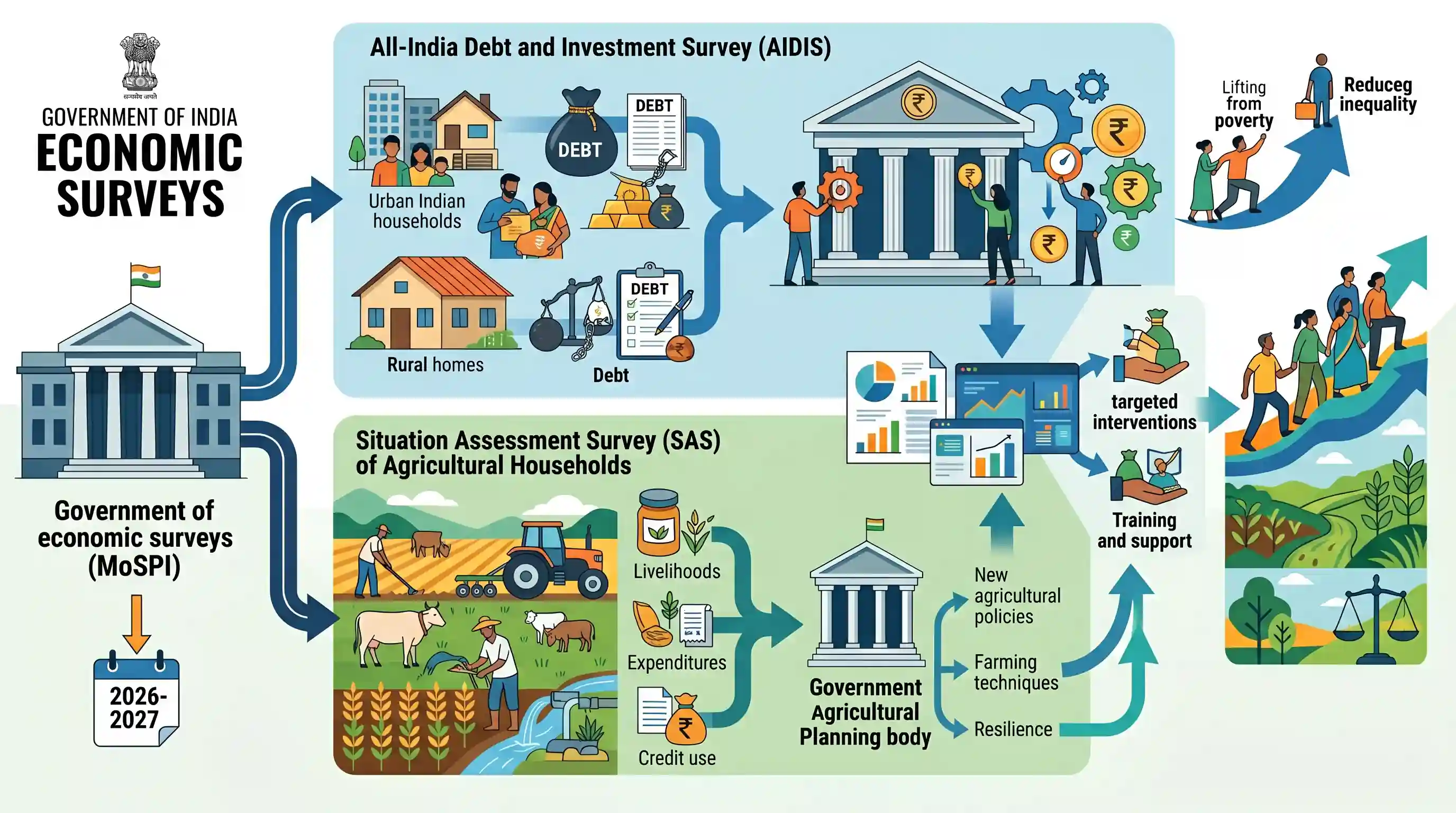
The Government of India, through the Ministry of Statistics and Programme Implementation (MoSPI), has announced it will carry out two major economic surveys—the All-India Debt and Investment Survey (AIDIS) and the Situation Assessment Survey (SAS) of Agricultural Households—between July 2026 and June 2027. These surveys play a foundational role in analyzing the financial health, indebtedness, and asset ownership of the Indian populace. While the AIDIS data helps the RBI and government bodies formulate monetary and credit policies by shedding light on household debt structures and poverty, the SAS focuses extensively on the livelihood, expenditure, and credit reliance of farmers. The resulting datasets will be critical for crafting targeted interventions for inclusive growth and agricultural resilience.
Key Points
- The Ministry of Statistics and Programme Implementation (MoSPI) will conduct two crucial national economic surveys between July 2026 and June 2027.
- The All-India Debt and Investment Survey (AIDIS) will track asset ownership, debt trends, and financial liabilities across both rural and urban households.
- The Situation Assessment Survey (SAS) will specifically measure the economic conditions of agricultural households, mapping income, expenditure, farming practices, and scheme access.
- Data collected from these surveys is pivotal for the Reserve Bank of India (RBI) and the Centre in framing credit policies, measuring inequality, and analyzing poverty.
- Previous SAS surveys (like those in 2003, 2013, and 2019) have historically shown critical trends such as average farmer incomes, reliance on informal credit, and crop insurance penetration.
Important Terms
All-India Debt and Investment Survey (AIDIS)

A decennial sample survey by the NSO providing data on household assets, debt, and capital expenditure. It identifies patterns of financial inclusion and wealth inequality in rural and urban India.
UPSC context
GS Paper III: Indian Economy. Crucial for topics on financial inclusion, rural indebtedness, and credit market structure.
Situation Assessment Survey (SAS) of Agricultural Households
A comprehensive periodic survey assessing the socio-economic status of farming households, including income, expenditure, and technology use. It serves as the primary dataset for measuring rural economic viability.
UPSC context
GS Paper III: Agriculture. Essential for analyzing agrarian distress, doubling farmers' income, and targeted welfare interventions.
Ministry of Statistics and Programme Implementation (MoSPI)
The nodal central ministry for national statistics and programme monitoring. It oversees the NSO and ensures data integrity for national accounts, inflation (CPI), and large-scale socio-economic surveys.
UPSC context
GS Paper II: Government Policies. Tests knowledge of the institutional machinery behind India’s statistical architecture and evidence-based governance.
National Statistical Office (NSO)
The premier statistical wing under MoSPI, formed in 2019 by merging the CSO and NSSO. It conducts large-scale sample surveys and compiles vital indicators like GDP and IIP.
UPSC context
GS Paper III: Economic Development. Relevant for questions on statistical reforms and the accuracy of Indian economic data.
Agricultural Household
An 'agricultural production unit' receiving at least ₹4,000 annually from activities like cultivation or livestock. SAS uses this definition to distinguish farmers from pure agricultural laborers.
UPSC context
GS Paper III: Agriculture. Tests precision in identifying beneficiaries for farm-sector schemes and analyzing rural employment trends.
Prelims Trap
"The All-India Debt and Investment Survey (AIDIS) is conducted by the Reserve Bank of India."
While the RBI heavily relies on AIDIS data to formulate monetary and credit policies, the survey is actually conducted by the NSO under MoSPI, not the RBI.
Static Concepts Connected
What constitutes an 'Agricultural Household' under the SAS?
- Value of produce: The household must have agricultural production of a minimum specified value (e.g., ₹4,000 in the 77th round) during the preceding 365 days.
- Member involvement: At least one member of the household must be self-employed in agriculture (farming, livestock, etc.) in either the principal or subsidiary status.
How has rural credit assessment evolved in India?
- AIRCS (1951-52): The landmark All India Rural Credit Survey famously concluded that cooperative societies were the most suitable form of rural credit organization.
- Current AIDIS: Now conducted as a decennial survey by MoSPI, it tracks assets, capital formation, and liabilities across rural and urban sectors, directly guiding RBI's Priority Sector Lending norms.
Cross-Topic Patterns
SAS data + Doubling Farmers' Income
SAS findings are the primary benchmark used by government committees (like the Dalwai Committee) to track structural shifts, such as small farmers earning more from daily wages than actual crop cultivation.
AIDIS + Monetary Transmission limits
AIDIS reveals the exact footprint of informal credit (moneylenders) in rural India, mapping out a critical structural bottleneck that continues to hinder the RBI's monetary policy transmission.

A multi-statement question on SAS and AIDIS is highly probable in 2026, pairing MoSPI as the nodal agency with past rural credit trends.
Linked PYQs · 4
Linked PYQs · 4
- 2014MainsGS3
In the villages itself no form of credit organization will be suitable except the cooperative society. -All India Rural Credit Survey. Discuss this statement in the background of agricultural finance in India. What constraints and challenges do financial institutions supplying agricultural finance face? How can technology be used to better reach and serve rural clients?
- 2022MainsGS3
Is inclusive growth possible under market economy ? State the significance of financial inclusion in achieving economic growth in India.
- 2020PrelimsGS1
In the context of the Indian economy, non-financial debt includes which of the following? 1. Housing loans owed by households 2. Amounts outstanding on credit cards 3. Treasury bills Select the correct answer using the code given below:
- 2022PrelimsGS1
With reference to the Indian economy, consider the following statements: 1. A share of the household financial savings goes towards government borrowings. 2. Dated securities issued at market-related rates in auctions form a large component of internal debt. Which of the above statements is/are correct?
