Centre to Amend NDPS Act to Curb Narco-Syndicates
Source:The Hindu ↗
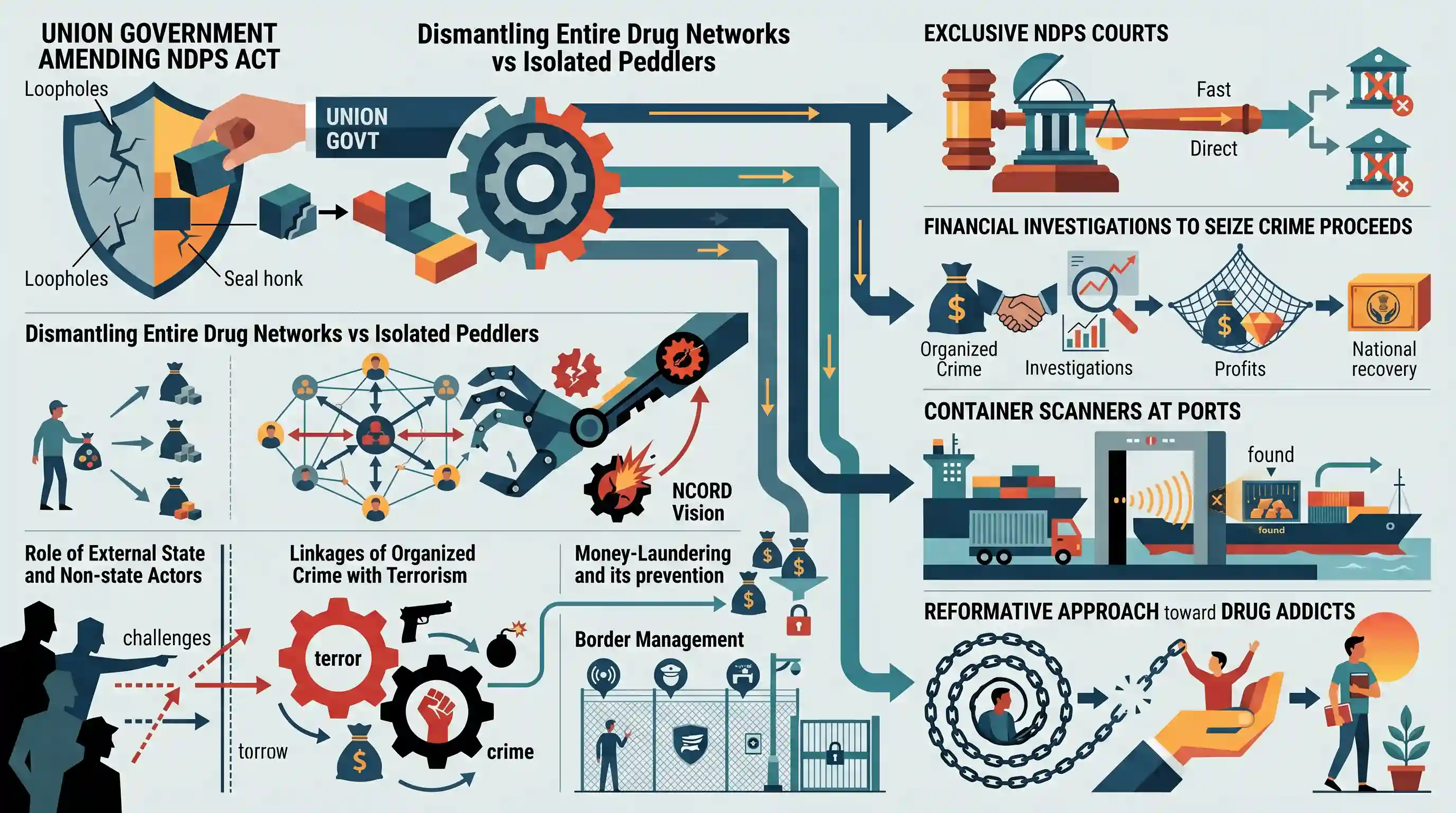
Why It Matters
Drug trafficking fuels narco-terrorism, money laundering, and organized crime, threatening India's internal security and social fabric. The planned NDPS Act amendments and the 2026-2029 Vision Document provide essential forward-looking policy measures (e.g., tech utilization, asset freezing) for Mains answers on internal security and organized crime.
Summary
The Union Government will amend the Narcotic Drugs and Psychotropic Substances (NDPS) Act to eliminate legal loopholes exploited by drug syndicates. During the 10th Narco-Coordination Centre (NCORD) meeting, Home Minister Amit Shah released the ‘Vision Document on Drug Control (2026-2029)’, which emphasizes dismantling entire drug networks rather than just catching isolated peddlers. Key initiatives include establishing exclusive NDPS courts, mandating financial investigations to seize crime proceeds, deploying more container scanners at ports, and adopting a reformative approach toward drug addicts.
Key Points
- The Centre plans to amend the NDPS Act to close loopholes exploited by narco-syndicates and tackle emerging threats like synthetic drugs.
- A 'Vision Document on Drug Control (2026-2029)' was unveiled to 'detect, disrupt and destroy' entire drug networks.
- Proposed measures include mandatory financial investigations to freeze illicit assets and the creation of exclusive NDPS courts for speedy trials.
- Law enforcement will increasingly leverage technology like container scanners at ports, AI-enabled profiling, and monitor the darknet to combat smuggling.
- The government emphasizes a compassionate, reformative approach toward drug addicts while coming down heavily on traffickers.
Important Terms
Narcotic Drugs and Psychotropic Substances (NDPS) Act

A 1985 law prohibiting the illicit production, sale, and consumption of narcotics. It features a graded punishment system and mandates the forfeiture of property derived from drug-related crimes.
UPSC context
GS-3/Internal Security. Core legislation for drug control; essential for understanding regulatory frameworks and recent legal amendments.
Narco-Coordination Centre (NCORD)
A 4-tier coordination mechanism (Apex, Executive, State, District levels) under the Ministry of Home Affairs designed to synchronize anti-drug efforts between Central and State law enforcement agencies.
UPSC context
GS-3/Internal Security. Key institutional framework for inter-agency coordination and cooperative federalism in tackling organized crime.
Narcotics Control Bureau (NCB)
India's nodal federal agency for drug law enforcement and intelligence, established in 1986. It coordinates with international bodies like UNODC and INTERPOL to combat trans-national trafficking.
UPSC context
GS-3/Internal Security. Nodal agency for drug enforcement; relevant for questions on national security institutions.
Vision Document on Drug Control (2026-2029)
A strategic roadmap (2026-2029) adopting a 'detect, disrupt, destroy' approach. It emphasizes dismantling entire narco-networks, mandating financial investigations, and establishing exclusive NDPS courts for speedy trials.
UPSC context
GS-3/Internal Security/Governance. Current policy framework for drug-free India; important for discussing latest government initiatives.
Narco-Terrorism
The symbiotic nexus between drug trafficking and terrorism, where narcotics proceeds finance militant activities while terror networks provide protection and routes for drug syndicates.
UPSC context
GS-3/Internal Security. Crucial for topics concerning the linkages between organized crime and terrorism.
Prelims Trap
The NDPS Act does not currently contain provisions for the forfeiture of illicit property.
Chapter V-A of the NDPS Act already allows forfeiture of property derived from illicit traffic. The new mandate enforces mandatory financial investigations, not brand-new seizure powers.
Static Concepts Connected
What are the key features of the NDPS Act, 1985?
- Strict Bail: Section 37 makes offenses non-bailable; the court must be satisfied the accused is not guilty before granting bail.
- Reverse Burden: The burden of proof lies heavily on the accused to prove they did not possess a culpable mental state.
- Asset Forfeiture: Contains strict provisions (Chapter V-A) for tracing, seizing, and forfeiting assets derived from illegal drug trade.
- Capital Punishment: Allows for the imposition of the death penalty for certain repeat drug trafficking offenses.
What makes India geographically vulnerable to illicit drug trafficking?
- Golden Crescent: Proximity to the illicit opium production region spanning Iran, Afghanistan, and Pakistan on India's western frontier.
- Golden Triangle: Proximity to the illicit drug region spanning Myanmar, Laos, and Thailand on India's eastern frontier.
- Transit Route: Porous borders and vast coastlines create structural challenges, making India both a destination and a major transit hub for narcotics.
Cross-Topic Patterns
Narco-terrorism and PMLA linkages
Drug syndicates rely heavily on hawala networks. Mandating financial investigations under NDPS directly activates the Prevention of Money Laundering Act (PMLA), linking organized crime to terror-financing probes.
Darknet and Smart Border Management
Using AI profiling, darknet tracking, and automated container scanners shifts the focus from physical border guarding to tech-integrated Smart Border Management to counter synthetic drug smuggling.

Expect a 2026 Prelims question combining NDPS Act provisions (reverse burden of proof, asset forfeiture) with the NCB and NCORD mandates.
Linked PYQs · 4
Linked PYQs · 4
- 2024MainsGS3
Explain how narco-terrorism has emerged as a serious threat across the country. Suggest suitable measures to counter narco-terrorism.
- 2022MainsGS3
Discuss the types of organised crimes. Describe the linkages between terrorists and organised crime that exist at the national and transnational levels.
- 2018MainsGS3
India's proximity to two of the world's biggest illicit opium-growing states has enhanced her internal security concerns. Explain the linkages between drug trafficking and other illicit activities such as gunrunning, money laundering and human trafficking. What counter-measures should be taken to prevent the same?
- 2021MainsGS3
Discuss how emerging technologies and globalisation contribute to money laundering. Elaborate measures to tackle the problem of money laundering both at national and international levels.
