Commerce Ministry Evaluates Impact of US Tariff Policy Shifts
Source:The Hindu ↗
Why It Matters
The escalating protectionist stance of major economies like the US disrupts global supply chains and directly affects India's export earnings. Understanding the mechanisms of US trade tariffs (like Section 232 and Trade Act 1974) is crucial for evaluating India's economic resilience, formulating defensive trade policies, and answering questions on the shift from multilateralism to bilateralism in global trade.
Summary
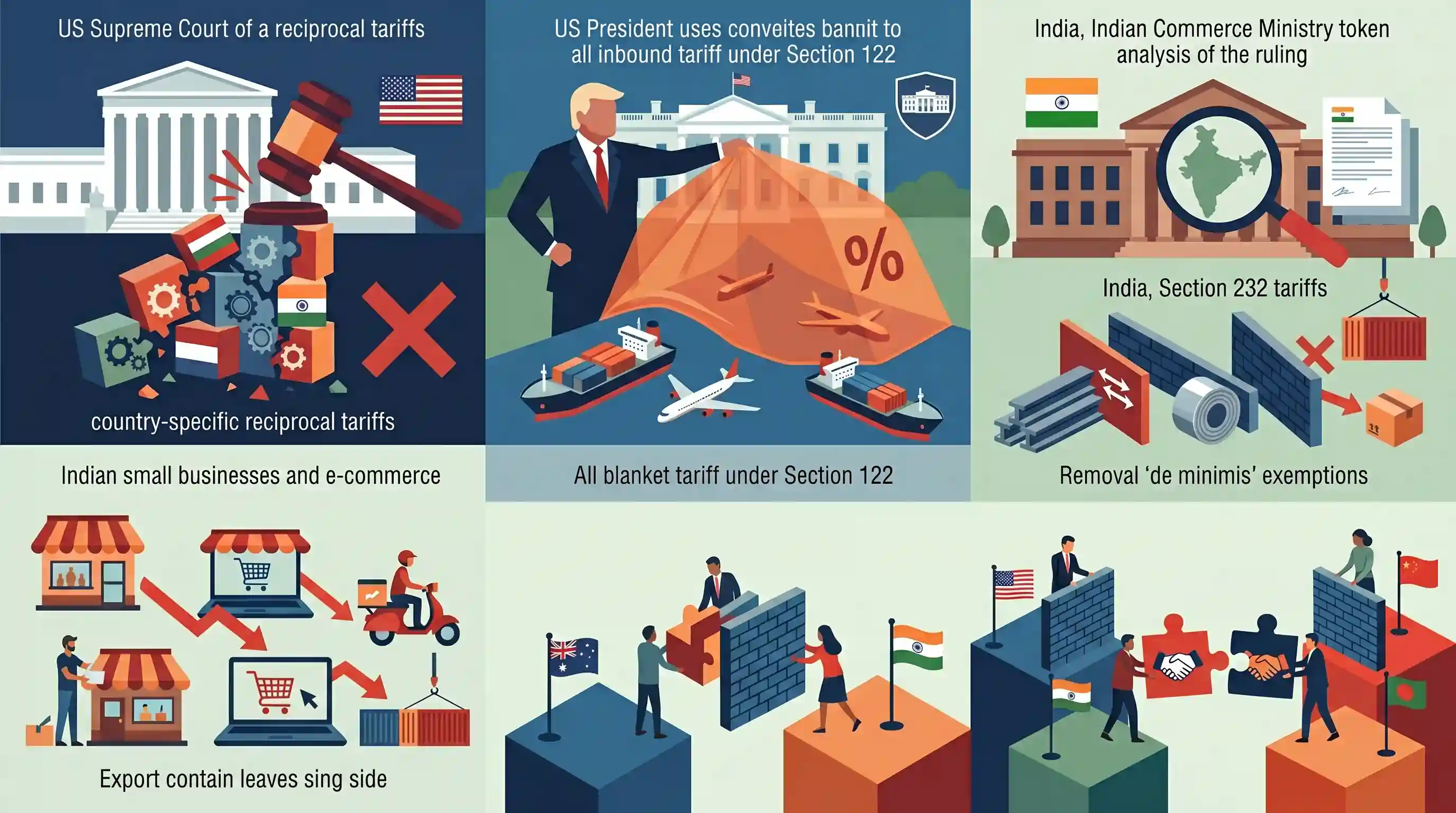
The US Supreme Court overturned country-specific 'reciprocal tariffs' imposed under the International Emergency Economic Powers Act. In response, US President Donald Trump introduced a 150-day blanket 10% baseline tariff on all imports using Section 122 of the Trade Act of 1974. The Indian Commerce Ministry is analyzing the ruling's impact, as other protectionist measures, such as Section 232 tariffs on steel and aluminium and the removal of 'de minimis' exemptions, remain in place. These ongoing trade barriers are expected to hurt Indian exports—especially e-commerce and small businesses—and force nations to reassess their trade agreements amidst growing global protectionism.
Key Points
- The US Supreme Court struck down country-specific 'reciprocal tariffs' and fentanyl-linked duties previously imposed under the International Emergency Economic Powers Act.
- In response, the US administration announced a 150-day, 10% blanket tariff on all imports under Section 122 of the Trade Act of 1974.
- India's Commerce Ministry is studying the impact of this new baseline tariff on bilateral trade.
- Despite the ruling, tariffs on steel and aluminium (under Section 232) and the suspension of 'de minimis' exemptions remain active, adversely impacting Indian small exporters and e-commerce.
- The ongoing trade protectionism by the US is expected to push countries, including India, to renegotiate existing trade agreements.
Important Terms
International Emergency Economic Powers Act (IEEPA)

A 1977 U.S. law authorizing the President to regulate international commerce and freeze assets during declared national emergencies involving "extraordinary threats" originating from outside the country.
UPSC context
GS Paper II/III: Tests executive authority in trade and its impact on Indian exports during shifts in global protectionism.
Section 122 of the Trade Act of 1974
A provision of the U.S. Trade Act of 1974 allowing the President to impose temporary import surcharges of up to 15% for 150 days to address "serious balance-of-payments deficits."
UPSC context
GS Paper III: International Trade. Tests understanding of balance-of-payments related trade measures and non-tariff barriers.
Section 232 of the Trade Expansion Act of 1962
A provision of the U.S. Trade Expansion Act of 1962 enabling the President to impose tariffs on imports found to "threaten to impair national security," such as steel and aluminium.
UPSC context
GS Paper II: Bilateral Relations (India-US). Tests impact of security-linked trade barriers on Indian manufacturing sectors.
De minimis exemptions
A trade rule allowing low-value goods (previously <$800 in the U.S.) to enter duty-free without formal customs entries, significantly benefiting small-scale e-commerce and MSME exporters.
UPSC context
GS Paper III: Economy (MSMEs). Crucial for evaluating the impact of foreign customs changes on India’s e-commerce export growth.
Reciprocal tariffs
A protectionist trade policy where a country sets its import duty rates to match the duties imposed by its trading partners on similar goods.
UPSC context
GS Paper II: International Relations. Examines the rise of protectionism and its effect on global multilateral trade and bilateral negotiations.
Prelims Trap
The removal of the 'de minimis' exemption limits India's agricultural domestic support subsidies at the WTO.
The US 'de minimis' here refers to an $800 duty-free threshold for import shipments, entirely distinct from the WTO Agreement on Agriculture's 10% subsidy limit.
Static Concepts Connected
What are the primary trade remedy measures permitted by the WTO?
- Anti-dumping duties: Applied when foreign firms export goods below their fair domestic market value, causing material injury.
- Countervailing duties: Levied by importing nations to neutralize the negative effects of specific subsidies provided by foreign governments.
- Safeguard measures: Temporary import restrictions (tariffs or quotas) applied to protect domestic industry from sudden, unforeseen surges in imports.
How do MFN and National Treatment principles differ at the WTO?
- Most-Favored-Nation (MFN): Requires a country not to discriminate between its different foreign trading partners (an external equality rule).
- National Treatment: Mandates that once foreign goods have entered the domestic market, they must be treated equally to domestically-produced goods (an internal equality rule).
- Allowed Exceptions: Countries can bypass MFN for Free Trade Agreements (FTAs) or special differential treatment for developing nations (e.g., GSP).
Cross-Topic Patterns
Global protectionism hits Indian e-commerce
The withdrawal of the US 'de minimis' exemption disproportionately impacts Indian MSMEs relying on cross-border e-commerce, severely increasing their compliance burden and eroding cost-competitiveness.
Unilateral tariffs bypass WTO framework
Using domestic national security laws for tariffs exploits loopholes in the WTO's paralyzed dispute settlement system, forcing targeted countries into bilateral retaliations outside multilateral rules.

Expect a multi-statement question interlinking US protectionism, the WTO's MFN exceptions, and the impact of 'de minimis' curbs on MSMEs.
Linked PYQs · 3
Linked PYQs · 3
- 2025MainsGS3
What are the challenges before the Indian economy when the world is moving away from free trade and multilateralism to protectionism and bilateralism? How can these challenges be met?
- 2016MainsGS2
The broader aims and objectives of WTO are to manage and promote international trade in the era of globalization. But the Doha round of negotiations seem doomed due to differences between the developed and the developing countries." Discuss in the Indian perspective.
- 2023PrelimsGS1
Consider the following statements: Statement-I: Recently, the United States of America (USA) and the European Union (EU) have launched the 'Trade and Technology Council'. Statement-II: The USA and the EU claim that through this they are trying to bring technological progress and physical productivity under their control. Which one of the following is correct in respect of the above statements?
