Government Defers FCRA Amendment Bill Amid Political Apprehensions
Source:The Hindu ↗
Why It Matters
The article is highly relevant for GS2 as it illustrates the continuous tension between state regulation of NGOs (via FCRA) and the functional autonomy of civil society. It also highlights how electoral politics and minority rights considerations can impact the trajectory of national security and governance legislation.
Summary
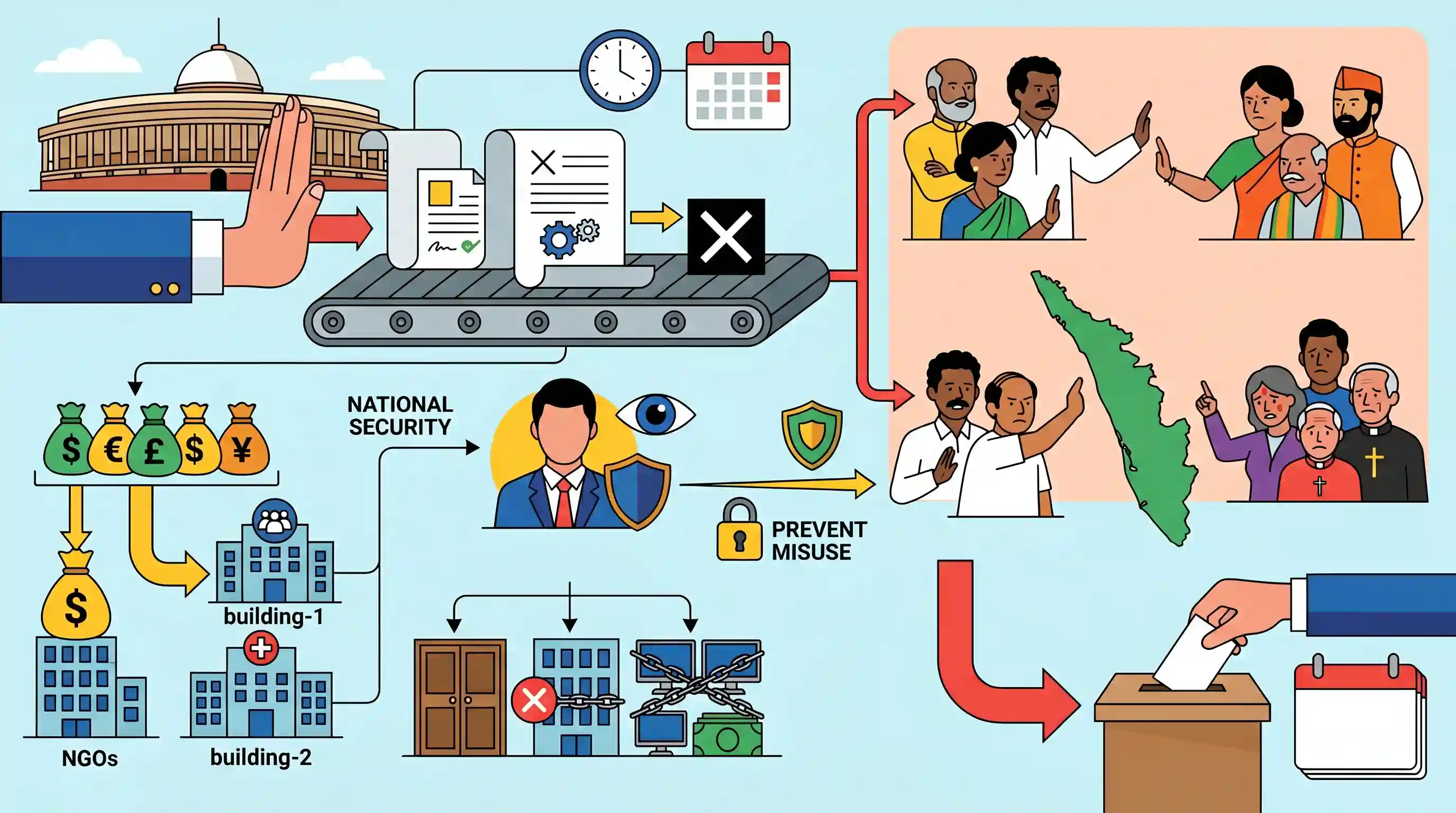
The Indian Government has decided to skip introducing the Foreign Contributions (Regulation) Act (FCRA) amendment Bill in the current Budget session amid political apprehensions. The proposed legislation seeks to establish a 'Designated Authority' to oversee and dispose of foreign assets belonging to NGOs with suspended or cancelled registrations. While the government maintains the Bill is crucial for national security and curbing fund misuse, opposition has mounted, particularly from Kerala MPs and the state's BJP unit. The pushback is driven by concerns over potential electoral backlash from the Christian community ahead of the 2026 Kerala Assembly elections, as many minority-run institutions rely on foreign contributions.
Key Points
- The Government has deferred the introduction of the Foreign Contributions (Regulation) Act (FCRA) amendment Bill during the ongoing Budget session.
- A key provision of the proposed Bill is the creation of a 'Designated Authority' to manage and dispose of foreign contributions and assets of NGOs whose registrations are suspended, cancelled, or unrenewed.
- Parliamentary Affairs Minister Kiren Rijiju defended the Bill, stating its purpose is to protect national security and curb misuse of foreign funds, rather than targeting specific religions or organisations.
- The delay is reportedly influenced by political concerns ahead of the 2026 Kerala Assembly elections, as local BJP leaders and Opposition MPs fear the Bill could alienate the Christian community, which operates many institutions reliant on foreign funding.
Important Terms
Foreign Contribution (Regulation) Act (FCRA)

A law regulating the receipt and utilization of foreign donations by individuals and associations to ensure they do not compromise India's national sovereignty, security, or public interest.
UPSC context
GS Paper II: Governance and Role of Civil Society; GS Paper III: Internal Security. Tests knowledge of regulatory frameworks for NGOs.
Designated Authority
A proposed official or body empowered under the FCRA Amendment Bill 2026 to take over, manage, or dispose of assets created using foreign funds by NGOs with cancelled or suspended registrations.
UPSC context
GS Paper II: Statutory bodies and legislative process. Tests understanding of proposed administrative oversight in the social sector.
Key Functionary
An individual (director, trustee, or partner) legally responsible for an NGO's operations; the 2026 amendment expands this definition to heighten personal liability for violations of funding norms.
UPSC context
GS Paper II: Governance and Transparency. Relevant for questions on institutional accountability and ease of doing business for civil society.
Minority Institutions
Educational or social organizations established and administered by religious or linguistic minorities under Article 30 of the Constitution, frequently reliant on foreign contributions for charitable activities.
UPSC context
GS Paper II: Social Justice and Constitutional Provisions. Tests knowledge of fundamental rights and the impact of regulation on vulnerable groups.
Consolidated Fund of India
The primary government account (Article 266) where all revenues are credited; the proposed FCRA amendments require proceeds from the disposal of seized NGO assets to be deposited here.
UPSC context
GS Paper II: Parliament and Financial Committees. Tests conceptual understanding of constitutional funds and public financial management.
Prelims Trap
"The Foreign Contribution (Regulation) Act (FCRA) is administered by the Ministry of Finance."
FCRA is administered by the Ministry of Home Affairs (MHA) for internal security. FEMA, which deals with foreign exchange management, is administered by the Finance Ministry.
Static Concepts Connected
Who is strictly prohibited from receiving foreign contributions under FCRA?
- Public Servants: Judges, government servants, or employees of any government-owned or controlled corporation.
- Political Actors: Election candidates, Members of any Legislature (MPs/MLAs), and registered political parties or their office bearers.
- Media Personnel: Correspondents, columnists, cartoonists, editors, or owners and printers of registered newspapers and broadcast news channels.
What were the major changes introduced in the FCRA 2020 Amendment?
- SBI Mandate: All foreign contributions must be received in a designated "FCRA Account" exclusively at the SBI, New Delhi main branch.
- Administrative Cap: The limit for using foreign funds for administrative purposes was reduced from 50% to 20%.
- Transfer Ban: Completely prohibited the transfer of received foreign contributions to any other person or NGO.
Cross-Topic Patterns
NGO Funding & Internal Security
Linking foreign funding regulations to non-state actors creating unrest. The proposed 'Designated Authority' signals a stricter state mechanism to seize NGO assets linked to anti-national activities.
Electoral impacts on legislative timelines
The delay due to Kerala elections highlights how regional demographic realities and minority institutional funding concerns actively dictate the timeline of national security legislations.

Mains 2026 GS2 will likely test the balance between 'Ease of Doing NGO' and internal security, citing the proposed 'Designated Authority'.
Linked PYQs · 3
Linked PYQs · 3
- 2015MainsGS2
Examine critically the recent changes in the rules governing foreign funding of NGOs under the Foreign Contribution (Regulation) Act (FCRA), 1976.
- 2025MainsGS2
Civil Society Organizations are often perceived as being anti-State actors than non-State actors. Do you agree? Justify.
- 2024MainsGS2
Public charitable trusts have the potential to make India's development more inclusive as they relate to certain vital public issues. Comment.
