India awaits US court records in Pannun assassination plot case
Source:The Hindu ↗
Why It Matters
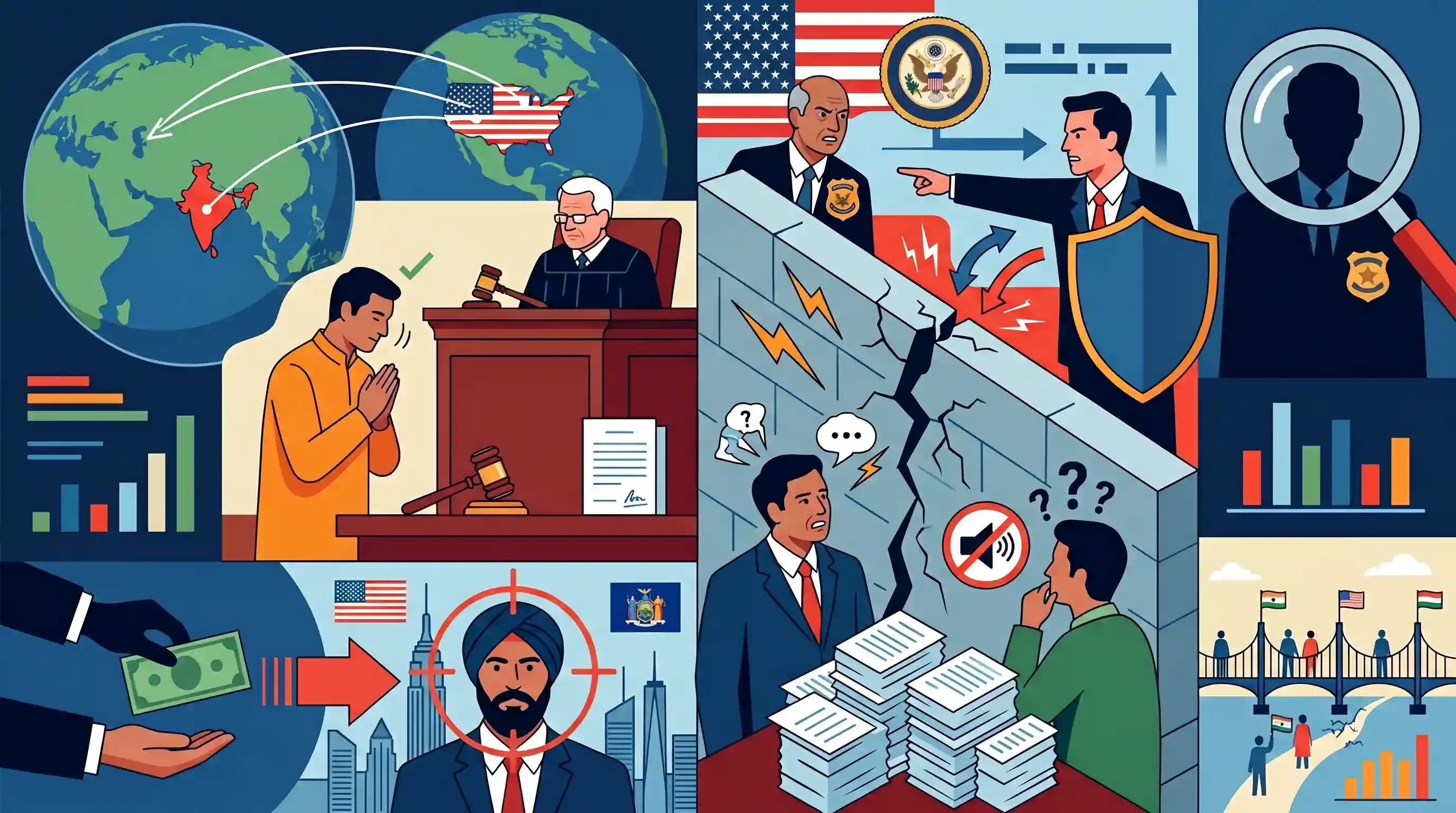
The case tests the resilience of the India-US strategic partnership amid serious allegations of transnational repression and extraterritorial operations by Indian intelligence. It highlights the diplomatic tension between protecting national security interests against designated extremists abroad and respecting the sovereignty and human rights frameworks of allied democratic nations.
Summary
An Indian citizen, Nikhil Gupta, has pleaded guilty in a New York court for his role in a foiled murder-for-hire plot targeting Gurpatwant Singh Pannun, an American citizen and Sikh separatist. The Indian government is currently silent on the development, stating it is waiting for official court documents. The U.S. Justice Department's indictment implicates a former Indian government intelligence official in directing the plot, framing the incident as a violation of sovereignty and transnational repression. This issue remains a major friction point in India's bilateral relations with the U.S. and Canada.
Key Points
- Indian national Nikhil Gupta pleaded guilty in a New York federal court to murder-for-hire charges in the foiled assassination plot of Gurpatwant Singh Pannun.
- The Indian government maintains a silent stance, awaiting official court documents before providing an official response.
- The U.S. indictment alleges the plot was directed by a former Indian government official, Vikash Yadav, whom the FBI has placed on its wanted list.
- U.S. officials portray the incident as a case of transnational repression targeting free speech, tying into broader diplomatic frictions stemming from a similar assassination in Canada.
Important Terms
Research and Analysis Wing (R&AW)

India’s premier external intelligence agency, established in 1968 to gather foreign intelligence, conduct counter-terrorism, and safeguard national interests. It reports directly to the Prime Minister’s Office.
UPSC context
GS Paper III (Security Architecture); tests roles of agencies in protecting external security and managing transnational threats.
Ministry of External Affairs (MEA)
The Union ministry responsible for formulating and implementing India’s foreign policy, managing diplomatic missions, and safeguarding the interests of Indian citizens and the diaspora abroad.
UPSC context
GS Paper II (International Relations); central to questions on bilateral ties, diplomatic protocols, and foreign policy implementation.
Transnational Repression
State-sponsored actions—such as harassment, surveillance, or physical violence—targeting dissidents or individuals living outside a state's borders to silence political opposition or dissent.
UPSC context
GS Paper II (International Relations); relevant to modern IR challenges, state ethics, and violations of international sovereignty.
Khalistan Movement
A separatist movement seeking to create a sovereign state for Sikhs (Khalistan) in the Punjab region, impacting India’s internal security and relations with countries like Canada and the US.
UPSC context
GS Paper III (Internal Security); tests understanding of secessionist challenges, radicalization, and their geopolitical implications.
Extradition
The legal process by which one nation surrenders an individual to another for prosecution or punishment, typically governed by bilateral treaties and the principle of dual criminality.
UPSC context
GS Paper II (IR/Polity); covers the Extradition Act, 1962, and legal cooperation in tracking fugitives and terrorists.
Indian Diaspora
The community of Indian-origin people living abroad who contribute to India’s soft power and economy but can also influence host-country policies toward India.
UPSC context
GS Paper II (International Relations); specifically mentioned in the syllabus regarding their role in politics and India’s interests.
Sovereignty
The supreme and independent authority of a state to govern itself, its people, and its territory without interference from external powers or authorities.
UPSC context
GS Paper II (Polity/IR); a foundational concept for territorial integrity, constitutional law, and international disputes.
Prelims Trap
Transnational repression is an explicitly codified crime under the UN Convention against Transnational Organized Crime (UNTOC).
"Transnational repression" is a geopolitical policy term used by Western states to describe foreign state interference. It is not currently a formally codified international crime under UNTOC.
Static Concepts Connected
What is the principle of 'Dual Criminality' in Extradition Treaties?
- Core Principle: For an extradition request to succeed, the alleged act must be a punishable criminal offense under the domestic laws of both countries.
- Political Exception: Extradition can be denied if the requested state considers the offense purely "political," though terrorism is universally exempted from this defense.
- India's Framework: Governed domestically by the Extradition Act, 1962, acting in tandem with specific bilateral treaties (e.g., India-US Extradition Treaty).
How are India's external intelligence agencies structurally overseen?
- Executive Mandate: Agencies like R&AW are established by executive orders and function under the Prime Minister's Office, lacking a dedicated statutory framework.
- Oversight Deficit: Unlike the US or UK, India lacks a specialized parliamentary standing committee dedicated to intelligence oversight.
- Audit Exemption: Secret service funds utilized for external operations are largely shielded from rigorous Comptroller and Auditor General (CAG) auditing.
Cross-Topic Patterns
Sovereignty vs. Western free speech norms
Western democracies often shield secessionist advocacy (like SFJ's campaigns) as protected free speech, directly clashing with India's UAPA framework and constitutional restrictions on threats to territorial integrity.
Compartmentalization in Strategic Partnerships
Despite the Pannun friction, the US and India continue advancing iCET and Indo-Pacific Quad initiatives, showcasing deliberate geopolitical compartmentalization in bilateral relations.

GS2 2026 will likely test the impact of 'diaspora-driven secessionism' and 'transnational repression' on India's strategic partnerships.
Linked PYQs · 3
Linked PYQs · 3
- 2023MainsGS3
What are the internal security challenges being faced by India? Give out the role of Central Intelligence and Investigative Agencies tasked to counter such threats.
- 2023MainsGS2
Indian diaspora has scaled new heights in the West. Describe its economic and political benefits for India.
- 2020MainsGS2
Indian diaspora has a decisive role to play in the politics and economy of America and European Countries'. Comment with examples.
