Opposition urges transparency on US trade deal claims
Source:The Hindu ↗
Why It Matters
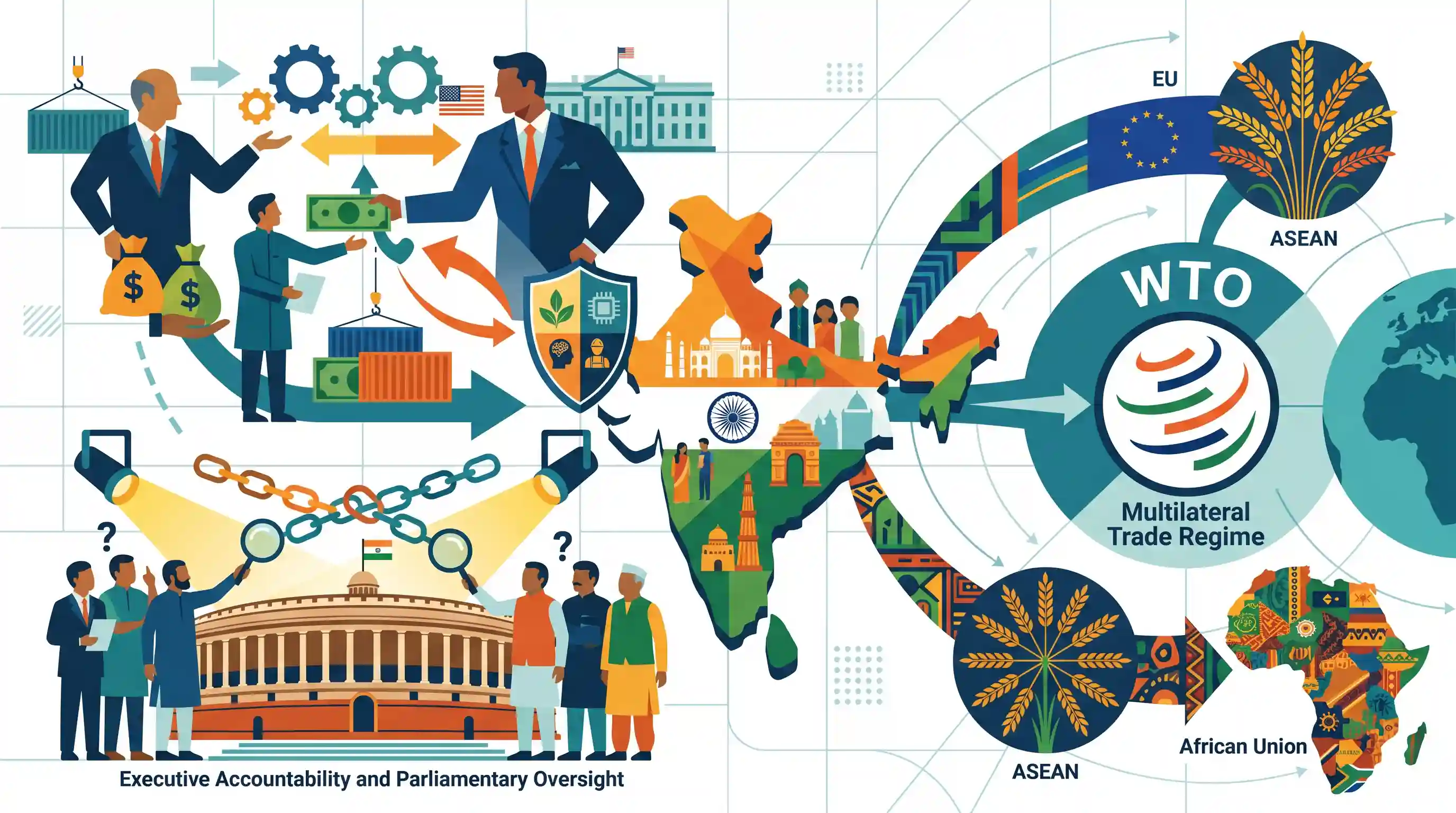
The article touches upon critical aspects of India's foreign policy and economic diplomacy, specifically highlighting the balance between securing vital bilateral trade deals (like with the US) and honoring multilateral commitments (WTO). It also raises an important polity theme regarding executive accountability in international negotiations and the necessity of domestic political consensus on foreign policy matters, relevant for GS-2.
Summary
Congress leaders have urged the Indian government to take the Opposition and State Chief Ministers into confidence regarding a potential major trade deal with the United States, following claims by US President Donald Trump about 'opening up' India. Congress leader Anand Sharma stressed that any such agreement must protect India's core national interests, be mutually beneficial, and avoid concessions made under pressure. He further emphasized the importance of adhering to the WTO's rules-based multilateral trade framework and called for enhanced trade engagements with other global blocs, including the EU, ASEAN, and the African Union. The statements underscore the demand for broader domestic consensus and transparency in India's economic diplomacy.
Key Points
- Congress leaders demanded transparency and consultation with the Opposition and State Chief Ministers regarding an impending, large-scale India-US trade deal claimed by US President Donald Trump.
- Senior leader Anand Sharma emphasized that any bilateral trade agreement must be mutually rewarding, thoroughly negotiated, and not finalized under external pressure or suboptimal terms.
- The Opposition reiterated India's commitment to a rules-based multilateral trade regime and warned against undermining India's obligations under the World Trade Organisation (WTO).
- The Congress party also advocated for broadening India's trade engagements beyond the US, pressing for deeper integration with other major trading blocs like the EU, ASEAN, African Union, GCC, and LAC.
- The demands highlight the tension between executive dominance in foreign policy and the democratic necessity for parliamentary oversight and multi-party consensus on major international agreements.
Important Terms
World Trade Organisation (WTO)

An intergovernmental organization (est. 1995) that regulates global trade. It operates on principles of non-discrimination (MFN) and provides a dispute settlement mechanism for member nations.
UPSC context
Relevant for GS Paper 2 (International Institutions) and GS Paper 3 (Trade/Agriculture); tests understanding of multilateralism and the 'Peace Clause'.
ASEAN
A regional grouping of ten Southeast Asian nations promoting economic and security cooperation. It is central to India's 'Act East' policy and Indo-Pacific strategy.
UPSC context
Critical for GS Paper 2 (Regional Groupings); focuses on 'ASEAN Centrality', maritime security, and trade imbalances (AIFTA).
Gulf Cooperation Council (GCC)
A political and economic alliance of six Middle Eastern nations (Saudi Arabia, UAE, Qatar, Kuwait, Oman, Bahrain). It is India's largest trading partner bloc and vital for energy security.
UPSC context
Significant for GS Paper 2 (West Asia/Extended Neighbourhood) and GS Paper 3 (Energy Security); covers diaspora, remittances, and strategic autonomy.
European Union (EU)
A unique economic and political union of 27 European countries. It is one of India's largest trading partners and a key source of foreign investment and green technology.
UPSC context
Important for GS Paper 2 (Bilateral Groupings); involves FTA negotiations (BTIA), data privacy standards, and carbon border adjustments (CBAM).
African Union (AU)
A continental body consisting of 55 member states of Africa. It recently became a permanent G20 member (2023) with India's strong advocacy for the Global South.
UPSC context
Relevant for GS Paper 2 (International Relations); tests India's leadership in the Global South, South-South cooperation, and resource security (critical minerals).
Latin America and Caribbean (LAC)
A diverse region of 33 countries serving as a significant source of crude oil, pulses, and critical minerals like lithium (the 'Lithium Triangle') for India.
UPSC context
Relevant for GS Paper 2 (Regional Groupings); focuses on diversifying trade beyond traditional partners and securing food and energy supply chains.
Prelims Trap
International treaties negotiated by the Executive require mandatory ratification by the Indian Parliament to become binding.
Under Article 73, treaty-making is an executive prerogative. Parliament’s role (Article 253) is limited to enacting domestic laws to implement treaties; it does not mandate prior ratification.
Static Concepts Connected
What is the constitutional distribution of treaty-making powers in India?
- Union Executive: Entering into treaties and agreements with foreign countries is the sole prerogative of the executive under Article 73.
- Legislative Action: Under Article 253, Parliament has exclusive power to make laws implementing international treaties, even on subjects enumerated in the State List.
- No Mandatory Ratification: Unlike the US Constitution, India does not mandate parliamentary ratification for treaties unless they require a formal change in domestic law.
What is the Generalized System of Preferences (GSP)?
- Definition: A preferential tariff system extending non-reciprocal, duty-free market access to developing nations by developed countries to promote economic growth.
- WTO Exception: It is explicitly permitted as an authorized exception to the WTO's fundamental Most-Favored-Nation (MFN) principle under the 'Enabling Clause'.
- India-US Context: The US revoked India's GSP beneficiary status in 2019, making its restoration a critical friction point in ongoing bilateral trade negotiations.
Cross-Topic Patterns
Paradiplomacy meets State List subjects
Trade deals often touch agriculture and local commerce (State List). Consequently, States are increasingly demanding consultative mechanisms, blending federalism disputes with economic diplomacy.
WTO MFN principle vs. Bilateral FTAs
While India defends the WTO's multilateral system, the stagnation of the Doha Round pushes it toward bilateral FTAs, requiring careful navigation of WTO's Article XXIV exemptions for preferential trade.

Paradiplomacy + Article 253 + Executive treaty powers could form a mixed IR/Polity multi-statement Prelims question in 2026.
Linked PYQs · 3
Linked PYQs · 3
- 2016MainsGS2
The broader aims and objectives of WTO are to manage and promote international trade in the era of globalization. But the Doha round of negotiations seem doomed due to differences between the developed and the developing countries." Discuss in the Indian perspective.
- 2014MainsGS2
WTO is an important international institution where decisions taken affect countries in a profound manner. What is the mandate of WTO and how binding are their decisions ? Critically analyse India's stand on the latest round of talks on Food security.
- 2021MainsGS2
To what extent, in your view, the Parliament is able to ensure accountability of the executive in India?
