Government school enrollment declines despite lower dropouts
Source:Indian Express ↗
কেন এটি গুরুত্বপূর্ণ
It highlights critical trends in India's public education system, reflecting tensions between retention rates, public versus private school enrollment, and resource optimization in human capital development.
সারসংক্ষেপ
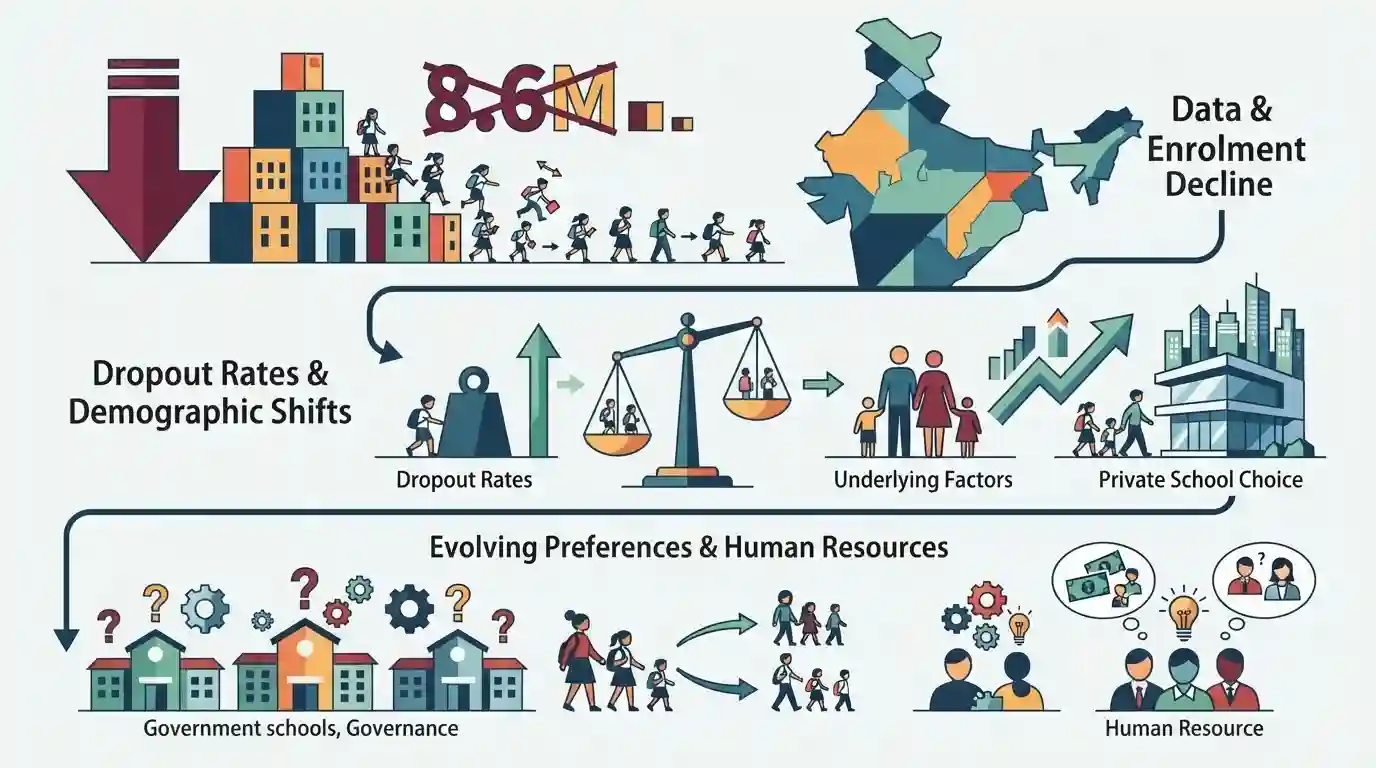
Data from the Unified District Information System for Education (UDISE) reveals that government school enrolment across India declined by 86 lakh over a span of two years. Interestingly, this shrinkage occurred despite a decrease in overall dropout rates, pointing to complex underlying demographic shifts and evolving parental preferences regarding schooling.
মূল বিষয়
- Government school enrollment across India shrunk by 86 lakh over a 2-year period despite lower dropout rates, according to UDISE data.
- The decline reflects shifting parental preferences, demographic changes, and urbanization trends towards private schooling or other educational avenues.
- Lower dropout rates indicate better retention, but overall shrinking public school enrollment poses policy questions regarding infrastructure utilization and public education financing.
গুরুত্বপূর্ণ শব্দ
UDISE

A comprehensive national database on school education in India, providing reliable data on enrollment, teachers, infrastructure, and indicators like dropout and retention rates to facilitate policy-making.
UPSC context
Crucial for GS Paper II (Social Justice - Education Governance); tests the ability to analyze education data, enrollment trends, and policy outcomes.
Ministry of Education
A central government ministry responsible for formulating national education policy, overseeing school and higher education systems, and publishing vital education statistics like UDISE reports.
UPSC context
Important for GS Paper II (Governance and Institutional Frameworks); tests understanding of administrative structures governing India's human resource development.
Right to Education Act
A fundamental right under Article 21A ensuring free and compulsory elementary education to all children aged 6 to 14 years in India.
UPSC context
Core for GS Paper II (Polity and Social Justice); tests statutory rights, welfare obligations, and challenges in universalizing primary schooling.
প্রিলিমস ফাঁদ
Shrinking government school enrolment is primarily driven by rising dropout rates across primary and secondary levels.
Aspirants often assume falling enrolment automatically means higher dropout rates. UDISE data shows enrolment can shrink even as retention improves due to demographic shifts and parental preference for private schools.
সংযুক্ত স্থির ধারণা
What are the key structural features and mandates of the UDISE+ database in India?
- Unified Database: Integrated platform capturing education data across all recognised and unrecognised schools in India.
- Data Evolution: Replaced older separate data collections like DISE and SEMIS for streamlined reporting.
- Administrative Control: Operated under the Ministry of Education to track indicators like enrolment, infrastructure, and teachers.
আন্তঃবিষয় প্যাটার্ন
Demographic Transition vs Public Infrastructure Planning
Falling birth rates and changing age pyramids are altering public school enrollment patterns across India, forcing a re-evaluation of demographic dividend assumptions in governance.
State Capacity vs Private School Preference
The flight from public to private schools even among low-income families mirrors broader questions of state capacity, quality-of-service delivery, and the commercialisation of basic social goods.

UDISE data trends on public school enrollment vs dropout rates are prime material for a Mains analytical question on education governance.
সংযুক্ত PYQ · 2
সংযুক্ত PYQ · 2
- 2023MainsGS2
Skill development programmes have succeeded in increasing human resources supply to various sectors. In the context of the statement analyse the linkages between education, skill and employment.
- 2018PrelimsGS1
Consider the following statements: 1. As per the Right to Education (RTE) Act, to be eligible for appointment as a teacher in a State, a person would be required to possess the minimum qualification laid down by the concerned State Council of Teacher Education. 2. As per the RTE Act, for teaching primary classes, a candidate is required to pass a Teacher Eligibility Test conducted in accordance with the National Council of Teacher Education guidelines. 3. In India, more than 90% of teacher education institutions are directly under the State Governments. Which of the statements given above is/are correct?
