Aviation Technical Defects and DGCA Regulatory Oversight
Source:The Hindu ↗
આ શા માટે મહત્વનું છે
Aviation safety is a crucial component of India's transport infrastructure. Understanding the role of the DGCA and the scale of technical defects is important for evaluating the effectiveness of regulatory frameworks, especially given the rapid expansion of domestic airlines and the need to prevent catastrophic air disasters.
સારાંશ
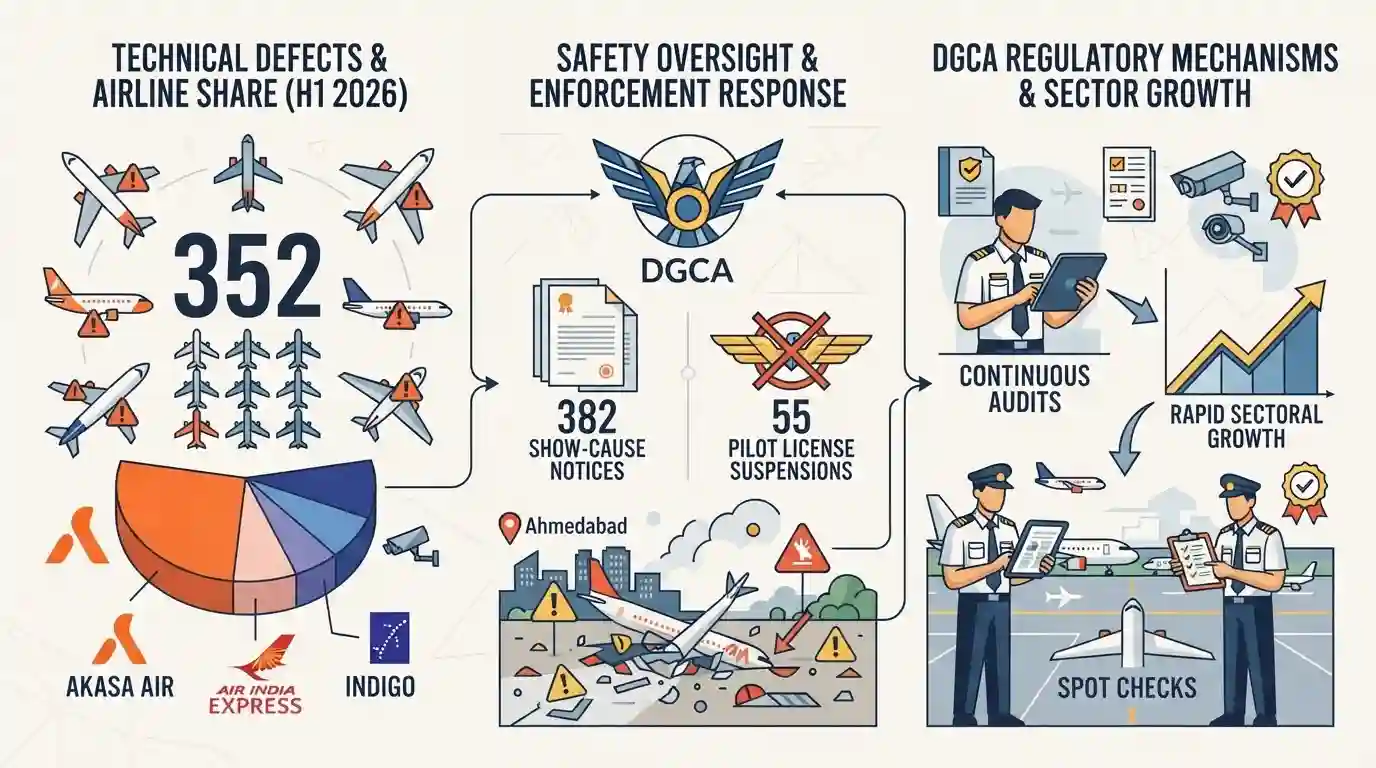
The Ministry of Civil Aviation reported 352 significant technical defects in Indian flight operations during the first half of 2026. Akasa Air accounted for the largest share of these snags, followed by Air India Express and IndiGo. In response to safety concerns—especially in the aftermath of the June 2025 Air India crash in Ahmedabad—the Directorate General of Civil Aviation (DGCA) has intensified regulatory oversight. The DGCA issued 382 show-cause notices for safety violations across the sector and suspended the licenses of 55 pilots. The data highlights ongoing challenges in maintaining aviation safety standards amidst rapid sectoral growth, emphasizing the critical role of continuous audits, spot checks, and strict enforcement mechanisms by the DGCA.
મુખ્ય મુદ્દા
- The Indian aviation sector saw 352 significant technical defects in flight operations from January to June 2026, according to the Civil Aviation Ministry.
- Akasa Air recorded the highest number of technical snags (152), followed by Air India Express (53) and IndiGo (47).
- The Directorate General of Civil Aviation (DGCA) issued 382 show-cause notices to airlines, non-scheduled operators, and training organizations for safety violations.
- 55 cases of pilot safety violations were documented, resulting in the suspension of their commercial licenses by the DGCA.
- These safety enforcements follow heightened scrutiny after the fatal Air India crash in Ahmedabad in June 2025.
- The DGCA conducts continuous safety oversight through regulatory audits, spot checks, and enforcement actions based on the severity of deficiencies.
મહત્વપૂર્ણ શબ્દો
Directorate General of Civil Aviation (DGCA)

The statutory regulatory body under the Ministry of Civil Aviation, responsible for enforcing civil air regulations, aviation safety, airworthiness standards, and licensing in India.
UPSC context
GS Papers 2 & 3: Crucial for topics on statutory bodies, infrastructure (airports), and regulatory frameworks for aviation safety.
Ministry of Civil Aviation
The nodal Union ministry responsible for formulating national policies and programs to develop and regulate India's civil aviation sector, overseeing airport infrastructure and safety.
UPSC context
GS Paper 2: Relevant to government ministries, policy formulation, and administrative oversight in the transportation sector.
Rajya Sabha
The upper house of India's bicameral Parliament, representing the states and union territories. It acts as a continuous chamber and a reviewing body for legislation.
UPSC context
GS Paper 2: Core polity concept testing knowledge of Parliament's structure, federalism, and legislative oversight mechanisms.
Air India
India's former state-owned national flag carrier, privatized and sold to the Tata Group in 2022. It operates extensive domestic and international passenger and cargo services.
UPSC context
GS Paper 3: Important for topics on disinvestment, privatization of public sector enterprises, and aviation sector economics.
પ્રિલિમ્સ ટ્રેપ
"The Bureau of Civil Aviation Security (BCAS) is responsible for regulating flight safety and suspending pilot licenses."
BCAS handles civil aviation security (e.g., anti-hijacking, airport protocols). The DGCA is the regulator for aviation safety, including airworthiness, technical snags, and licensing.
સંલગ્ન સ્થિર ખ્યાલો
What is the statutory status and mandate of the DGCA?
- Statutory status: It was upgraded from an attached office to a statutory body via the Aircraft (Amendment) Act, 2020.
- Primary mandate: Regulates civil aviation safety, enforces airworthiness standards, and issues licenses for pilots and aircraft maintenance engineers.
- Global linkage: Serves as the nodal regulatory agency interacting with the International Civil Aviation Organization (ICAO).
How is India's aviation regulatory ecosystem functionally divided?
- Safety (DGCA): Focuses on technical flight operations, regulatory audits, standard enforcement, and airworthiness.
- Security (BCAS): Handles physical security, anti-hijacking protocols, and airport safeguarding measures.
- Investigation (AAIB): The Aircraft Accident Investigation Bureau independently investigates fatal crashes and serious aviation incidents.
આંતર-વિષય પેટર્ન
UDAN expansion vs. Safety oversight
Rapid regional connectivity growth (UDAN scheme) and massive airline fleet expansions often outpace regulatory human resources, highlighting the conflict between infrastructure scaling and safety auditing.
ICAO's Chicago Convention framework
DGCA's enforcement actions directly impact India's global ranking in the Universal Safety Oversight Audit Programme (USOAP) conducted by the UN's International Civil Aviation Organization (ICAO).

Expect a 2026 prelims question differentiating the functional mandates of DGCA (safety), BCAS (security), and AAIB (investigation).
સંલગ્ન PYQ · 2
સંલગ્ન PYQ · 2
- 2017MainsGS3
Examine the development of Airports in India through joint ventures under Public-Private Partnership (PPP) model. What are the challenges faced by the authorities in this regard?
- 2026PrelimsGS1
Which of the following statements about insurance in aviation sector is/are correct ? 1. 'Aviation Hull Insurance' covers the physical aircraft, including the body, engine, and on-board equipment. 2. Under the Montreal Convention, adopted in 1999 by over 130 countries, including India, airlines are strictly liable to pay compensation to the family/nominee of every deceased passenger without requiring the family to prove fault. Select the answer using the code given below :
