Andhra Pradesh advance tariff subsidy allocation for power DISCOMs
Source:deccanchronicle ↗
Why It Matters
State budgetary support and the financial viability of electricity distribution companies (DISCOMs) are critical pillars of regional economic development in Andhra Pradesh. For APPSC Group 1 Prelims, understanding the institutional structure of the state's electricity distribution network (APEPDCL, APSPDCL, and APCPDCL) along with the mechanics of tariff subsidies is highly relevant for questions on economic sectors, public finance, and infrastructure.
Summary
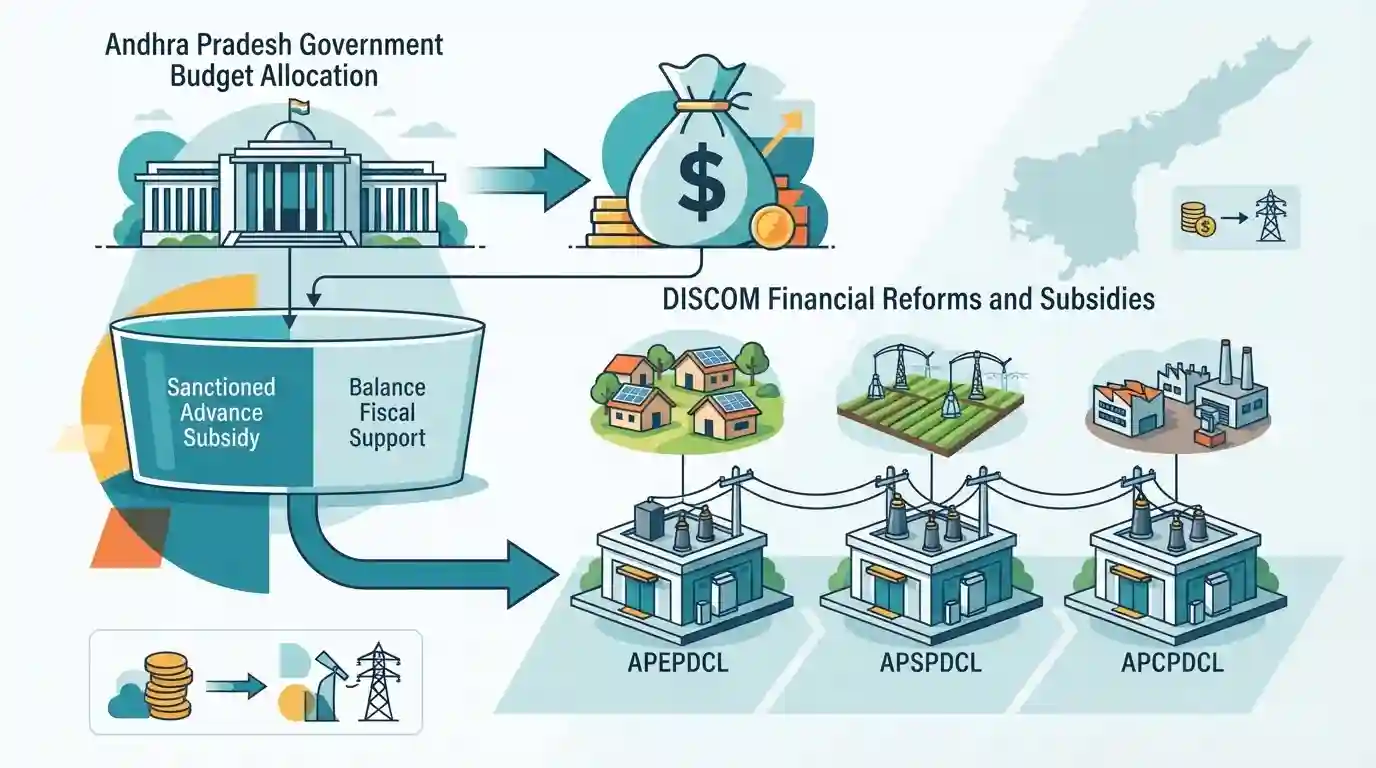
The Government of Andhra Pradesh has sanctioned an advance tariff subsidy of Rs 1,381 crore to its three state-owned DISCOMs—APEPDCL, APSPDCL, and APCPDCL—for the financial year 2026-27. Authorized by the Energy Department, this allocation draws from a total budgeted pool of Rs 2,744.4 crore, leaving a balance of Rs 1,364 crore to ensure continuous fiscal support for the power distribution sector.
Key Points
- The Government of Andhra Pradesh has issued a Government Order (GO) sanctioning an advance tariff subsidy of Rs 1,380.7 crore (approx. Rs 1,381 crore) for the state's three electricity distribution companies (DISCOMs) for the financial year 2026-27.
- The individual allocation among the DISCOMs is as follows: Rs 603 crore to Andhra Pradesh Southern Power Distribution Company Ltd (APSPDCL), Rs 445 crore to Andhra Pradesh Central Power Distribution Corporation Ltd (APCPDCL), and Rs 332 crore to Andhra Pradesh Eastern Power Distribution Company Ltd (APEPDCL).
- The advance subsidy is aimed at addressing the cost gap for subsidised electricity categories, helping maintain the operational and financial viability of state DISCOMs.
- The administrative sanction was authorized by K. Vijayanand, the Special Chief Secretary of the Energy Department.
- Out of the total available budgetary provision of Rs 2,744.4 crore, the Rs 1,381 crore sanction leaves a remaining balance of Rs 1,364 crore (specifically Rs 1,363.7 crore) in the tariff subsidy reserve.
Important Terms
Advance Tariff Subsidy Scheme

Funds transferred upfront by the government to electricity distribution companies (DISCOMs) to compensate them for supplying power to specific consumer categories at subsidized rates below actual costs.
UPSC context
Core to GS Paper 3 (Energy/Economy). Addresses structural challenges of DISCOM indebtedness, power sector reforms, and fiscal management.
Energy Department, Government of Andhra Pradesh
The apex state authority overseeing power generation, transmission, and distribution policies. It sanctions administrative and financial support, such as advance subsidies, to sustain public energy utilities.
UPSC context
Pertains to GS Paper 2 (Governance) and GS Paper 3 (Energy). Explores the state's administrative role in ensuring energy security and utility viability.
Andhra Pradesh Southern Power Distribution Company Ltd (APSPDCL)
A state-owned electricity distribution utility managing power supply in southern AP. It relies on government tariff subsidies to bridge the gap between service costs and consumer tariffs.
UPSC context
Relevant to GS Paper 3 (Infrastructure). Highlights regional energy distribution models and the dependency of state utilities on budgetary support.
Andhra Pradesh Central Power Distribution Corporation Ltd (APCPDCL)
The power distribution entity managing electricity supply for central AP. It collaborates with the state Energy Department to implement subsidized tariff policies for consumers.
UPSC context
Key for GS Paper 3 (Infrastructure). Demonstrates the decentralization of state power grids and the fiscal dynamics of energy subsidies.
Andhra Pradesh Eastern Power Distribution Company Ltd (APEPDCL)
The state-run distribution company responsible for electricity retail and infrastructure in eastern AP, currently receiving substantial advance subsidies to ensure uninterrupted utility operations.
UPSC context
Features in GS Paper 3 (Energy). Illustrates the operational challenges and financial mechanisms of regional power distribution companies.
Prelims Trap
The Central Government funds state-level electricity tariff subsidies to rescue DISCOMs.
State governments, not the Centre, are legally mandated (Sec 65 of Electricity Act) to fund and pay in advance any electricity subsidies they declare.
Static Concepts Connected
What is the ACS-ARR gap in India's power distribution sector?
- ACS (Cost): Total cost incurred by a DISCOM to purchase and supply one unit (kWh) of electricity.
- ARR (Revenue): Total revenue earned by the DISCOM per unit of electricity billed and successfully collected.
- Health Indicator: A positive gap (ACS > ARR) indicates financial bleeding. Eliminating this gap is a primary objective of the Revamped Distribution Sector Scheme (RDSS).
What constitute Aggregate Technical and Commercial (AT&C) losses?
- Technical Losses: Physical energy lost as heat during the flow of electricity through transmission and distribution networks (lines and transformers).
- Commercial Losses: Revenue losses caused by electricity theft, unmetered supply, faulty metering, and billing or collection inefficiencies.
- Target Limit: The RDSS targets reducing pan-India AT&C losses to a sustainable 12-15% margin.
Cross-Topic Patterns
Energy Subsidies + State Fiscal Deficits
Delayed subsidy payments by states to DISCOMs often lead to massive off-budget borrowings (contingent liabilities), directly impacting state fiscal deficit metrics and FRBM Act compliance.
RDSS + Cooperative Federalism
The Revamped Distribution Sector Scheme (RDSS) links Central infrastructure grants to mandatory state-level governance reforms, acting as a prime example of conditional fiscal transfers under cooperative federalism.

Expect a 2026 prelims question linking DISCOM financial health metrics (ACS-ARR gap, AT&C losses) with Electricity Act mandates.
Linked PYQs · 1
Linked PYQs · 1
- 2024APPSC_PRELIMSGS1
Which of the following statement/statements is/are valid regarding the socio-economic status of Andhra Pradesh ? I. Andhra Pradesh won the Best State Award of ICAR - National Research Center for Banana (NRCB) for export promotion. II. Andhra Pradesh GSDP growth rate has been registering a decline in recent times owing to repeated lower returns in certain sub-sectors of the Service Sector. III. For the FY 2024 - 25, the Revenue Deficit is budgeted higher than the Fiscal Deficit in terms of percentage of Andhra Pradesh GSDP. IV. The technology used by the Government of Andhra Pradesh while conducting resurvey of landholdings is referred to as 'Continuously Operating Reference Stations (CORS)' technology. Select the correct answer using the codes given below :
