Petroleum Export Duty Revisions and Domestic Energy Security Measures
Source:The Hindu ↗
কেন এটি গুরুত্বপূর্ণ
This article practically demonstrates how India uses taxation tools (like Special Additional Excise Duty or windfall taxes) to ring-fence its domestic energy security against external geopolitical shocks. It is highly relevant for GS-3 (Energy, Economy) and GS-2 (International Relations affecting India's interests).
সারসংক্ষেপ
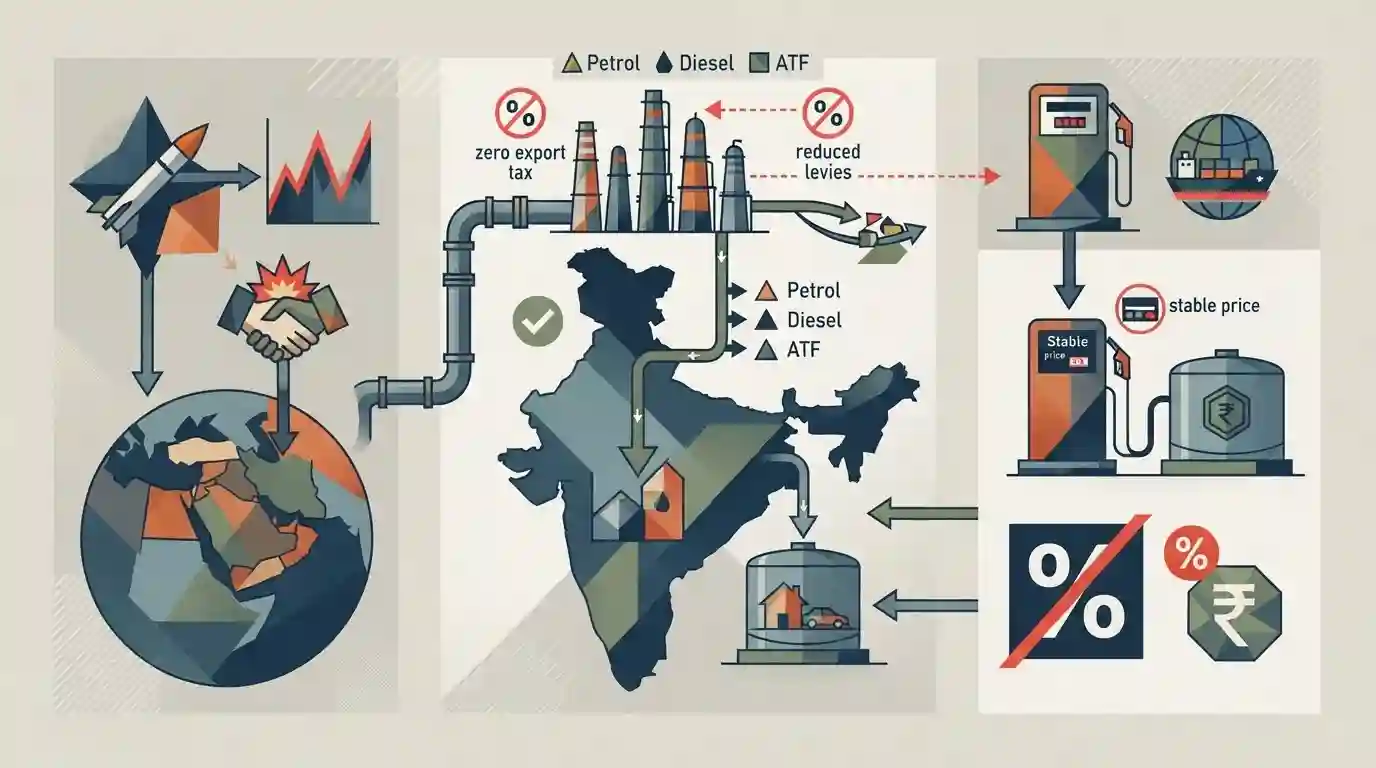
The Indian Government has slashed the export duty on petrol to zero and reduced the levies on diesel and Aviation Turbine Fuel (ATF) to ensure adequate domestic availability. Through a system of fortnightly reviews initiated in March following peak tensions in West Asia (including Israel-US strikes on Iran), the government seeks to disincentivize domestic refineries from aggressively exporting fuels to capitalize on higher international prices. While export taxes have been cut, the excise duty for domestic consumption remains unchanged. This measure highlights the direct link between global geopolitics, energy security, and domestic macroeconomic policy in protecting consumers from supply shocks.
মূল বিষয়
- The Indian Government has reduced the export duty on petrol from ₹3.5 per litre to nil to ensure domestic availability.
- The export levy on diesel has been lowered from ₹25.5 to ₹24 per litre, and on Aviation Turbine Fuel (ATF) from ₹22 to ₹19.5 per litre.
- Domestic excise duties on petrol and diesel for internal consumption remain unchanged.
- These fortnightly reviews of export duties were initiated in March to discourage fuel exports and secure domestic supplies amid global price fluctuations.
- The policy action stems from geopolitical tensions in West Asia, particularly the peak of the conflict involving Israel-US strikes on Iran, which threatened global energy markets.
গুরুত্বপূর্ণ শব্দ
Windfall Tax

A temporary levy imposed by governments on industries or companies experiencing sudden, exceptionally high profits ("supernormal profits") due to external market anomalies or geopolitical disruptions rather than active operational improvements.
UPSC context
GS Paper III (Indian Economy); tests knowledge of tax structures, fiscal measures to curb inflation, and macroeconomic stability.
Special Additional Excise Duty (SAED)
An additional central excise levy used as the legal mechanism in India to impose windfall taxes on the production of domestic crude oil and exports of petrol, diesel, and aviation turbine fuel.
UPSC context
GS Paper III (Indian Economy & Mobilization of Resources); tests fiscal federalism, indirect tax administration, and energy security policy.
Excise Duty
A central indirect tax levied on the manufacture or production of goods within the country. In India, key petroleum products remain under central excise duty rather than the Goods and Services Tax (GST).
UPSC context
GS Paper III (Fiscal Policy); tests understanding of indirect tax regimes, the scope of GST, and state-centre tax sharing.
প্রিলিমস ফাঁদ
PNGRB regulates upstream crude oil exploration and production along with downstream retail marketing of petrol and diesel.
PNGRB's mandate is strictly limited to midstream and downstream sectors; upstream exploration and production is regulated by the Directorate General of Hydrocarbons (DGH).
সংযুক্ত স্থির ধারণা
What is a Windfall Tax and how is it implemented in India?
- Definition: A surtax imposed on industries experiencing sudden, extraordinarily high profits due to external economic or geopolitical anomalies.
- Mechanism: In India, it is levied as Special Additional Excise Duty (SAED) on crude petroleum production and exports of petrol, diesel, and aviation fuel.
- Review Cycle: Adjusted fortnightly by the Ministry of Finance based on international refining margins and crude benchmarks to protect domestic supplies.
How is petroleum sector regulation divided between DGH and PNGRB?
- Upstream (DGH): The Directorate General of Hydrocarbons regulates upstream exploration, licensing, and production of crude oil and natural gas.
- Downstream (PNGRB): The Petroleum and Natural Gas Regulatory Board regulates midstream and downstream activities, including refining, pipelines, storage, and marketing.
- Key Exclusion: PNGRB has no jurisdiction over upstream exploration and production activities, which remain solely under the purview of DGH.
আন্তঃবিষয় প্যাটার্ন
Geopolitical conflict + Fiscal defense
West Asian conflicts directly translate to domestic fiscal intervention via SAED to prevent private refiners from starving the domestic market in search of global export premiums.
Asymmetric trade value chains
India's dual identity as a massive crude importer and a major refined fuel exporter highlights critical vulnerabilities in trade balance during supply-side shocks.

Multi-statement questions on the jurisdiction of PNGRB vs DGH, paired with the fiscal mechanism of SAED/windfall taxes, are highly probable.
সংযুক্ত PYQ · 4
সংযুক্ত PYQ · 4
- 2025PrelimsGS1
Consider the following activities : I. Production of crude oil II. Refining, storage and distribution of petroleum III. Marketing and sale of petroleum products IV. Production of natural gas How many of the above activities are regulated by the Petroleum and Natural Gas Regulatory Board in our country?
- 2017MainsGS2
The question of India's Energy Security constitutes the most important part of India's economic progress. Analyze India's energy policy cooperation with West Asian countries.
- 2025MainsGS2
"Energy security constitutes the dominant kingpin of India's foreign policy, and is linked with India's overarching influence in Middle Eastern countries.” How would you integrate energy security with India's foreign policy trajectories in the coming years?
- 2018MainsGS3
“Access to affordable, reliable, sustainable and modern energy is the sine qua non to achieve Sustainable Development Goals (SDGs).” Comment on the progress made in India in this regard.
