Government Prepares Kharif Contingency Plans for El Nino
Source:The Hindu ↗
Why It Matters
The convergence of climate threats (El Nino) and agricultural planning highlights the urgency of crop diversification. Understanding how shifting away from water-intensive rice towards pulses and oilseeds can enhance food security, ecological sustainability, and economic self-reliance is highly relevant for GS3.
Summary
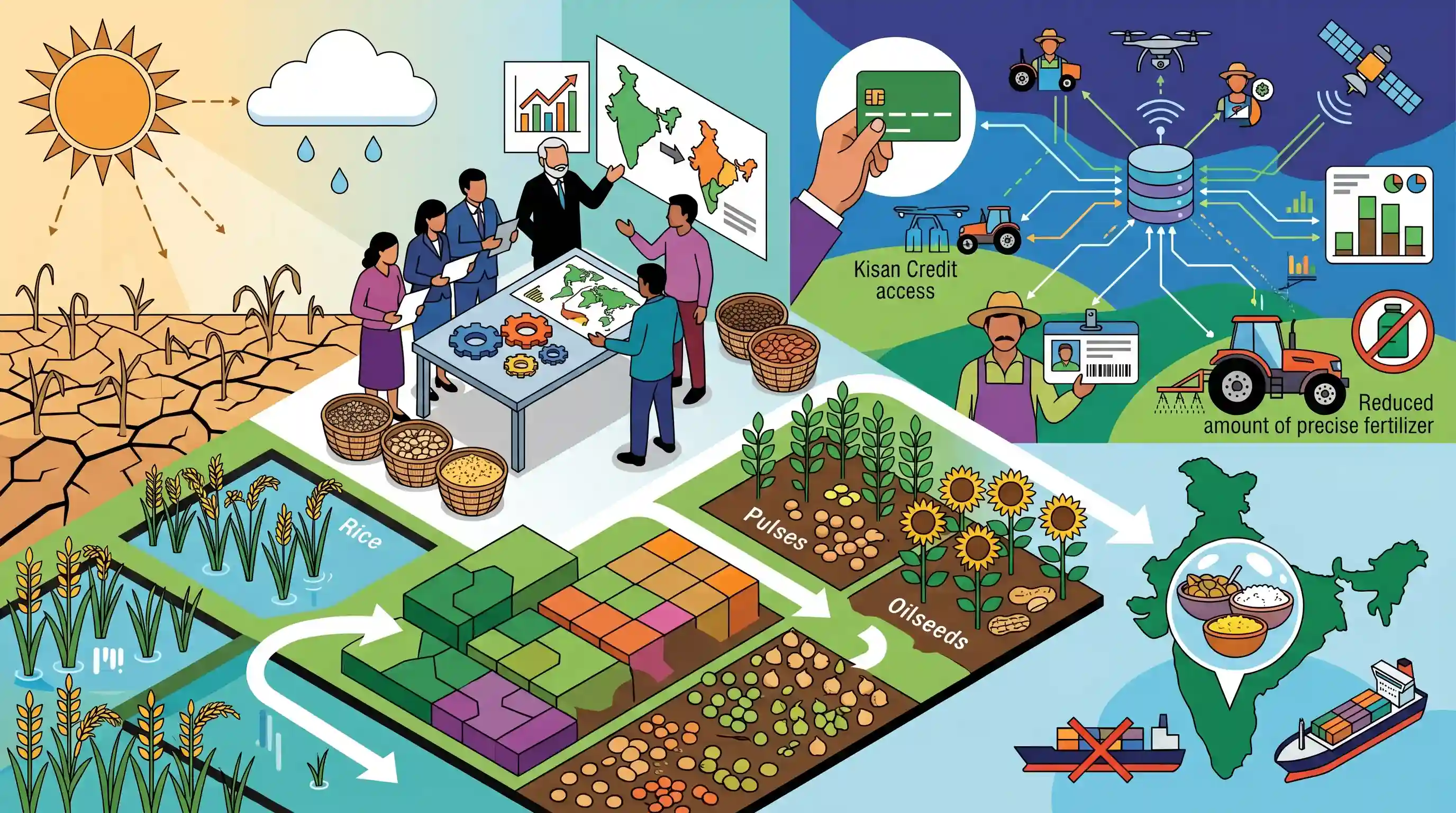
In response to forecasts of El Nino and a below-normal southwest monsoon, the Indian government, led by Agriculture Minister Shivraj Singh Chouhan, is preparing Kharif season contingency plans, including alternative crop strategies and seed availability. Experts from ICAR are pushing for large-scale crop diversification, suggesting the reallocation of 15 million hectares of rice fields to pulses and oilseeds to ensure national self-reliance and reduce reliance on imports. Further agricultural modernization efforts include reducing fertilizer overuse, expanding Kisan Credit Card access, issuing Farmer IDs, and leveraging the Bharat Vistar data platform.
Key Points
- The Indian government is formulating contingency plans for the upcoming Kharif season in response to El Nino and below-normal monsoon forecasts by the IMD.
- Contingency measures include identifying alternative crops and ensuring the availability of suitable seeds for districts likely to face rainfall deficits.
- ICAR Director General highlighted that India has met its rice output targets for 2047 and advocated for reallocating 15 million hectares from rice to pulses and oilseeds to achieve self-reliance.
- Experts stressed the need for crop diversification and reduced fertilizer usage to build agricultural resilience.
- The government is focusing on building a robust data ecosystem via the Bharat Vistar platform and expanding coverage for Kisan Credit Cards and Farmer IDs under a 'Team Agriculture' approach.
Important Terms
Kisan Credit Card (KCC)

Introduced in 1998, this scheme provides farmers with timely, single-window credit for cultivation, post-harvest needs, and consumption. It includes interest subvention for prompt repayment and extends to fisheries and animal husbandry.
UPSC context
GS Paper III (Agriculture); tests knowledge of rural financial inclusion and agricultural credit mechanisms.
Bharat Vistar platform
An AI-driven Digital Public Infrastructure (DPI) that provides farmers with real-time, voice-based advisory services in multiple languages. It integrates weather intelligence, mandi prices, and government scheme data to support decision-making.
UPSC context
GS Paper III (S&T & Agriculture); tests AI applications in governance and digital infrastructure.
Farmer ID
A unique digital identity ("Kisan ki Pehchaan") created under the Digital Agriculture Mission's AgriStack. It links farmers to land records, livestock, and crop data to streamline the delivery of government benefits.
UPSC context
GS Paper III (Digital Agriculture); tests data-driven governance and modernization of the agricultural sector.
ICAR (Indian Council of Agricultural Research)
The apex autonomous body under the Ministry of Agriculture for coordinating agricultural research and education. It played a pivotal role in the Green Revolution and ensures national food security.
UPSC context
GS Paper III (Agriculture); tests institutional frameworks and scientific contributions to food security.
IMD (India Meteorological Department)
Established in 1875 under the Ministry of Earth Sciences, it is the principal agency responsible for meteorological observations, weather forecasting, and monitoring the critical southwest monsoon in India.
UPSC context
GS Paper I (Geography) and III (Disaster Management); tests monsoon dynamics and early warning systems.
WMO (World Meteorological Organization)
A specialized UN agency headquartered in Geneva that coordinates international cooperation on meteorology and climate. It issues authoritative reports on global temperature records and phenomena like El Nino.
UPSC context
GS Paper III (Environment); tests international organizations and global climate change monitoring.
Prelims Trap
Bharat-VISTAAR is a centrally sponsored scheme establishing physical extension centres across all blocks.
Bharat-VISTAAR is a multilingual AI-based Digital Public Infrastructure (DPI) integrating AgriStack and data, not a physical brick-and-mortar agricultural extension network.
Static Concepts Connected
How does the El Niño Southern Oscillation (ENSO) impact the Indian Monsoon?
- El Niño impact: Warming of the central/eastern equatorial Pacific typically suppresses the southwest monsoon, leading to spatial and temporal rainfall deficits.
- La Niña contrast: Cooling of the same Pacific region strengthens the monsoon, often bringing above-normal rainfall to India.
- Mitigating factor: A positive Indian Ocean Dipole (IOD) can offset El Niño's negative effects, potentially saving the Kharif season from severe drought.
Why is shifting from rice to pulses/oilseeds ecologically and economically strategic?
- Water efficiency: Pulses and oilseeds are often rainfed, drought-resistant crops requiring vastly less water than puddle-irrigated rice, building climate resilience.
- Soil rejuvenation: Leguminous pulses fix atmospheric nitrogen in the soil, naturally enhancing fertility and reducing the need for chemical fertilizers like urea.
- Economic self-reliance: Shifting acreage reduces the massive import burden—like the $5.5 billion spent on pulses in 2024-25—while ensuring domestic nutritional security.
Cross-Topic Patterns
Monsoon Deficits & Monetary Policy
El Niño-induced Kharif shortfalls drive food inflation, often forcing the RBI to maintain hawkish interest rates and the government to deploy trade remedies like export controls.
Agri-DPI & Financial Inclusion
Integrating Farmer IDs and AgriStack with Kisan Credit Cards creates an agricultural DPI, mirroring the JAM trinity to enable precision-targeted institutional credit and reduce defaults.

Expect a multi-statement Prelims 2026 question linking El Nino's impact on Kharif with India's new Agri-DPI platforms (Bharat-VISTAAR).
Linked PYQs · 5
Linked PYQs · 5
- 2014MainsGS1
Most of the unusual climatic happenings are explained as an outcome of the El-Nino effect. Do you agree?
- 2021MainsGS3
What are the present challenges before crop diversification? How do emerging technologies provide an opportunity for crop diversification?
- 2017MainsGS3
What are the major reasons for declining rice and wheat yield in the cropping system? How crop diversification is helpful to stabilise the yield of the crops in the system?
- 2019PrelimsGS1
With reference to the cultivation of Kharif crops in India in the last five years, consider the following statements: 1. Area under rice cultivation is the highest. 2. Area under the cultivation of jowar is more than that of oilseeds. 3. Area of cotton cultivation is more than that of sugarcane. 4. Area under sugarcane cultivation has steadily decreased. Which of the statements given above are correct?
- 2013PrelimsGS1
Consider the following crops : 1. Cotton 2. Groundnut 3. Rice 4. Wheat Which of these are Kharif crops?
