Government Revises Natural Gas Price Ceilings for Deepwater Fields
Source:The Hindu ↗
આ શા માટે મહત્વનું છે
Understanding domestic energy pricing mechanisms like APM and deepwater caps is crucial for evaluating India's energy security, subsidy burdens, inflation management, and incentives for upstream hydrocarbon exploration.
સારાંશ
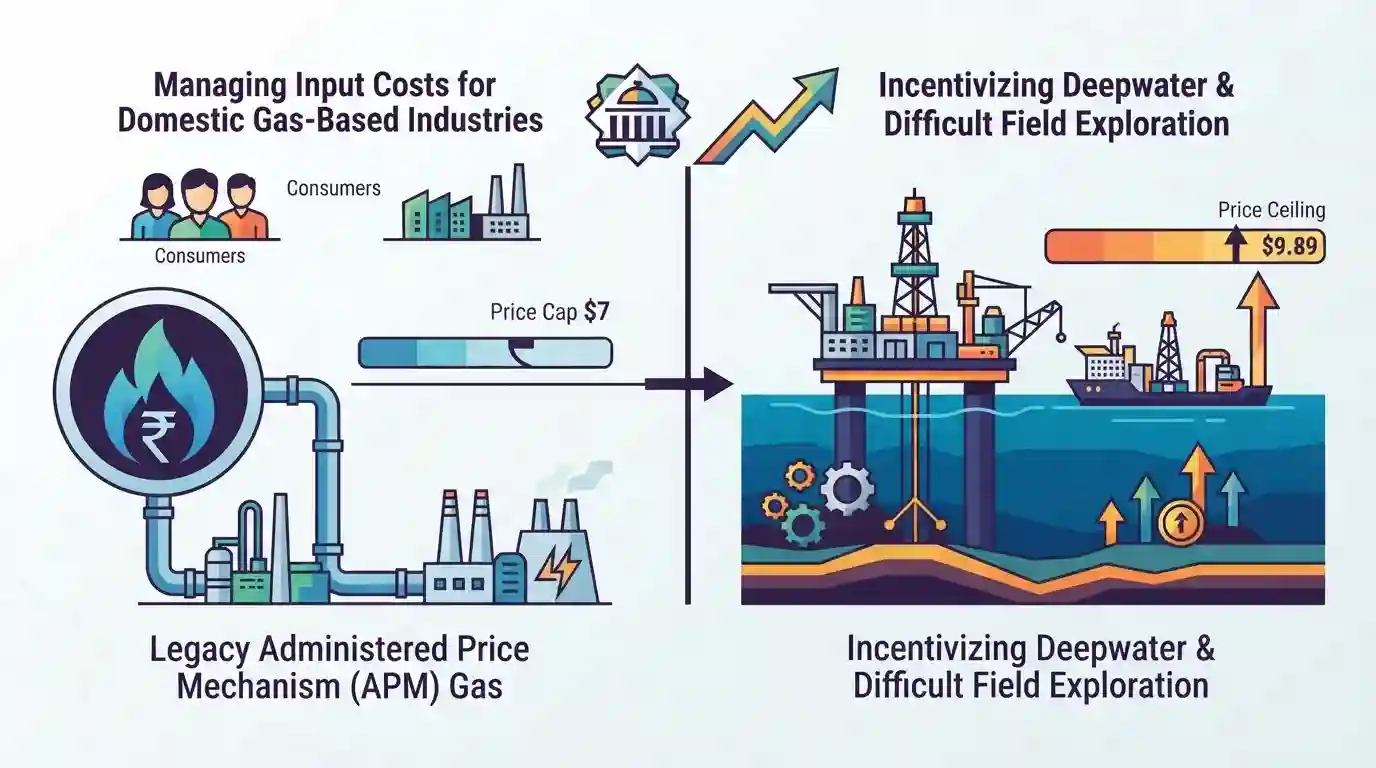
The Indian government has revised natural gas pricing ceilings, increasing the price ceiling for complex deepwater and difficult fields to $9.89 per MMBtu, while keeping the cap for legacy Administered Price Mechanism (APM) gas at $7 per MMBtu. The move aims to incentivize capital-intensive domestic exploration while managing input costs for domestic gas-based industries.
મુખ્ય મુદ્દા
- The government raised the price ceiling for natural gas produced from difficult and deepwater fields to $9.89 per million British thermal units (MMBtu) for a specific period.
- The cap for Administered Price Mechanism (APM) gas—produced mainly by legacy fields of ONGC and Oil India—has been capped at $7 per MMBtu.
- These pricing adjustments balance incentives for upstream energy exploration in complex geological fields with the need to moderate raw material costs for downstream consumers like city gas distribution (CGD) networks, power, and fertilizer sectors.
મહત્વપૂર્ણ શબ્દો
Administered Price Mechanism (APM)

A pricing framework used by the government to regulate and cap domestic natural gas prices for legacy fields to ensure affordable supplies for priority sectors like fertilizers and city gas.
UPSC context
GS Paper III (Economy / Energy Security): Tests understanding of government pricing interventions, energy subsidies, and balancing producer incentives with consumer costs.
ONGC
Maharatna public sector undertaking responsible for crude oil and natural gas exploration and production in India, operating major nomination legacy fields.
UPSC context
GS Paper III (Infrastructure & Energy): Tests the role of Central Public Sector Enterprises (CPSEs) in India's energy security and upstream oil production.
Oil India Ltd.
A premier public sector oil exploration and production company in India engaged in exploring, developing, and producing crude oil and natural gas in legacy fields.
UPSC context
GS Paper III (Economy / Industry): Important for questions on India's domestic hydrocarbon sector and energy independence strategies.
પ્રિલિમ્સ ટ્રેપ
The government maintains a single uniform ceiling price for all domestic natural gas produced across legacy and deepwater fields.
Aspirants often assume a uniform national price for all domestic natural gas, missing the dual pricing structure that grants higher ceilings exclusively to difficult and deepwater fields.
સંલગ્ન સ્થિર ખ્યાલો
What is the Administered Price Mechanism (APM) and how is domestic natural gas priced in India?
- Kirit Parikh Panel: Kirit Parikh Committee recommended linking domestic gas prices from legacy fields to 10% of international crude prices with a floor of $4 and cap of $6.50-$7 per MMBtu.
- Legacy Fields: APM gas refers to legacy fields held mostly by ONGC and Oil India, sold at government-regulated rates to downstream sectors like fertilizer, power, and CGD.
- Deepwater Premium: Complex fields (deepwater, ultra-deepwater, HPHT) enjoy marketing and pricing freedom or higher ceilings to incentivize risky, high-cost capital investments.
આંતર-વિષય પેટર્ન
Energy Pricing + Fiscal Deficit Management
Balancing upstream producer incentives with downstream fertilizer and power subsidy burdens ties energy pricing reforms directly to fiscal deficit management.
PSU Disinvestment + Upstream Energy Regulation
Differential gas pricing for legacy ONGC/Oil India fields versus high-risk deepwater blocks illustrates the regulatory balancing act between PSUs and private E&P players.

APM gas formula (10% of crude import price) and deepwater caps frequently appear in matching or statement-based prelims questions.
સંલગ્ન PYQ · 2
સંલગ્ન PYQ · 2
- 2025PrelimsGS1
Consider the following activities : I. Production of crude oil II. Refining, storage and distribution of petroleum III. Marketing and sale of petroleum products IV. Production of natural gas How many of the above activities are regulated by the Petroleum and Natural Gas Regulatory Board in our country?
- 2019PrelimsGS1
Consider the following statements : 1. Petroleum and Natural Gas Regulatory Board (PNGRB) is the first regulatory body set up by the Government of India. 2. One of the tasks of PNGRB is to ensure competitive markets for gas. 3. Appeals against the decisions of PNGRB go before the Appellate Tribunals for Electricity. Which of the statements given above are correct?
