Solar Module Waste Recycling Guidelines In India
Source:Indian Express ↗
Why It Matters
As India scales up its solar energy capacity to meet ambitious climate commitments, managing solar photovoltaic waste becomes critical to prevent environmental hazards and promote resource recovery, making this topic highly relevant for GS Paper 3 (Environment and Infrastructure).
Summary
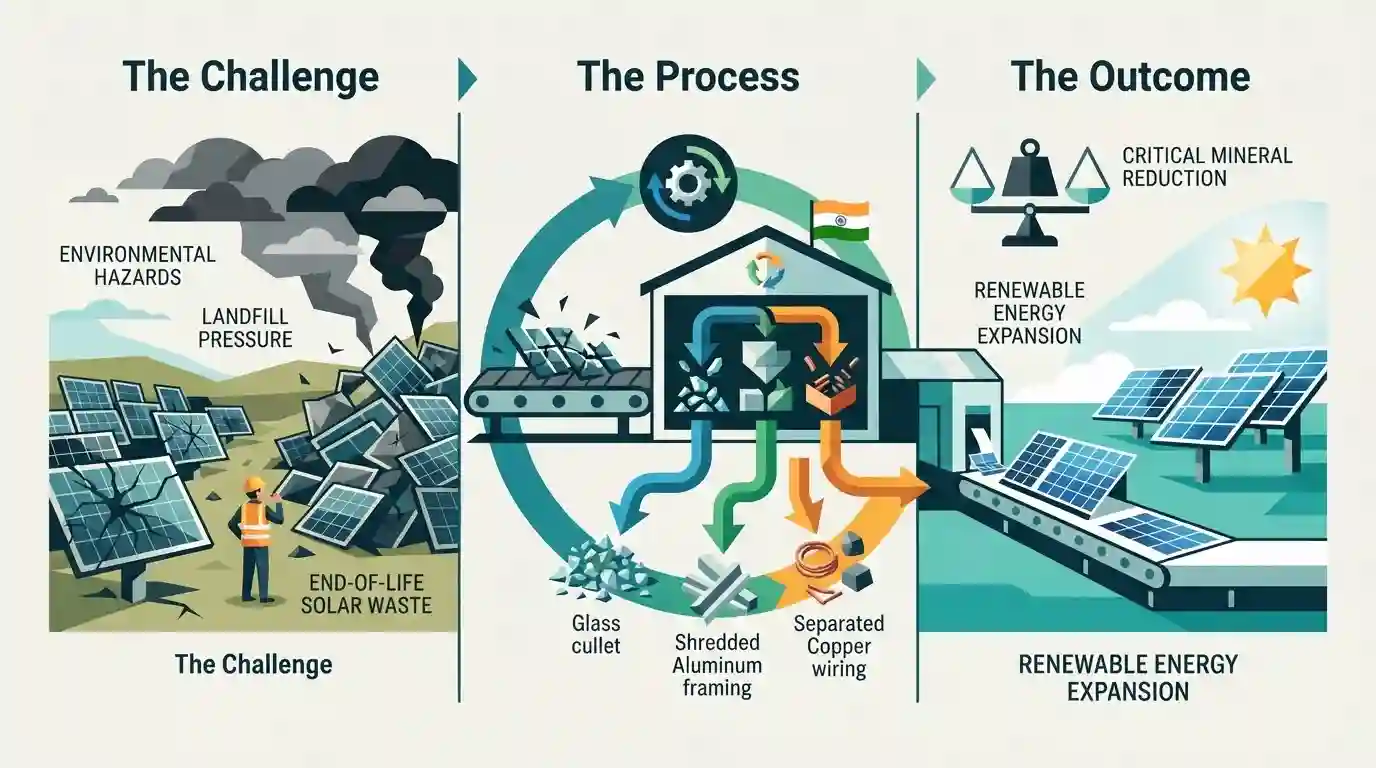
The Indian government is developing guidelines for solar module waste recycling to address the exponential growth of photovoltaic waste from clean energy expansion. The framework will facilitate material recovery, reduce critical mineral dependency, and manage environmental hazards under circular economy principles.
Key Points
- The Indian government is formulating comprehensive guidelines for the recycling and management of solar module waste to address emerging environmental concerns.
- With massive targets for solar energy deployment under the national clean energy transition, the volume of discarded photovoltaic panels is projected to grow exponentially in the coming decades.
- The upcoming framework aims to establish standardized procedures for safe collection, dismantling, recycling, and recovery of valuable materials like silicon, silver, and copper from expired solar panels.
- This initiative supports India's broader goals of promoting a circular economy, reducing reliance on critical mineral imports through domestic recycling, and mitigating e-waste/hazardous waste risks.
Important Terms
E-Waste Management Rules

Regulatory framework under the Environment Protection Act that governs the safe collection, handling, and recycling of electronic and electrical waste, including solar photovoltaic modules.
UPSC context
UPSC Prelims/Mains (GS Paper III): Important for environmental pollution, waste management regulations, and circular economy principles.
Ministry of New and Renewable Energy
The nodal ministry of the Government of India responsible for formulating policies, programs, and regulations related to clean energy expansion, including solar power.
UPSC context
UPSC Prelims/Mains (GS Paper III): Tests knowledge of institutional frameworks driving India's energy transition and renewable targets.
Central Pollution Control Board
A statutory organization under the Ministry of Environment, Forest and Climate Change tasked with enforcing environmental standards, monitoring pollution, and issuing waste guidelines.
UPSC context
UPSC Prelims: Essential for questions on statutory bodies, pollution control mechanisms, and environmental compliance.
Static Concepts Connected
How are solar photovoltaic modules regulated under India's environmental waste framework?
- Statutory Coverage: Covered under E-Waste Rules 2022, which formally bring solar waste, panels, and cells under regulatory purview.
- Extended Producer Responsibility: Assigned to manufacturers and producers to ensure environmentally safe collection, dismantling, and recycling.
- Storage Guidelines: Issued by the CPCB to govern temporary storage and handling protocols prior to commercial processing.
Cross-Topic Patterns
Critical Minerals & Solar Waste Linkage
Solar module recycling directly intersects with the Critical Minerals Mission, aiming to recover silicon, silver, and copper to reduce import dependency on China.
EPR Mandates in Industrial Circular Economy
Under the E-Waste Management Rules, manufacturers bear Extended Producer Responsibility (EPR), linking environmental compliance directly to industrial manufacturing liabilities.

Expect a statement-based question pairing E-Waste Rules 2022 coverage of PV panels with EPR obligations and critical mineral recovery goals.
Linked PYQs · 3
Linked PYQs · 3
- 2025MainsGS3
How can India achieve energy independence through clean technology by 2047? How can biotechnology can play a crucial role in this endeavour?
- 2022MainsGS3
Do you think India will meet 50 percent of its energy needs from renewable energy by 2030 ? Justify your answer. How will the shift of subsidies from fossil fuels to renewables help achieve the above objective ? Explain.
- 2018MainsGS3
What are the impediments in disposing the huge quantities of discarded solid wastes which are continuously being generated? How do we remove safely the toxic wastes that have been accumulating in our habitable environment?
