India implements sweeping overhaul of criminal justice system
Source:Indian Express ↗
Why It Matters
The transition to a new criminal justice framework is a monumental shift in India's legal architecture. UPSC aspirants must understand the institutional preparation, digital modernization (CCTNS, e-Sakshya), and administrative challenges of implementing these laws, as it forms a critical part of GS-2 (Governance, Rule of Law) and GS-3 (Internal Security technology).
Summary
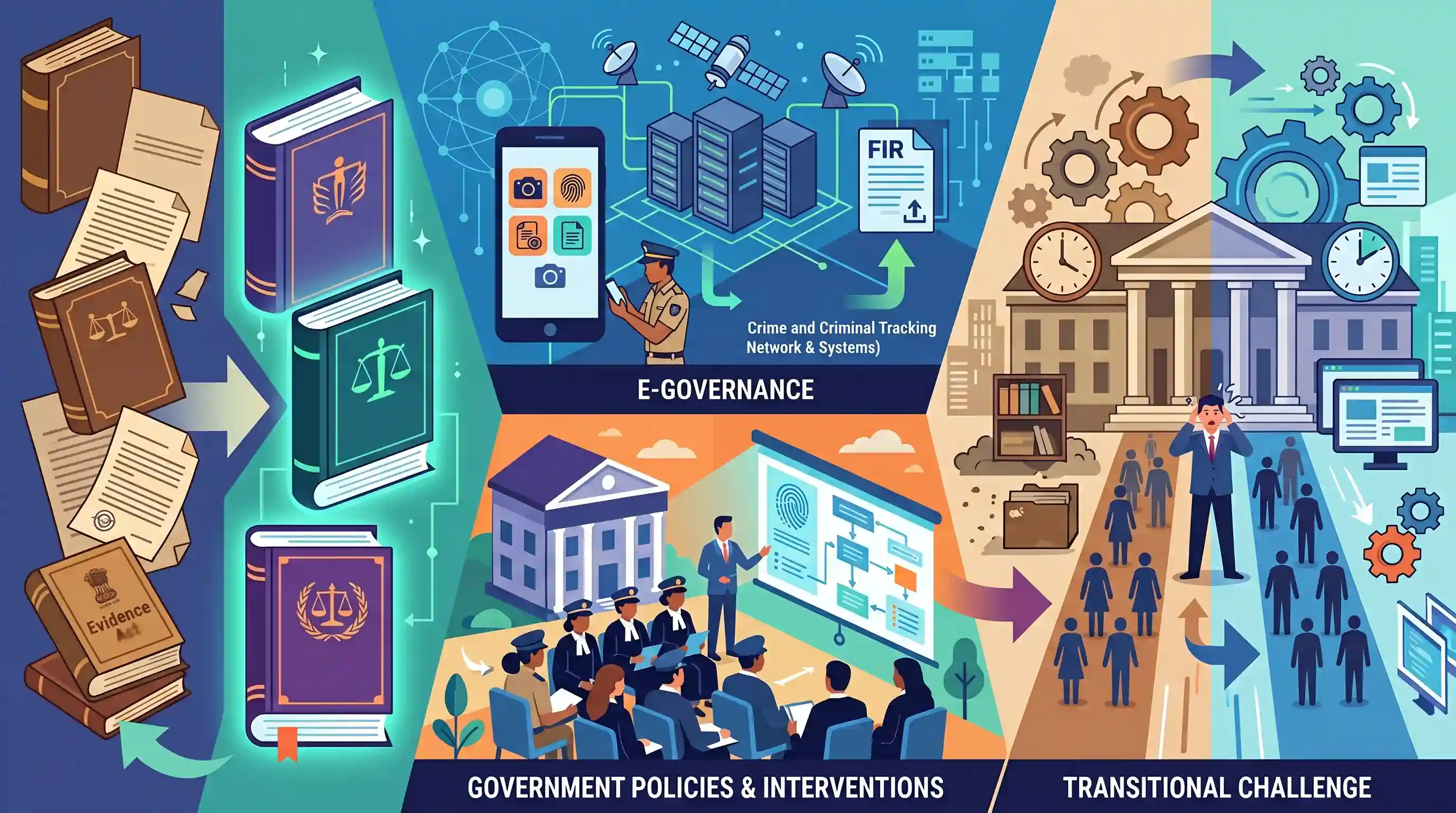
The Government of India is implementing a sweeping overhaul of the criminal justice system with the enforcement of three new criminal laws: BNS, BNSS, and BSA, replacing the IPC, CrPC, and Evidence Act. To support this transition, technological upgrades like the modernization of the CCTNS and the launch of the e-Sakshya app have been deployed to ensure seamless digital evidence collection and FIR registration. Despite extensive training modules developed by the BPR&D for police and judicial officers, the parallel running of old and new legal regimes for past and future crimes presents a significant transitional challenge for the policing and judicial infrastructure.
Key Points
- The Bharatiya Nyaya Sanhita, Bharatiya Nagarik Suraksha Sanhita, and Bharatiya Sakshya Adhiniyam replace the colonial-era IPC, CrPC, and Indian Evidence Act.
- The NCRB has upgraded the Crime and Criminal Tracking Network and Systems (CCTNS) to handle the parallel implementation of both old and new legal frameworks.
- The NIC launched the e-Sakshya application to facilitate mandatory videography and photography of crime scenes and digital evidence transmission.
- Law enforcement will face a transitional challenge, operating dual systems as offenses committed prior to the rollout date will still be governed by the legacy IPC/CrPC.
- Massive capacity-building exercises are underway, spearheaded by the BPR&D, to train police personnel, prosecutors, and judicial officers on the new criminal procedures, including e-FIRs and zero FIRs.
Important Terms
Bharatiya Nyaya Sanhita (BNS)

The primary substantive criminal code replacing the Indian Penal Code (IPC). It defines offenses and punishments, introducing new categories like terrorism and organized crime while replacing sedition with provisions targeting acts endangering national sovereignty.
UPSC context
GS II (Governance) and GS III (Security). Tests awareness of legislative overhauls and substantive legal reforms in India’s justice system.
Bharatiya Nagarik Suraksha Sanhita (BNSS)
The procedural law replacing the Code of Criminal Procedure (CrPC). It establishes the framework for investigation, arrest, and trial, mandating forensic evidence collection for serious offenses and introducing time-bound judicial processes.
UPSC context
GS II (Governance). Critical for questions on judicial efficiency, police accountability, and procedural changes in the legal system.
Bharatiya Sakshya Adhiniyam (BSA)
The legislation replacing the Indian Evidence Act, 1872. It modernizes evidence law by treating electronic records as primary evidence and expanding secondary evidence to include oral/written admissions and expert testimony.
UPSC context
GS II (Judiciary) and GS III (Cyber Security). Evaluates understanding of how the law adapts to the digital age.
e-Sakshya
A mobile application developed by the NIC for law enforcement to record and upload digital evidence from crime scenes. It ensures evidence integrity through automated geo-tagging, time-stamping, and secure cloud storage.
UPSC context
GS II (E-governance) and GS III (Security). Relevant for technological interventions in policing and ensuring a transparent chain of custody.
Crime and Criminal Tracking Network and Systems (CCTNS)
A Mission Mode Project under the National e-Governance Plan connecting police stations nationwide. It serves as a centralized database for crime recording and has been upgraded to support the new criminal laws.
UPSC context
GS II (Governance) and GS III (Security). Central to topics on e-governance and digital integration of the criminal justice system.
Bureau of Police Research and Development (BPR&D)
An agency under the Ministry of Home Affairs tasked with modernization and training. It developed the comprehensive training modules and handbooks essential for the transition to the BNS, BNSS, and BSA.
UPSC context
GS II (Statutory/Regulatory Bodies) and GS III (Police Reforms). Important for understanding institutional roles in police modernization and training.
National Crime Records Bureau (NCRB)
The central nodal agency under the Ministry of Home Affairs responsible for collecting and analyzing crime data. It manages the CCTNS and oversees the technological infrastructure for the new criminal law regime.
UPSC context
GS II (Governance) and GS III (Security). Essential for topics on crime statistics and data-driven policing.
Prelims Trap
The new Bharatiya Nyaya Sanhita (BNS) will immediately apply retrospectively to all pending criminal trials to ensure legal uniformity.
Article 20(1) of the Constitution prohibits ex post facto criminal laws. Therefore, offenses committed before the rollout date must still be tried under the legacy IPC/CrPC framework.
Static Concepts Connected
What are the three fundamental protections granted under Article 20 for accused persons?
- Ex post facto law: Prohibits conviction or enhanced penalty under a law not in force at the time the act was committed. This applies strictly to criminal, not civil, laws.
- Double jeopardy: No person shall be prosecuted and punished for the same offence more than once.
- Self-incrimination: No person accused of any offence shall be compelled to be a witness against himself.
What is the Crime and Criminal Tracking Network and Systems (CCTNS)?
- Core objective: A comprehensive, integrated nationwide system for effective policing, aiming to digitally interconnect all police stations across India.
- Nodal agency: It is managed by the National Crime Records Bureau (NCRB) functioning under the Ministry of Home Affairs.
- ICJS linkage: It forms a foundational pillar of the Inter-operable Criminal Justice System (ICJS), seamlessly linking police, courts, prisons, and forensic labs.
Cross-Topic Patterns
Digital Evidence & IT Act Rules
Mandatory videography under BSA links directly to digital evidence admissibility rules and cyber forensics, a frequent UPSC Science & Tech and Polity crossover topic.
Police Reforms & Institutional Capacity
The massive capacity-building mandate for BPR&D underscores structural deficits in state police infrastructure, echoing the long-pending Prakash Singh Supreme Court directives on police modernization.

Expect a multi-statement Prelims question blending Article 20(1) (ex-post facto protections) with the dual-running mechanism of IPC and BNS.
Linked PYQs · 2
Linked PYQs · 2
- 2023PrelimsGS1
With reference to India, consider the following pairs: Action The Act under which it is covered 1. Unauthorized wearing of police or military uniforms : The Official Secrets Act, 1923 2. Knowingly misleading or otherwise interfering with a police officer or military officer when engaged in their duties : The Indian Evidence Act, 1872 3. Celebratory gunfire which can endanger the personal safety of others : The Arms (Amendment) Act, 2019 How many of the above pairs are correctly matched?
- 2020MainsGS3
Discuss different types of cyber crimes and measures required to be taken to fight the menace.
