Wheat Export Policy Revision and Agricultural Price Stabilization
Source:The Hindu ↗
हे का महत्त्वाचे आहे
This policy shift highlights the ongoing structural trade-offs in Indian agriculture between consumer welfare (curbing food inflation via export restrictions) and producer welfare (ensuring remunerative prices via free export channels). It is an excellent case study of government intervention in market mechanisms, buffer stock adequacy, and trade policies managed by agencies like the DGFT and FCI.
सारांश
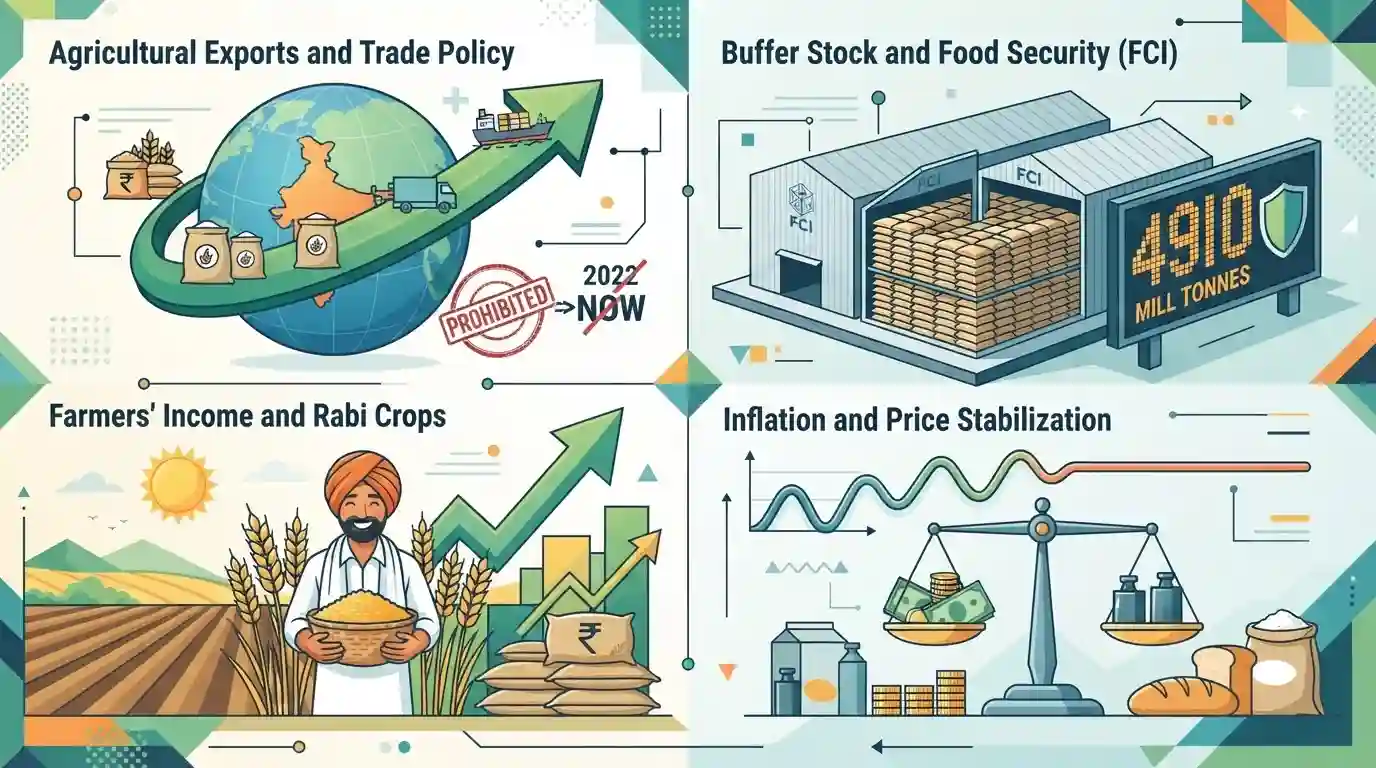
The Government of India has lifted its May 2022 ban on the export of wheat and its derivative products (such as wheat flour, semolina, and maida) with immediate effect. Moving the export policy from 'prohibited' to 'free', the decision is driven by a bumper crop year (with record production of 120.65 million tonnes in 2025-26) and depressed domestic prices that were hurting farmers' realizations. The lifting of the ban is expected to elevate local market prices to benefit farmers and incentivize sowing in the upcoming rabi season. Furthermore, the Food Corporation of India (FCI) holds a robust buffer stock of nearly 49 million tonnes, which ensures domestic food security and price stability despite the trade opening.
मुख्य मुद्दे
- The Indian Government has lifted the export ban on wheat and its products (such as maida, semolina, and wheat flour) with immediate effect, transitioning the export status from 'prohibited' to 'free'.
- The export ban was originally imposed in May 2022 to control domestic food inflation and protect national food security.
- The current policy reversal is aimed at supporting farmers' incomes amid depressed domestic wheat prices and encouraging robust sowing in the upcoming rabi season.
- India's wheat production hit a record high of 120.65 million tonnes in the 2025-26 crop year (July–June), compared to 117.94 million tonnes in the previous year.
- The Food Corporation of India (FCI) holds nearly 49 million tonnes of wheat in its buffer stock, providing a substantial safety net to prevent domestic consumer price shocks despite the opening of exports.
- Domestic retail prices of wheat and wheat flour have remained flat compared to the previous year, averaging Rs 31.46 per kg and Rs 37.3 per kg respectively.
पूर्वपरीक्षा सापळा
The authority to notify changes in export classifications (moving wheat from Prohibited to Free) rests with the Ministry of Agriculture.
Export classifications (Free, Restricted, Prohibited) are formulated and notified by the Directorate General of Foreign Trade (DGFT) under the Ministry of Commerce and Industry, not the Ministry of Agriculture.
संबंधित स्थिर संकल्पना
How are Buffer Stock Norms determined and managed in India?
- Definition: The minimum foodgrain stock (wheat and rice) FCI must maintain to meet PDS requirements and emergencies.
- Fixing Authority: The Cabinet Committee on Economic Affairs (CCEA) fixes these norms quarterly (Jan 1, Apr 1, July 1, Oct 1) to match harvest cycles.
- Components: FCI maintains both an 'Operational Stock' for immediate PDS distribution and a 'Strategic Reserve' for emergency shortfalls.
What are the geographical and climatic requirements for wheat cultivation?
- Temperature: Cool weather during sowing/growth (10°C to 15°C) and bright warm sunshine during ripening (21°C to 26°C).
- Rainfall: Requires moderate rainfall of 50 to 75 cm; light winter showers from Western Disturbances are highly beneficial.
- Soil Type: Well-drained fertile loamy and clayey soils (e.g., Indo-Gangetic plains, black soil tract of Deccan).
आंतर-विषय नमुने
Agri-Export Policy + WTO Rules
India's ad-hoc export bans and sudden policy reversals highlight the tension between protecting domestic consumers and adhering to WTO disciplines on export restrictions and market access.
Western Disturbances + Food Security Buffer
Increasingly volatile Western Disturbances due to climate change directly impact Rabi wheat yields, making domestic buffer stock resilience a primary tool for climate adaptation.

Expect a multi-statement question linking DGFT export classifications, quarterly FCI buffer norms, and the geography of Rabi crops.
संबंधित PYQ · 2
संबंधित PYQ · 2
- 2024MainsGS3
Elucidate the importance of buffer stocks for stabilizing agricultural prices in India. What are the challenges associated with the storage of buffer stock? Discuss.
- 2024MainsGS3
What are the causes of persistent high food inflation in India? Comment on the effectiveness of the monetary policy of the RBI to control this type of inflation.
