Great Nicobar Project: Ecological and Tribal Concerns
Source:Indian Express ↗
Why It Matters
The Great Nicobar project is a prime case study for UPSC aspirants on the 'Development vs. Environment' debate. It directly touches upon core syllabus themes: Environmental Impact Assessment (EIA), Coastal Regulation Zone (CRZ) rules, Compensatory Afforestation (CAMPA), and the protection of Particularly Vulnerable Tribal Groups (PVTGs) like the Shompen.
Summary
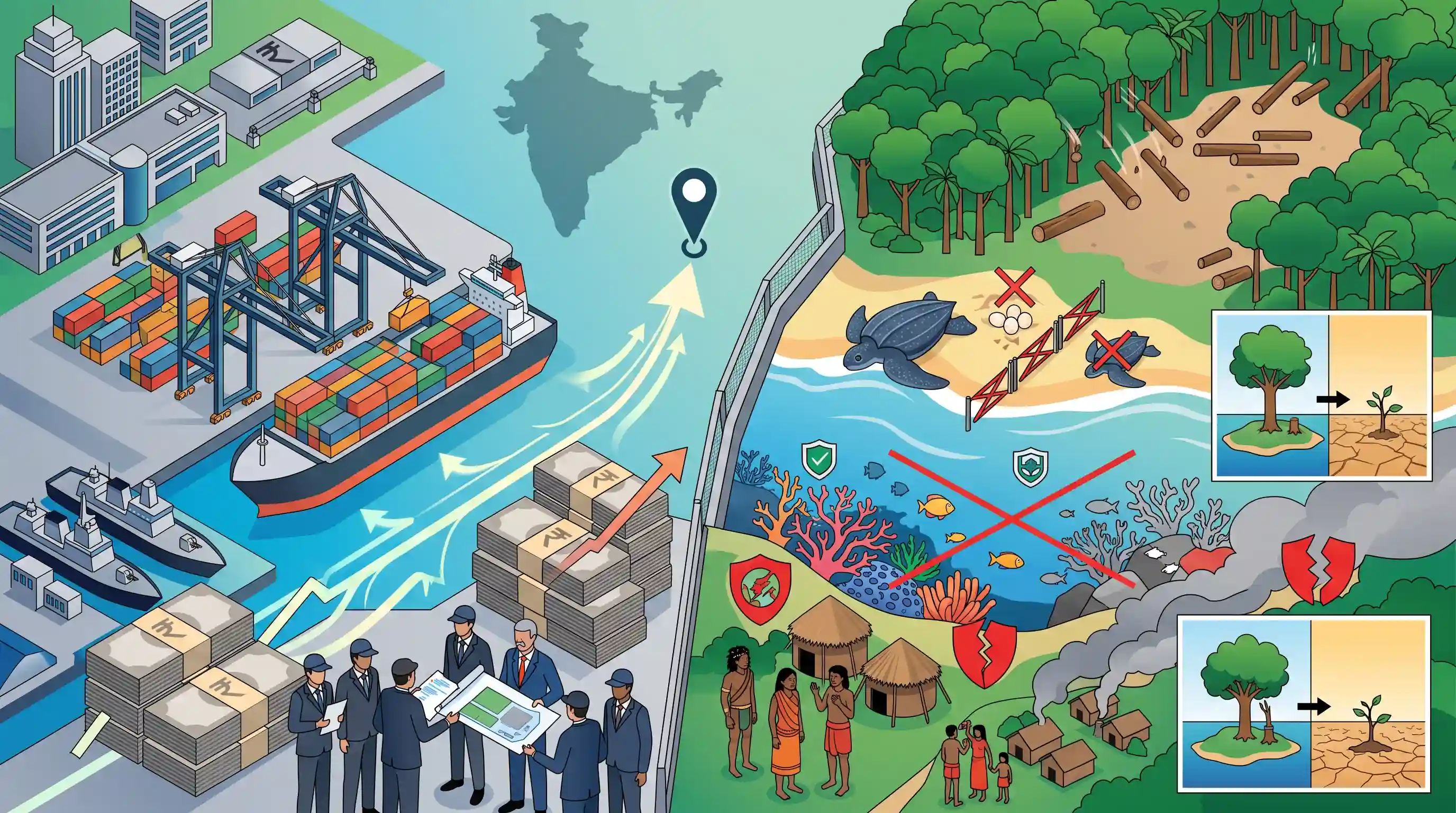
The Union Government is facing strong opposition regarding the ₹72,000 crore Great Nicobar infrastructure project, which aims to build a transshipment port and defense facilities. Critics, notably from the Congress party, argue that the project bypasses crucial environmental and tribal safeguards. Key concerns include the threat to the nesting sites of the Giant Leatherback turtle and rich coral reefs in Galathea Bay (a CRZ-1A area), the felling of nearly a million rainforest trees with mismatched compensatory afforestation in semi-arid Haryana, and the existential threat to the indigenous Shompen (a PVTG) and Nicobarese tribes. The debate highlights the tension between strategic infrastructure development and strict ecological/human rights compliance.
Key Points
- The Centre faces criticism for its ₹72,000 crore Great Nicobar mega infrastructure project, accused of ignoring severe ecological, tribal, and procedural concerns.
- Ecological risks include the destruction of over 20,000 coral colonies and nesting sites of the Giant Leatherback turtle in Galathea Bay, a restricted CRZ-1A zone.
- Forest clearance involves felling up to 9.64 lakh rainforest trees; compensatory afforestation is controversially planned in Haryana's semi-arid Aravallis, an ecological mismatch.
- The project poses survival risks to the Shompen (an uncontacted PVTG) and the Nicobarese tribes, with allegations that consent was either coerced or improperly handled.
- While the government cites strategic, defense, and maritime transshipment (competing with Singapore/Colombo) needs, critics argue the environmental and social costs are unviable.
Important Terms
Environmental Impact Assessment (EIA)

A regulatory process under the Environment Protection Act, 1986, that evaluates the potential environmental, social, and economic impacts of a proposed project before granting clearance.
UPSC context
GS-III: Environmental impact assessment; critical for understanding the balance between infrastructure development and ecological conservation.
Coastal Regulation Zone (CRZ)
Coastal stretches where the government regulates activities to protect marine ecosystems. It classifies areas from CRZ-I (highly sensitive) to CRZ-IV (water bodies) under the Environment Protection Act.
UPSC context
GS-III: Conservation and environment; tests knowledge of coastal management and legal safeguards for ecologically sensitive zones.
Particularly Vulnerable Tribal Groups (PVTG)
A sub-category of Scheduled Tribes identified as most vulnerable based on criteria like declining population, pre-agricultural technology, and extremely low literacy levels.
UPSC context
GS-I/GS-II: Social justice and tribal welfare; essential for questions regarding indigenous rights and government safeguards.
Compensatory Afforestation Fund (CAMPA)
A statutory authority established under the 2016 Act to manage funds collected from project proponents to compensate for the diversion of forest land for non-forest purposes.
UPSC context
GS-III: Environment and forest conservation; relevant for examining the implementation of afforestation and net present value (NPV) policies.
Shompen
An uncontacted or minimally contacted PVTG inhabiting the tropical rainforests of Great Nicobar; they are semi-nomadic hunter-gatherers with Mongoloid traits.
UPSC context
GS-I: Geography and Society; specific focus on the protection of indigenous tribes from developmental displacement.
Galathea Bay
A crucial ecological site in Great Nicobar, serving as a major nesting ground for Giant Leatherback turtles and designated as a CRZ-IA area.
UPSC context
GS-III: Biodiversity and Biosphere Reserves; tests specific knowledge of Indian geography and environmental hotspots under threat.
Prelims Trap
"Compensatory afforestation under CAMPA must strictly be undertaken within the same state and ecological zone."
CAMPA rules actually permit afforestation in other states if non-forest land is unavailable in the home UT, legally allowing this exact tropical-to-semi-arid ecological mismatch.
Static Concepts Connected
Who are the PVTGs of the Andaman and Nicobar Islands and what are their ethnic origins?
- Negrito Tribes: Great Andamanese, Jarawas, Onges, and Sentinelese belong to the Negrito race and inhabit the Andaman Islands.
- Mongoloid Tribes: The Shompen belong to the Mongoloid race and reside in Great Nicobar. Note: The Nicobarese are Scheduled Tribes but NOT classified as PVTGs.
What distinguishes CRZ-IA areas under the Coastal Regulation Zone Notification?
- Ecological Sensitivity: CRZ-IA covers the most highly ecologically sensitive coastal areas, including mangroves, coral reefs, and critical turtle nesting grounds like Galathea Bay.
- Construction Prohibition: It generally prohibits new construction, though recent amendments have allowed mechanisms to exempt strategic, defense, and vital public utility projects.
Cross-Topic Patterns
EIA bypasses for strategic infra
The denotification of Galathea Bay highlights a growing trend of granting EIA and CRZ exemptions for strategic mega-projects, mirroring recent ecological controversies over border road expansions in the Himalayas.
Transshipment hubs and maritime security
Great Nicobar's container terminal links to India's push to reduce reliance on Colombo port, aiming to secure maritime supply chains near the critical Malacca Strait choke point.

Expect a 2026 multi-statement question mapping Shompen/Nicobarese ethnicity, Galathea Bay turtle nesting, and interstate CAMPA loopholes.
Linked PYQs · 5
Linked PYQs · 5
- 2009PrelimsGS1
In which one of the following places is the Shompen tribe found?
- 2019PrelimsGS1
Consider the following statements about Particularly Vulnerable Tribal Groups (PVTGs) in India : 1. PVTGs reside in 18 States and one Union Territory. 2. A stagnant or declining population is one of the criteria for determining PVTG status. 3. There are 95 PVTGS officially notified in the country so far. 4. Irular and Konda Reddi tribes are included in the list of PVTGs. Which of the statements given above are correct?
- 2022PrelimsGS1
"Biorock technology" is talked about in which one of the following situations?
- 2014MainsGS3
Environmental Impact Assessment studies are increasingly undertaken before a project is cleared by the Government. Discuss the environmental impacts of coal-fired thermal plants located at coal pitheads.
- 2024MainsGS3
What role do environmental NGOs and activists play in influencing Environmental Impact Assessment (EIA) outcomes for major projects in India? Cite four examples with all important details.
