Bihar Stubble Burning Penalties and Control Measures
Source:patnapress ↗
Why It Matters
Important for BPSC aspirants tracking state-specific environmental policies, agricultural challenges, and administrative steps taken to combat air pollution in Bihar.
Summary
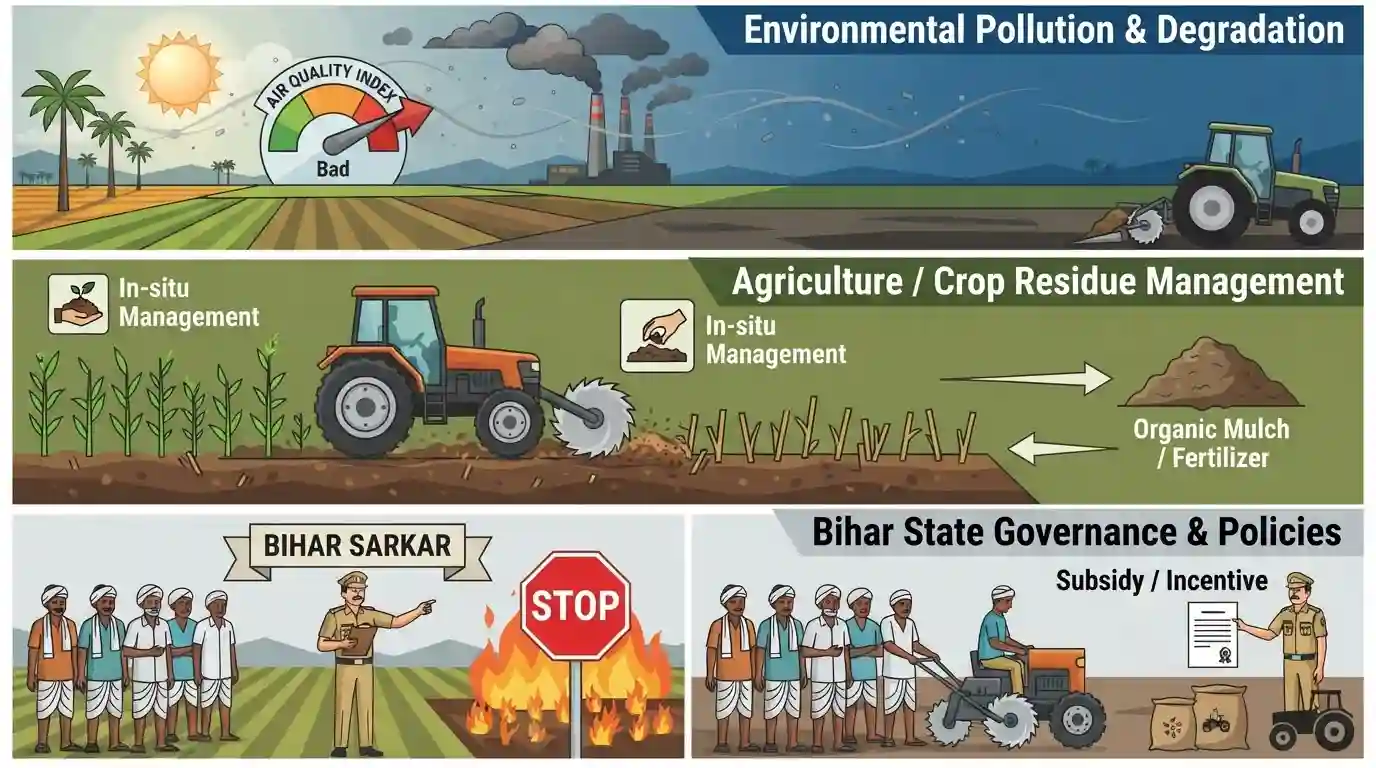
The Government in Bihar has introduced stringent measures against stubble burning to mitigate environmental pollution, enforce sustainable agriculture practices, and penalize non-compliant farmers.
Key Points
- The Bihar government has implemented stricter measures and punitive actions to curb stubble burning across the state.
- Stubble burning is a major contributor to regional air pollution, deteriorating air quality index (AQI) levels during the post-harvest season.
- Authorities are promoting alternative crop residue management techniques and penalizing violators to enforce environmental norms.
Important Terms
Bihar Government

The executive branch of the state government in Bihar, responsible for formulating policies, administering laws, and implementing environmental and agricultural measures such as crackdowns on stubble burning.
UPSC context
Relevant for BPSC General Studies Paper II (State Governance and Policy implementation). Tests knowledge of state-level administrative actions.
Stubble Burning
The practice of intentionally setting fire to crop residue, such as paddy or wheat straw, left in fields after harvest, leading to severe air pollution and soil degradation.
UPSC context
Important for BPSC GS Paper II (Environment, Pollution and Sustainable Development). Evaluates understanding of contemporary environmental challenges in India and Bihar.
Crop Residue Management
The systematic approach of handling agricultural waste through in-situ incorporation, ex-situ utilization, machinery subsidies, and composting rather than open burning to preserve soil fertility and air quality.
UPSC context
Essential for BPSC General Studies Paper II (Agriculture, Rural Economy, and Environmental Sustainability). Tests awareness of sustainable farming solutions.
Stubble Burning Penalties in Bihar
A government initiative in Bihar involving punitive actions—such as suspending Direct Benefit Transfer (DBT) registrations and blocking subsidies—against farmers violating bans on crop residue burning.
UPSC context
High relevance for BPSC Current Affairs and State Governance. Tests awareness of specific administrative deterrents used by the Bihar administration.
Prelims Trap
Central government uniform laws directly penalize farmers for stubble burning across every state without state-level executive orders.
Aspirants often assume stubble burning bans and penal actions apply uniformly across all states via central legislation, whereas enforcement, fines, and machinery subsidies are executed at the state government level.
Static Concepts Connected
What are the primary in-situ and ex-situ methods of crop residue management recommended in India?
- In-situ CRM:: Super Seeder, Happy Seeder, and Straw Management System (SMS) mix stubble directly into the soil.
- Ex-situ CRM:: Baling machines and rake collectors bundle straw for biomass power plants, industrial boilers, or packaging.
- Microbial Spray:: PUSA Decomposer accelerates the biological decomposition of crop residue into organic manure rapidly.
Cross-Topic Patterns
Bihar Air Pollution + Agricultural Subsidies
Stubble burning management in Bihar links environmental air pollution control under the National Clean Air Programme with sustainable agricultural mechanization schemes like CRM.
Punitive Enforcement vs Incentive Schemes
The transition from punitive administrative fines to incentive-based in-situ crop residue management reflects a broader shift in Indian agri-environmental governance.

Bihar stubble burning fines + CRM machinery subsidies likely to appear in BPSC Prelims as a multi-statement governance question.
Linked PYQs · 2
Linked PYQs · 2
- 2023BPSC_PRELIMSGS1
Bihar Government has planned to make Bihar State ‘pollution-free’ by reducing carbon emissions by which year?
- 2024-EBPSC_PRELIMSGS1
Which of the following is a major cause of air pollution?
