Kharif MSP Hiked by Government for 2026 Season
Source:The Hindu ↗
Why It Matters
MSP declarations are a recurring and critical aspect of India's agricultural policy, directly impacting food security, inflation, farmer incomes, and crop diversification. For UPSC, understanding the MSP calculation methodology (A2+FL vs. C2), the crops covered, the CCEA's role, and the socio-economic implications of these policies is fundamental for GS3 (Agriculture and Economy).
Summary
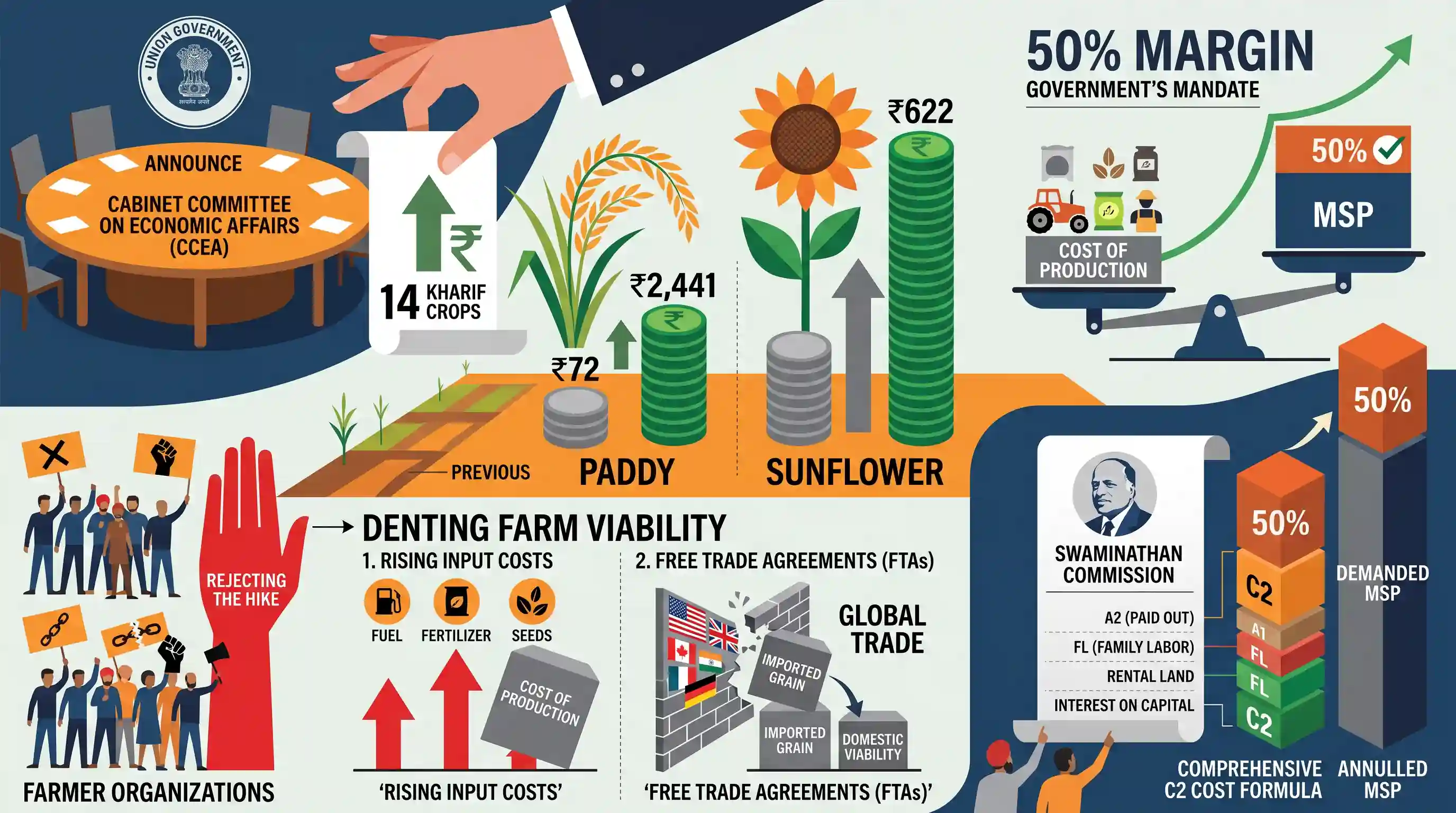
The Union Government, through the Cabinet Committee on Economic Affairs (CCEA), has announced the Minimum Support Price (MSP) for 14 Kharif crops for the upcoming season, increasing the paddy MSP by ₹72 to ₹2,441 per quintal and the sunflower seed MSP by ₹622 per quintal. The government asserts that the revised prices align with its mandate to provide at least a 50% margin over the estimated cost of production. However, farmer organizations have rejected the hike as insufficient, pointing out that rising input costs and the impact of Free Trade Agreements (FTAs) severely dent farm viability. They continue to demand MSP calculations based on the comprehensive 'C2' cost formula recommended by the Swaminathan Commission.
Key Points
- The Cabinet Committee on Economic Affairs (CCEA) approved Minimum Support Price (MSP) hikes for 14 Kharif season crops for the 2026-27 season.
- Paddy MSP was increased by ₹72 to ₹2,441 per quintal, while sunflower seed saw the highest absolute increase of ₹622 per quintal.
- The government maintained that the new rates guarantee a return of at least 50% over the all-India weighted average cost of production, with the highest margins projected for bajra, tur, and urad.
- Farmer unions criticized the MSP hikes as inadequate, arguing they do not offset the soaring input costs for seeds, fertilizers, pesticides, and diesel.
- Farmers reiterated demands for a legal guarantee of MSP calculated using the Swaminathan Commission's comprehensive C2+50% formula, alongside concerns over the adverse impacts of FTAs on domestic agriculture.
Important Terms
Minimum Support Price (MSP)

A guaranteed price floor at which the government purchases agricultural produce from farmers, aimed at protecting them from market volatility and ensuring food security.
UPSC context
GS Paper III (Agriculture); essential for questions on farm subsidies, procurement, and agricultural price policy.
Commission for Agricultural Costs and Prices (CACP)
An attached office of the Ministry of Agriculture that evaluates production costs and market trends to recommend MSP for 23 mandated crops annually.
UPSC context
GS Paper III (Agriculture); tests understanding of institutional mechanisms in India's agricultural economy.
Cabinet Committee on Economic Affairs (CCEA)
The apex decision-making body chaired by the Prime Minister that grants final approval for MSP revisions and critical economic policies.
UPSC context
GS Paper II (Governance); important for understanding the executive's role in economic administration.
Swaminathan Commission Recommendations
Proposals by the National Commission on Farmers (2004) advising that MSP be set at 1.5 times the comprehensive 'C2' cost of production.
UPSC context
GS Paper III (Major Crops); critical for evaluating farm distress and the 'C2+50%' demand.
C2 Cost Formula
A comprehensive cost formula including paid-out expenses, family labor, and the imputed rental value of owned land plus interest on fixed capital.
UPSC context
GS Paper III (Agriculture); relevant for technical discussions on agricultural pricing and cost-benefit analysis.
Kharif Crops
Monsoon-season crops sown in June-July and harvested in September-October, heavily dependent on southwest monsoon rainfall (e.g., Paddy, Maize, Cotton).
UPSC context
GS Paper I (Geography) and III (Agriculture); foundational for cropping patterns and food security topics.
Prelims Trap
"The Commission for Agricultural Costs and Prices (CACP) approves and announces the MSP."
The CACP only recommends the MSP. The final approval and formal announcement are made by the Cabinet Committee on Economic Affairs (CCEA), chaired by the Prime Minister.
Static Concepts Connected
What is the difference between A2+FL and C2 cost in MSP calculation?
- A2+FL Cost: Includes actual paid-out costs (seeds, fertilizers, hired labour) plus the imputed value of unpaid family labour. This is the baseline currently used by the government.
- C2 Cost: A comprehensive cost that includes A2+FL plus the imputed rental value of owned land and interest on fixed capital. This was recommended by the Swaminathan Commission.
Which crops are officially mandated for MSP recommendations by CACP?
- Total Mandated Crops: The CACP recommends Minimum Support Prices for exactly 22 mandated crops, plus a separate Fair and Remunerative Price (FRP) for sugarcane.
- Crop Breakdown: The 22 crops consist of 14 Kharif crops, 6 Rabi crops, and 2 commercial crops (jute and copra).
Cross-Topic Patterns
MSP and WTO's Amber Box
India's MSP regime frequently faces scrutiny at the WTO for breaching the 10% de minimis limit on domestic support, directly linking local agrarian pricing to Amber Box subsidies and the Peace Clause.
FTAs vs. Domestic Price Support
Lowering import duties under FTAs exposes farmers to cheaper, heavily subsidized global imports, which can depress domestic market prices and neutralize the protective intent of the MSP framework.

Expect a paired-statement question in Prelims 2026 comparing A2+FL vs C2 cost formulas alongside CCEA's exact role in MSP.
Linked PYQs · 5
Linked PYQs · 5
- 2020PrelimsGS1
Consider the following statements: 1. In the case of all cereals, pulses and oil-seeds, the procurement at Minimum Support Price (MSP) is unlimited in any State/UT of India. 2. In the case of cereals and pulses, the MSP is fixed in any State/UT at a level to which the market price will never rise. Which of the statements given above is/are correct?
- 2023PrelimsGS1
Consider the following statements: 1. The Government of India provides Minimum Support Price for niger (Guizotia abyssinica) seeds. 2. Niger is cultivated as a Kharif crop. 3. Some tribal people in India use niger seed oil for cooking. How many of the above statements are correct?
- 2018PrelimsGS1
Consider the following: 1. Areca nut 2. Barley 3. Coffee 4. Finger millet 5. Groundnut 6. Sesamum 7. Turmeric The Cabinet Committee on Economic Affairs has announced the Minimum Support Price for which of the above?
- 2019PrelimsGS1
The economic cost of food grains to the Food Corporation of India is Minimum Support Price and bonus (if any) paid to the farmers plus
- 2017MainsGS3
How do subsidies affect the cropping pattern, crop diversity and economy of farmers? What is the significance of crop insurance, minimum support price and food processing for small and marginal farmers?
