Centre increases onion procurement rate for buffer stock creation
Source:The Hindu ↗
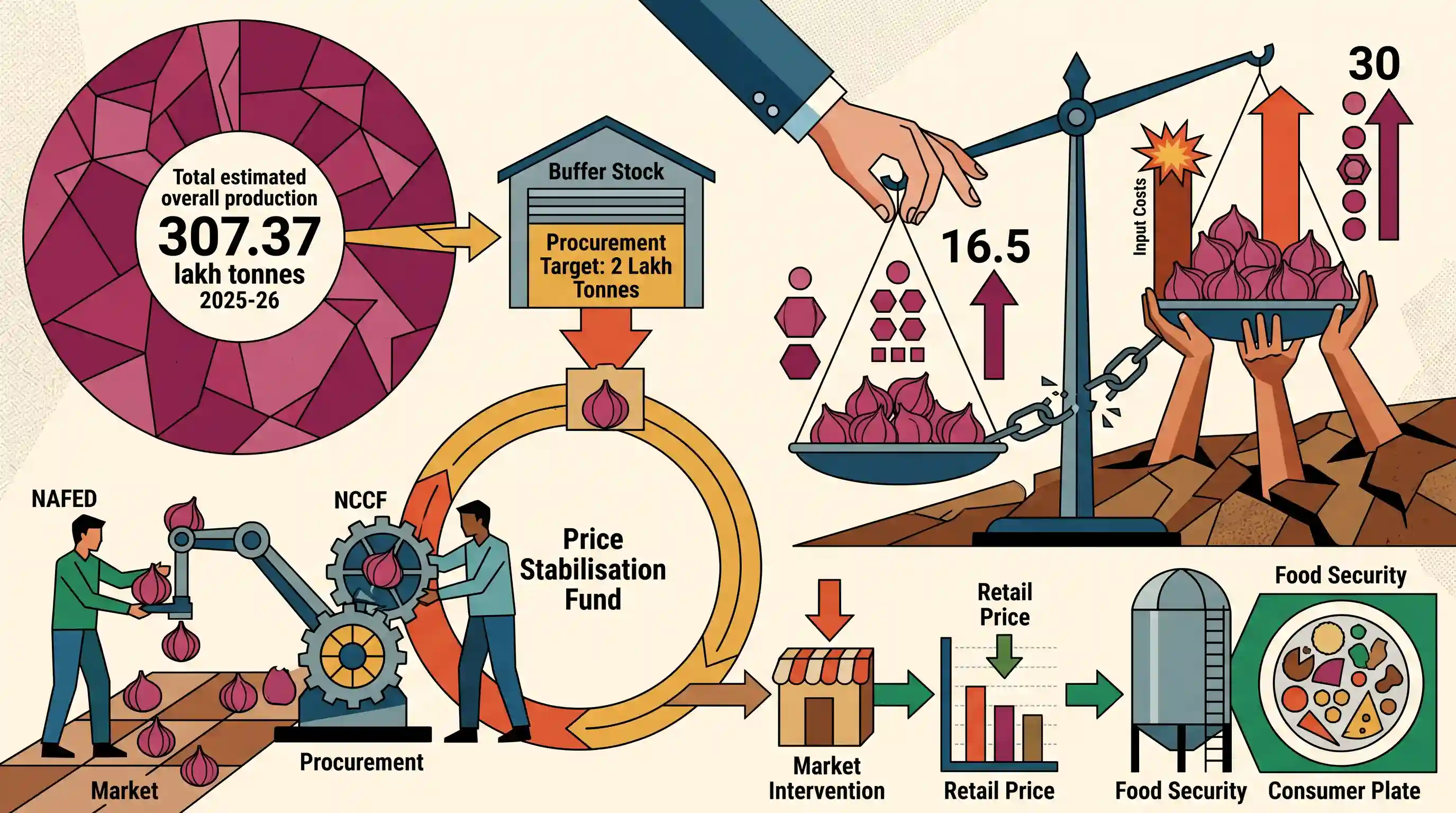
Why It Matters
It illustrates the practical implementation of agricultural buffer stocks and market intervention strategies via the Price Stabilisation Fund. Understanding the roles of NAFED and NCCF, alongside the ongoing debate over fair procurement pricing relative to input costs, is crucial for GS3 topics on agricultural marketing and farmers' welfare.
Summary
The Indian government has hiked the onion procurement rate to ₹16.5 per kg to bolster farmers' income, with procurement led by NAFED and NCCF. This buffer stock is maintained under the Price Stabilisation Fund (PSF) for timely market intervention. However, farmers in Maharashtra, the top onion-producing State, are demanding ₹30 per kg to offset rising input costs. The procurement target has been set at 2 lakh tonnes against an estimated overall production of 307.37 lakh tonnes for 2025-26.
Key Points
- The Centre has increased the onion procurement rate from ₹15.80 to ₹16.50 per kg effective June 13 to support farmers.
- Despite the hike, farmers in Maharashtra (the largest onion-producing State) are demanding a higher rate of ₹30 per kg to cover high input costs.
- The government builds an annual buffer stock of onions under the Price Stabilisation Fund (PSF) for strategic market intervention.
- The procurement target for the year is set at 2 lakh tonnes, down from 3 lakh tonnes in 2025-26.
- Procurement is currently being carried out by nodal agencies such as NAFED and NCCF.
- Overall onion output is estimated at 307.37 lakh tonnes for the year 2025-26.
Important Terms
Price Stabilisation Fund (PSF)

A central sector fund created to mitigate extreme price volatility in agri-horticultural commodities like onions, potatoes, and pulses through market intervention and procurement.
UPSC context
GS Paper 3: Agriculture/Inflation. Essential for understanding government mechanisms to control food inflation and protect consumer interests.
NAFED
The apex body of marketing cooperatives in India, established in 1958 to promote cooperative trade and implement price support for agricultural produce.
UPSC context
GS Paper 3: Procurement/Subsidies. Tests knowledge of institutional frameworks for agricultural marketing and the role of cooperatives.
NCCF
The national-level federation of consumer cooperatives, established in 1965, responsible for distributing essential commodities to consumers at reasonable prices during shortages.
UPSC context
GS Paper 3: Food Security. Relevant for questions on price monitoring and the distribution aspect of the food supply chain.
Buffer Stock
A strategic reserve of essential commodities maintained by the government to stabilize prices, ensure food security, and discourage hoarding during lean production periods.
UPSC context
GS Paper 3: Food Security. A core concept in public distribution and supply chain management topics.
Market Intervention Scheme (MIS)
A price support mechanism for horticultural and perishable crops (like onions) that are not covered under the formal Minimum Support Price (MSP) regime.
UPSC context
GS Paper 3: Agriculture. Tests the distinction between MSP for staples and intervention prices for perishable commodities.
Department of Consumer Affairs
Nodal department under the Ministry of Consumer Affairs responsible for price monitoring, the Price Stabilisation Fund, and consumer protection policies.
UPSC context
GS Paper 2: Governance. Important for understanding the executive's role in managing internal trade and essential commodity availability.
Prelims Trap
"The Centre has hiked the Minimum Support Price (MSP) for onions to Rs 16.5 per kg."
Onions are NOT covered under the 23 mandated MSP crops. They are procured via the Price Stabilisation Fund (PSF) and Market Intervention Scheme (MIS) under the Ministry of Consumer Affairs.
Static Concepts Connected
How does the Price Stabilisation Fund (PSF) function?
- Objective: Established in 2014-15 to absorb extreme price volatility of selected essential commodities, particularly onions, potatoes, and pulses.
- Nodal Ministry: Administered by the Ministry of Consumer Affairs, Food & Public Distribution. It was crucially shifted away from the Agriculture Ministry in 2016.
- Operational Mechanism: Provides working capital to central agencies like NAFED and NCCF to procure directly from farmers or mandis, building strategic buffer stocks to calm retail markets.
What distinguishes the Market Intervention Scheme (MIS) from MSP?
- Commodity Coverage: MIS covers perishable agricultural and horticultural commodities (like onions, apples, and garlic) that are specifically excluded from the standard 23-crop MSP regime.
- Trigger Conditions: Activated conditionally upon a State's request only if there is at least a 10% drop in prevailing market prices compared to the previous normal year.
- Loss Sharing: Operational losses incurred during procurement are shared equally (50:50) between the Centre and the requesting State government (75:25 for Northeastern states).
Cross-Topic Patterns
Food Inflation vs Monetary Policy
Onion price spikes frequently drive headline CPI inflation. The RBI often highlights that monetary policy cannot resolve these supply-side shocks, making PSF interventions crucial for macroeconomic stability.
Cooperatives in Agricultural Supply Chains
NAFED and NCCF serve as critical procurement nodes. This connects to the Ministry of Cooperation's broader push to integrate Primary Agricultural Credit Societies (PACS) into national storage and procurement networks.

A 2026 Prelims question will likely contrast MSP (Agriculture Ministry) with PSF/MIS (Consumer Affairs) using perishable crops as bait.
Linked PYQs · 4
Linked PYQs · 4
- 2024MainsGS3
Elucidate the importance of buffer stocks for stabilizing agricultural prices in India. What are the challenges associated with the storage of buffer stock? Discuss.
- 2018MainsGS3
What do you mean by Minimum Support Price (MSP)? How will MSP rescue the farmers from the low income trap?
- 2023PrelimsGS1
Consider the following statements: 1. The Government of India provides Minimum Support Price for niger (Guizotia abyssinica) seeds. 2. Niger is cultivated as a Kharif crop. 3. Some tribal people in India use niger seed oil for cooking. How many of the above statements are correct?
- 2025MainsGS3
Elaborate the scope and significance of supply chain management of agricultural commodities in India.
