Export duty hikes on diesel and jet fuel amid West Asia conflict
Source:Indian Express ↗
Why It Matters
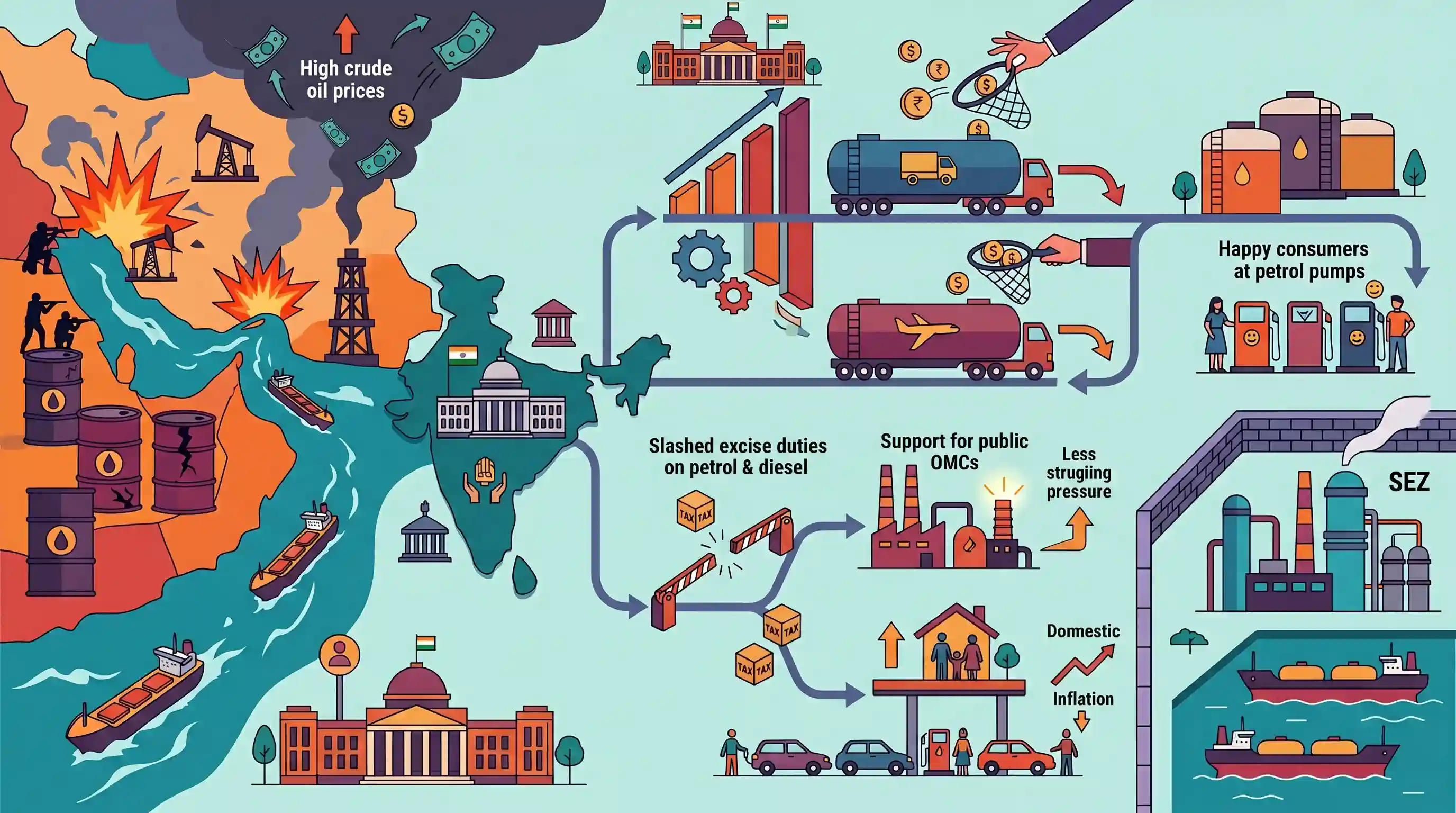
It illustrates the complex interplay between global geopolitics (West Asia conflict) and domestic economic management. It highlights the government's use of fiscal tools (windfall taxes, export duties, and excise cuts) to balance energy security, inflation control, and the financial health of OMCs against the profit motives of private refiners.
Summary
In response to skyrocketing global crude prices caused by the conflict in West Asia and potential disruptions in the Strait of Hormuz, the Indian government has raised export duties on diesel and aviation turbine fuel (ATF). The move aims to curb exports by private refiners profiting from high international margins and to ensure adequate fuel availability in the domestic market. Concurrently, the government slashed excise duties on petrol and diesel to alleviate the heavy under-recoveries faced by public Oil Marketing Companies (OMCs), which have kept retail prices frozen to manage domestic inflation. However, refineries located in Special Economic Zones (SEZs) remain exempt from these export levies due to specific legal protections.
Key Points
- The government significantly increased export duties on diesel and aviation turbine fuel (ATF) to secure domestic supplies amidst surging global prices.
- Global crude and refined product prices have spiked due to the conflict in West Asia, threatening supply chains through the critical Strait of Hormuz chokepoint.
- Oil Marketing Companies (OMCs) are experiencing high under-recoveries because they have not passed on the increased international crude costs to domestic consumers, aiding inflation management.
- To provide relief to OMCs, the government simultaneously slashed excise duties on domestic petrol and diesel sales.
- Exports originating from Special Economic Zones (SEZs), such as RIL's Jamnagar refinery, are exempt from these new export levies due to judicial rulings.
Important Terms
Oil Marketing Companies (OMCs)

Entities engaged in refining, distributing, and retailing petroleum products. Major public sector OMCs include IOCL, BPCL, and HPCL, which are pivotal in maintaining India's energy supply chain and managing retail fuel prices.
UPSC context
GS Paper III: Energy Security and Infrastructure. Tests understanding of the downstream oil sector and government control over fuel pricing.
Under-recoveries
The revenue shortfall faced by OMCs when regulated retail selling prices are lower than the actual cost of production, procurement, and taxes, often occurring during global crude price spikes.
UPSC context
GS Paper III: Indian Economy and Fiscal Policy. Crucial for understanding subsidies, fiscal deficits, and the financial health of public sector undertakings.
Special Economic Zones (SEZs)
Specially delineated duty-free enclaves treated as foreign territories for trade purposes. Refineries located here, such as Reliance's Jamnagar unit, often enjoy exemptions from certain domestic taxes and export levies.
UPSC context
GS Paper III: Indian Economy (Trade Policy). Tests knowledge of export promotion, tax incentives, and legal frameworks like the SEZ Act, 2005.
Export Duty
A levy on goods sent outside the country. In the oil sector, it is often applied as a 'windfall tax' to capture excessive profits made by refiners during global price surges.
UPSC context
GS Paper III: Mobilization of Resources and Taxation. Tests understanding of fiscal tools used to manage domestic supply and inflation.
Reliance Industries Ltd (RIL)
India’s largest private refiner operating the world's largest refining complex in Jamnagar. It is a major exporter of refined products and significantly benefits from SEZ tax protections and global margin fluctuations.
UPSC context
GS Paper III: Indian Economy. Representative of the role of private players in energy exports and their interaction with government fiscal policy.
Nayara Energy
A major private Indian refiner, majority-owned by Russian entities (including Rosneft). It plays a key role in processing crude and exporting fuels, often coming under scrutiny during geopolitical supply disruptions.
UPSC context
GS Paper II & III: International Relations and Energy. Tests knowledge of foreign investment in strategic sectors and geopolitical impacts on trade.
Special Additional Excise Duty (SAED)
An additional tax levied on certain goods, such as diesel, to regulate consumption or manage prices. It is frequently adjusted alongside windfall taxes to align domestic and international fuel rates.
UPSC context
GS Paper III: Fiscal Policy. Tests understanding of specific indirect tax instruments and their role in the government's revenue strategy.
Prelims Trap
Export duties and windfall taxes apply uniformly to all refineries located within Indian territory to ensure domestic fuel supply.
Refineries located in Special Economic Zones (SEZs) are treated as foreign territories for trade purposes under the SEZ Act, 2005, making them exempt from domestic export levies.
Static Concepts Connected
What is a Windfall Tax and how does it function?
- Definition: A higher tax rate levied on sudden, unexpectedly large profits (super-normal profits) caused by external geopolitical events rather than active corporate investment.
- Mechanism: In India, it is often structured as a Special Additional Excise Duty (SAED) targeting crude oil producers and exporters of refined fuels.
- Objective: It aims to redistribute unexpected gains to the exchequer and disincentivize the excessive export of critical commodities, ensuring adequate domestic supply.
How do Special Economic Zones (SEZs) operate regarding domestic taxation?
- Foreign Territory Status: Under the SEZ Act, 2005, these are specifically demarcated enclaves treated as foreign territory for the purposes of trade operations, duties, and tariffs.
- Export Duty Exemption: SEZ units enjoy zero-rating on exports and are generally exempt from domestic export duties, shielding them from sudden fiscal levies meant for the domestic tariff area.
Cross-Topic Patterns
Maritime chokepoints & imported inflation
West Asian instability disrupting the Strait of Hormuz directly impacts India's Current Account Deficit (CAD) and domestic inflation, showcasing how geographical maritime chokepoints dictate RBI and fiscal policy maneuvers.
OMC under-recoveries vs private windfall gains
Highlights a dual energy economy: public OMCs absorb 'under-recoveries' to check inflation, while private refiners reap windfall export margins, necessitating asymmetric taxation like SAED to balance domestic supply.

Expect a multi-statement Prelims question interlinking the SEZ Act's 'foreign territory' clause with the application of Windfall Taxes.
Linked PYQs · 4
Linked PYQs · 4
- 2025MainsGS2
"Energy security constitutes the dominant kingpin of India's foreign policy, and is linked with India's overarching influence in Middle Eastern countries.” How would you integrate energy security with India's foreign policy trajectories in the coming years?
- 2017MainsGS2
The question of India's Energy Security constitutes the most important part of India's economic progress. Analyze India's energy policy cooperation with West Asian countries.
- 2015MainsGS3
There is a clear acknowledgement that Special Economic Zones (SEZs) are a tool of industrial development, manufacturing and exports. Recognizing this potential, the whole instrumentality of SEZs requires augmentation. Discuss the issues plaguing the success of SEZs with respect to taxation, governing laws and administration.
- 2024PrelimsGS1
Consider the following statements : Statement-I : Sumed pipeline is a strategic route for Persian Gulf oil and natural gas shipments to Europe. Statement-II : Sumed pipeline connects the Red Sea with the Mediterranean Sea. Which one of the following is correct in respect of the above statements?
