Agrarian Distress and Challenges in Minimum Support Price Procurement
Source:The Hindu ↗
Why It Matters
This issue perfectly illustrates the multi-dimensional challenges in Indian agriculture for UPSC aspirants. It highlights the vulnerability of domestic farmers to international trade policies (like import duty cuts) and demonstrates how administrative bottlenecks (e-crop registration delays) and procurement failures undermine the safety net of the Minimum Support Price (MSP).
Summary
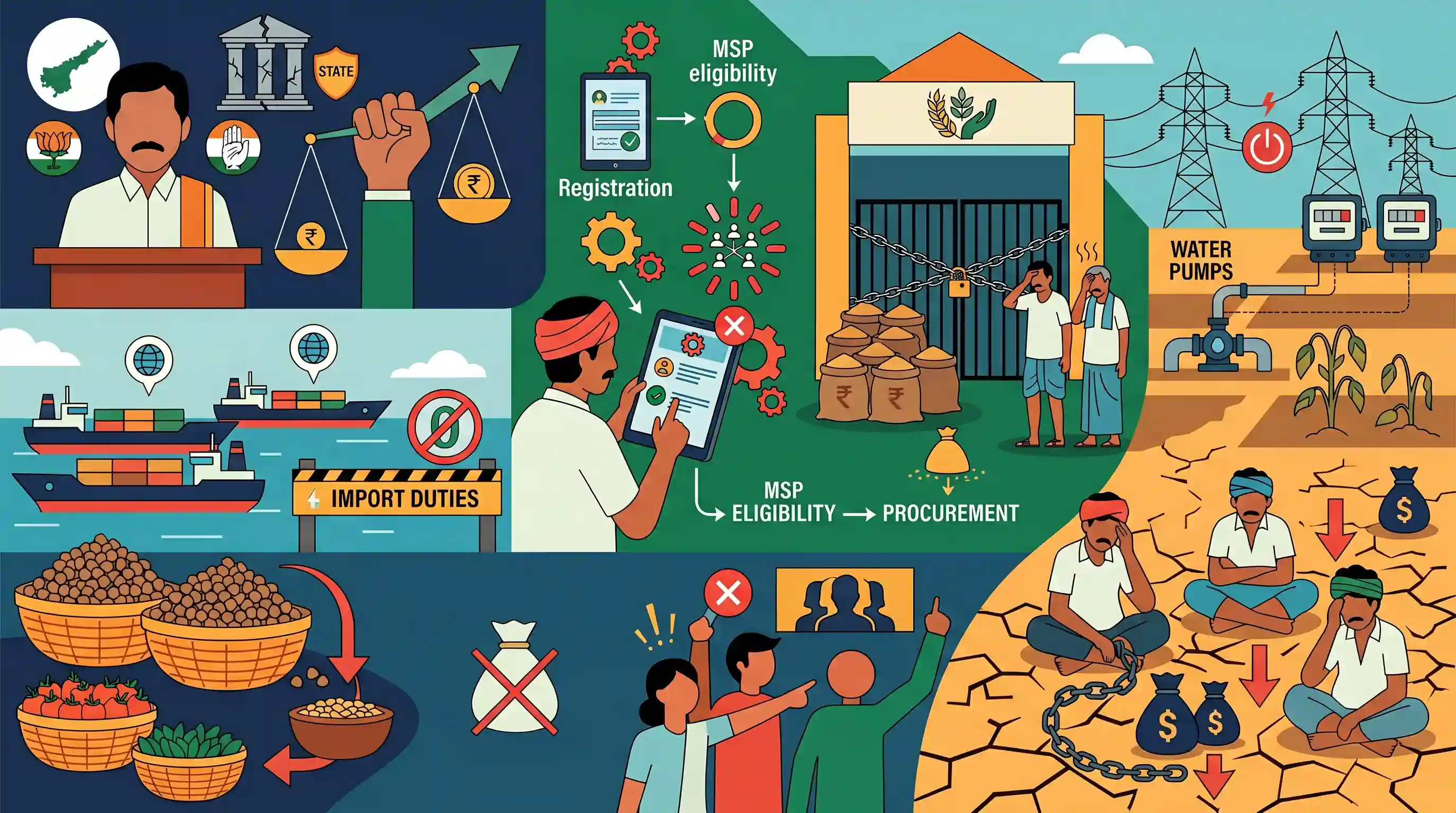
The YSR Congress Party (YSRCP) has strongly criticized the NDA government in Andhra Pradesh for its failure to ensure Minimum Support Price (MSP) for agricultural produce, highlighting a growing crisis among farmers. The opposition pointed out that a combination of factors, including a reduction in import duties to zero which flooded the market with cheap chickpeas, lack of timely procurement, and the absence of a promised crop bonus, has driven local market prices well below the MSP. Additionally, systemic failures such as delays in e-crop registrations, which dictate MSP eligibility, and inadequate supply of free agricultural electricity have exacerbated the agricultural distress in the state.
Key Points
- The YSRCP accused the NDA government in Andhra Pradesh of failing to ensure the Minimum Support Price (MSP) for crops, leading to severe distress among farming communities.
- Chickpea farmers in particular are suffering as market prices have fallen significantly below the MSP, driven by the Central government's decision to slash import duties on chickpeas from 60% to zero.
- The Opposition demanded an additional bonus of ₹1,000 per quintal over the MSP and criticized the government for delaying procurement through agencies like Markfed.
- Administrative and systemic issues, such as delays in e-crop registration and failure to provide reliable free electricity for agriculture, have further aggravated the plight of the farmers.
Important Terms
Minimum Support Price (MSP)

A pre-announced minimum price at which the government purchases crops from farmers to protect them against price crashes and ensure income stability.
UPSC context
GS Paper 3: Agriculture, Food Security. Tests knowledge of pricing policies and government intervention to prevent distress sales.
Rythu Bharosa Kendras (RBKs)
Village-level, single-window service centers in Andhra Pradesh providing seeds, fertilizers, technical advice, and a platform for MSP-based procurement.
UPSC context
GS Paper 3: Agricultural Extension Services. Tests understanding of decentralised service delivery models and farmer support systems.
Markfed (AP Markfed)
The state-level cooperative marketing federation in Andhra Pradesh that serves as the nodal agency for procuring pulses, oilseeds, and coarse grains at MSP.
UPSC context
GS Paper 3: Agricultural Marketing and Procurement. Tests knowledge of state-level institutional frameworks for crop procurement.
e-Crop Registration
A digital system (e-Panta) for recording land and crop details to verify eligibility for government schemes, crop insurance, and MSP procurement.
UPSC context
GS Paper 3: e-Technology in the aid of farmers. Tests understanding of digital tools for transparency and targeted subsidy delivery.
Import Duty (Agricultural)
Taxes levied on imported agricultural goods to protect domestic farmers from cheap foreign competition and maintain domestic price stability.
UPSC context
GS Paper 3: International Trade and Indian Economy. Tests knowledge of trade policy impacts on domestic agricultural markets.
Prelims Trap
CACP fixes the Minimum Support Price (MSP) which is a legally binding statutory right for farmers.
CACP only recommends the MSP; the Cabinet Committee on Economic Affairs (CCEA) approves it. Furthermore, MSP is an administrative measure, not currently a legally binding statutory right.
Static Concepts Connected
How does the PM-AASHA scheme ensure remunerative prices for pulse and oilseed farmers?
- Price Support Scheme (PSS): Involves physical procurement of pulses, oilseeds, and copra by Central Nodal Agencies (NAFED, FCI) working alongside state-level agencies.
- Price Deficiency Payment Scheme (PDPS): Direct payment of the difference between the MSP and the selling/modal price to pre-registered farmers, without the government undertaking physical procurement.
- Private Procurement & Stockist Scheme: A pilot scheme allowing private sector participation in the procurement operations for oilseeds on a pilot basis.
What determines the Minimum Support Price (MSP) calculation by the CACP?
- A2 Cost: Covers all out-of-pocket expenses incurred by farmers on seeds, fertilizers, chemicals, hired labor, fuel, and irrigation.
- A2+FL Cost: Adds the imputed value of unpaid family labor to the A2 cost. This is the metric generally used by CACP for recommending MSP.
- C2 Cost: A more comprehensive cost that includes A2+FL plus imputed rent and interest on owned land and fixed capital assets. Farmers often demand MSP based on C2.
Cross-Topic Patterns
Import Tariffs vs. Food Inflation
Cutting import duties on pulses to control CPI inflation often conflicts with the goal of increasing domestic pulse production, highlighting the tension between consumer inflation targeting and farmer welfare.
Digital Exclusion in Agricultural Safety Nets
Mandatory e-Crop registration links MSP eligibility and crop insurance to digital databases, but administrative delays and server issues frequently exclude marginalized farmers from these safety nets.

Expect a GS3 question evaluating the contradictory impacts of trade policy (zero import duties) on the success of domestic MSP procurement.
Linked PYQs · 5
Linked PYQs · 5
- 2018MainsGS3
What do you mean by Minimum Support Price (MSP)? How will MSP rescue the farmers from the low income trap?
- 2017MainsGS3
How do subsidies affect the cropping pattern, crop diversity and economy of farmers? What is the significance of crop insurance, minimum support price and food processing for small and marginal farmers?
- 2023MainsGS3
How does e-Technology help farmers in production and marketing of agricultural produce? Explain it.
- 2018PrelimsGS1
Consider the following: 1. Areca nut 2. Barley 3. Coffee 4. Finger millet 5. Groundnut 6. Sesamum 7. Turmeric The Cabinet Committee on Economic Affairs has announced the Minimum Support Price for which of the above?
- 2019PrelimsGS1
The economic cost of food grains to the Food Corporation of India is Minimum Support Price and bonus (if any) paid to the farmers plus
