Government Examines Meta Recommendation Systems Intermediary Status
Source:The Hindu ↗
কেন এটি গুরুত্বপূর্ণ
The debate over 'intermediary liability' vs. 'publisher responsibility' is central to the ongoing regulation of Big Tech. For UPSC aspirants, this illustrates the tension between algorithmically driven social media and national security/law enforcement. It directly connects to the syllabus topics of cyber security, the challenges of synthetic media (deepfakes), and regulatory responses to secure the digital space.
সারসংক্ষেপ
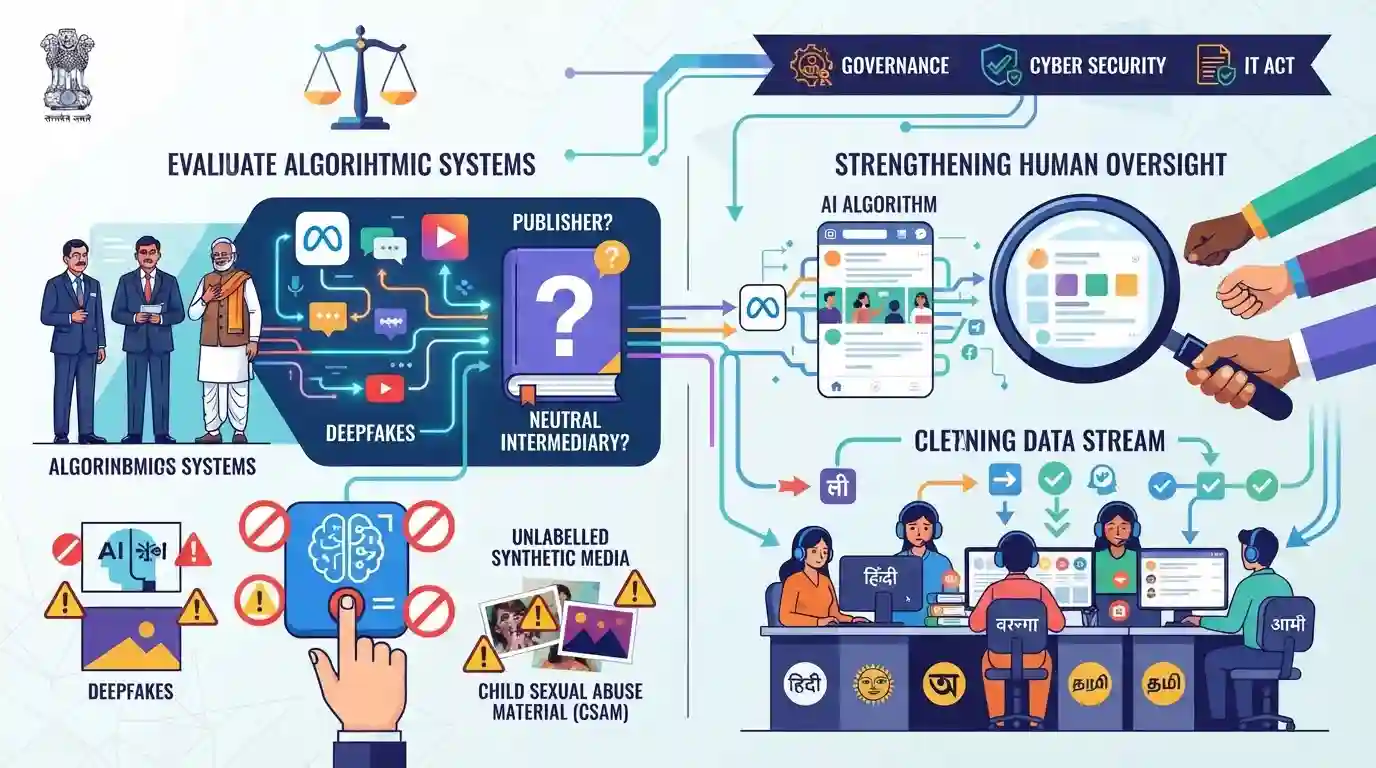
The Indian government is evaluating whether Meta’s algorithmic recommendation systems—which actively decide what content to show users and promote paid content—mean the company acts more as a publisher than a neutral 'intermediary.' This reclassification would strip Meta of the legal 'safe harbour' provided under Section 79 of the IT Act, exposing the company to liability for third-party content. During high-level talks, officials pressed Meta on its handling of deepfakes, unlabelled synthetic media, and Child Sexual Abuse Material (CSAM). The government also insisted on strengthening human oversight in content moderation by employing reviewers proficient in Indian languages and cultural contexts to prevent AI systems from missing harmful content.
মূল বিষয়
- The Indian government is scrutinizing whether Meta’s use of recommendation algorithms to decide content visibility disqualifies it from being classified as an 'intermediary' under the IT Act.
- Losing 'intermediary' status under Section 79 would remove Meta's 'safe harbour' protection, making the platform legally liable for user-generated content.
- The government strongly raised concerns over the unchecked spread of deepfakes, unlabelled AI-generated synthetic content, and Child Sexual Abuse Material (CSAM).
- Officials demanded robust human oversight in content moderation, specifically requiring personnel who understand Indian languages and cultural contexts, rather than relying solely on automated AI filters.
গুরুত্বপূর্ণ শব্দ
Information Technology Act, 2000

The primary Indian legislation governing cybercrime, electronic commerce, and digital regulation. It provides legal recognition for electronic transactions and outlines the regulatory framework for cyberspace.
UPSC context
Crucial for GS Paper 3 (Cyber Security) and GS 2 (Governance), testing foundational knowledge of India's digital legal framework.
Section 79 of the IT Act
A provision granting 'safe harbour' to internet intermediaries. It exempts platforms from liability for third-party user content they host, provided they act neutrally and observe prescribed due diligence.
UPSC context
Key for GS Paper 2 (Polity); tests understanding of the safe harbour doctrine, intermediary liability, and free speech online.
IT Rules, 2021
Regulations establishing mandatory due diligence, a three-tier grievance redressal mechanism, and oversight for social media intermediaries, OTT platforms, and digital news publishers in India.
UPSC context
Significant for GS Paper 3 (Internal Security) regarding the role of social media in challenges and regulating platform accountability.
Bharatiya Nyaya Sanhita (BNS)
The recent criminal code that replaced the Indian Penal Code (IPC). It is invoked alongside the IT Act for consequential legal actions against digital platforms failing due diligence.
UPSC context
Highly relevant for GS Paper 2 (Governance) regarding modern legal reforms and the statutory framework for criminal justice.
Meta
A multinational technology conglomerate owning platforms like Facebook and Instagram. In India, its legal classification as an 'intermediary' is being scrutinized due to its algorithmic recommendation systems.
UPSC context
Useful as a case study for GS Paper 3 (Internal Security) when discussing AI algorithms, deepfakes, and social networking challenges.
Ministry of Electronics and Information Technology (MeitY)
The apex executive agency of the Government of India responsible for IT policy, electronics manufacturing, digital public infrastructure, and administering laws regulating cyberspace.
UPSC context
Relevant for GS Paper 2 (Institutions); tests awareness of the nodal body overseeing India's digital ecosystem and cyber regulations.
প্রিলিমস ফাঁদ
Social media platforms enjoy unconditional immunity from legal liability for all third-party user content under the IT Act.
Safe harbour under Section 79 is strictly conditional. Platforms must observe due diligence and act merely as neutral conduits. Active algorithmic curation forfeits this immunity.
সংযুক্ত স্থির ধারণা
What is 'Safe Harbour' protection under Section 79 of the IT Act?
- Conditional immunity: Protects digital intermediaries from legal liability for third-party, user-generated content hosted on their platforms.
- Neutral conduit requirement: Protection applies only if the platform acts passively—it cannot initiate the message, select the receiver, or modify the transmission.
- Due diligence compliance: Intermediaries must adhere strictly to government takedown timelines and grievance redressal mechanisms to retain this legal shield.
What distinguishes 'Significant Social Media Intermediaries' (SSMIs) under IT Rules, 2021?
- User threshold: Applies to social media platforms operating in India that have more than 50 lakh (5 million) registered users.
- Resident officers: Must appoint a Chief Compliance Officer, Nodal Contact Person, and Resident Grievance Officer who are all resident in India.
- Originator traceability: Must enable identification of the 'first originator' of malicious messages upon lawful court or government orders.
আন্তঃবিষয় প্যাটার্ন
Deepfakes + Bharatiya Nyaya Sanhita (BNS)
Weaponized synthetic media linking to riots or state security threats bridges the IT Act's civil compliance with direct criminal liability under the new BNS framework for intermediaries.
Algorithmic Bias + Democratic Discourse
Curated echo chambers restrict the citizen's Right to Information (Article 19), transforming technical recommendation algorithms into systemic governance challenges during elections and political discourse.

Expect a 2026 GS3 question on how algorithmic curation strips social media of 'neutrality', turning platforms into active security threats.
সংযুক্ত PYQ · 3
সংযুক্ত PYQ · 3
- 2024MainsGS3
Social media and encrypting messaging services pose a serious security challenge. What measures have been adopted at various levels to address the security implications of social media? Also suggest any other remedies to address the problem.
- 2016MainsGS3
Use of Internet and social media by non-state actors for subversive activities is a major security concern. How have these been misused in the recent past? Suggest effective guidelines to curb the above threat.
- 2020MainsGS3
Discuss different types of cyber crimes and measures required to be taken to fight the menace.
