Government Dissolves Digital Communications Commission
Source:The Hindu ↗
ఇది ఎందుకు ముఖ్యం
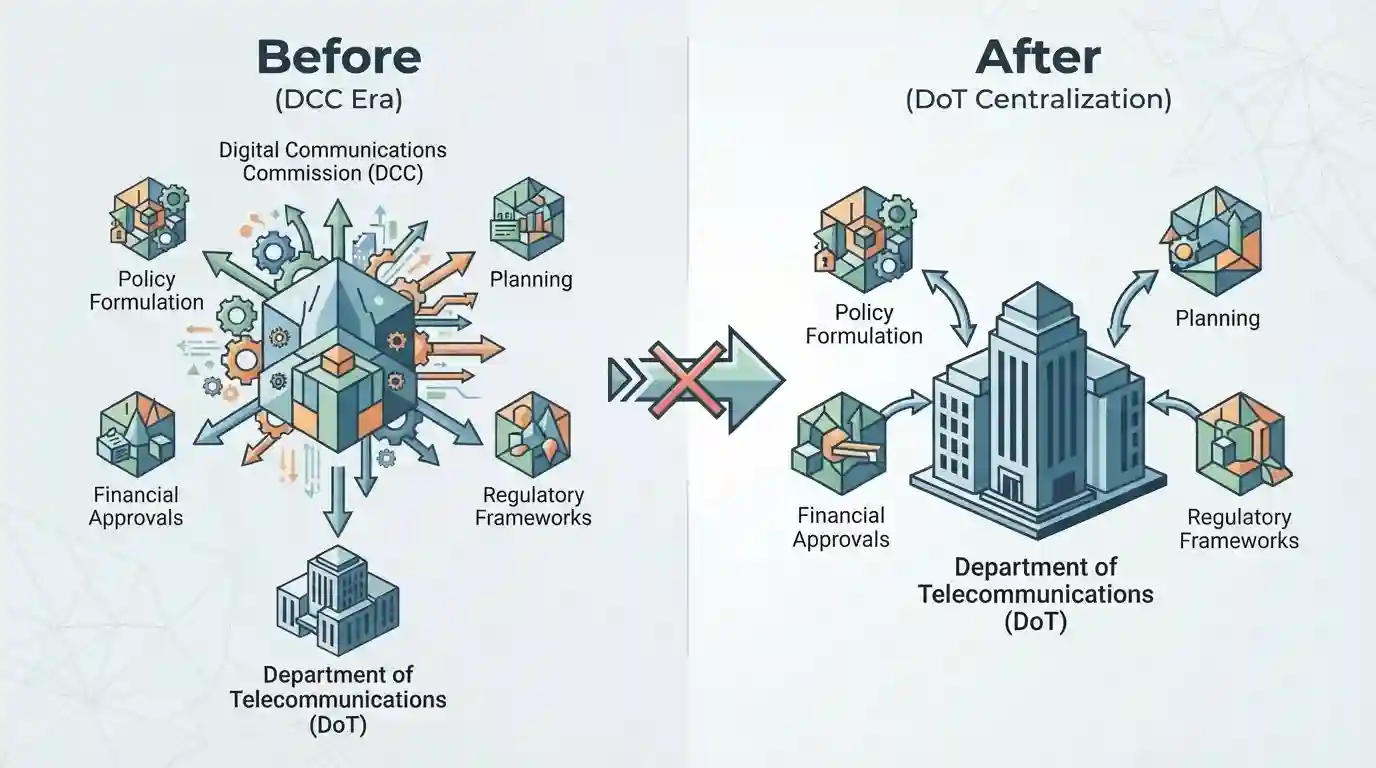
The dissolution of the Digital Communications Commission marks a significant institutional restructuring in India's telecommunications governance, impacting how major telecom policies, licensing matters, and financial approvals are handled by the government.
సారాంశం
The Union government has dissolved the 37-year-old Digital Communications Commission (DCC), formerly the Telecom Commission, established in 1989. The apex body was tasked with policy formulation, planning, and financial approvals for India's telecommunications sector. Its closure reflects a structural shift to streamline telecom governance and centralize administrative decision-making directly within the Department of Telecommunications (DoT).
ముఖ్య అంశాలు
- The central government has dissolved the 37-year-old Digital Communications Commission (DCC), formerly known as the Telecom Commission.
- Originally established in 1989, the body was responsible for policy formulation, reviewing telecom structural developments, and approving licensing and financial matters for the sector.
- The dissolution is part of bureaucratic rationalization and institutional restructuring, shifting core policy execution and administrative decision-making back directly under the Department of Telecommunications (DoT).
- The move aims to streamline administrative processes and eliminate redundancy in telecommunications governance.
ముఖ్యమైన పదాలు
Digital Communications Commission

The apex government body formerly known as the Telecom Commission, responsible for telecom policy formulation, planning, and financial approvals, which was dissolved in 2025 to streamline governance.
UPSC context
GS Paper II (Governance) & GS Paper III (Economy/Infrastructure); tests institutional restructuring and regulatory frameworks in India's telecom sector.
Telecom Commission
The original name of the Digital Communications Commission, established in 1989 to deal with policy formulation and financial matters of the telecommunications sector.
UPSC context
GS Paper II & III; tests the evolution of regulatory institutions in India's public administration and telecommunications.
Department of Telecommunications
The central government department under the Ministry of Communications responsible for formulating telecom policies, licensing, and overall administration of telecommunications in India.
UPSC context
GS Paper II (Government Policies & Interventions); tests understanding of ministerial structures, administrative control, and sector governance.
Union Cabinet
The highest executive decision-making body in the Indian government, headed by the Prime Minister, responsible for ultimate policy approvals including major telecom decisions.
UPSC context
GS Paper II (Indian Constitution & Polity); tests the role, powers, and decision-making authority of the executive wing.
ప్రిలిమ్స్ ఉచ్చు
The Digital Communications Commission is a statutory body established under the Telecom Regulatory Authority of India Act.
The DCC was not a statutory body created by an Act of Parliament; rather, it was established via an executive resolution of the Government of India in 1989.
అనుసంధానమైన స్థిర భావనలు
What is the institutional evolution and mandate of the Department of Telecommunications (DoT) in India?
- Administrative Role: Originally functioning under the Ministry of Communications, DoT deals with policy, licensing, and coordination of all telecommunications services.
- Historical Apex Body: The Telecom Commission was created in 1989 with executive powers to deal with policy formulation, but was renamed DCC in 2018 before its recent dissolution.
అంతర-అంశ నమూనాలు
Bureaucratic Rationalization & Governance Reforms
The restructuring of telecom governance mirrors past attempts at bureaucratic rationalization like the 2019 merger of railway budgets and restructuring of central public sector enterprises.

Dissolution of apex bodies like DCC to centralize power within line ministries is a recurring administrative reform trend tested in Mains.
