Great Nicobar Project and Strategic Infrastructure Concerns
Source:The Hindu ↗
Why It Matters
The Great Nicobar Project is a highly debated intersection of strategic infrastructure, environmental conservation, and tribal rights. It tests a UPSC aspirant's ability to balance national security imperatives in the Indian Ocean Region against ecological sustainability and the protection of Particularly Vulnerable Tribal Groups (PVTGs).
Summary
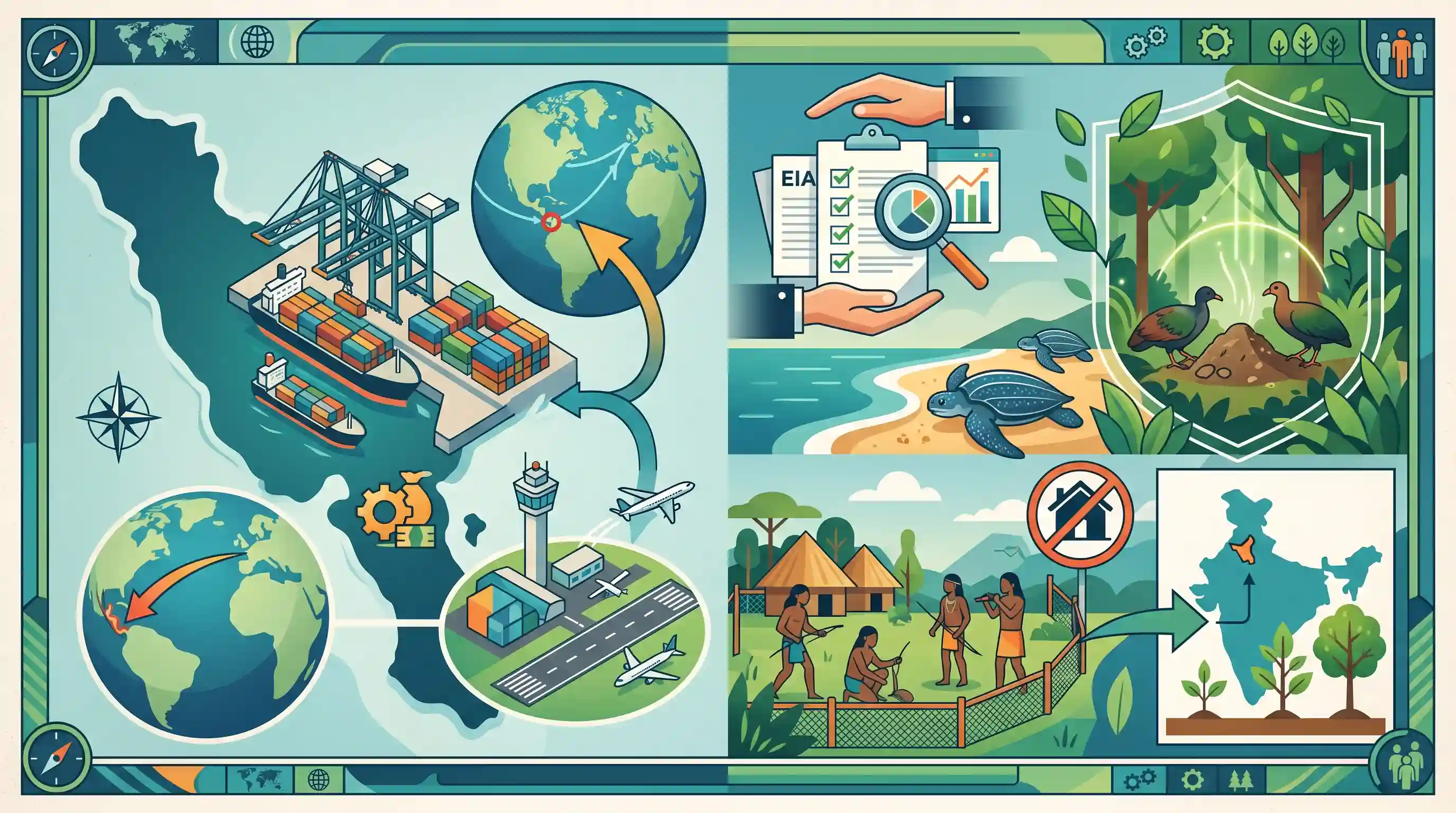
The Union government has strongly defended the ₹72,000 crore Great Nicobar Island development project against environmental and tribal rights concerns. The project, which includes an International Container Transhipment Port (ICTP) and a greenfield airport, is deemed strategically vital due to its proximity to the Malacca Strait and the Six Degree Channel, key chokepoints for global maritime trade. The Environment Ministry emphasized that all statutory clearances were obtained legitimately and highlighted extensive safeguards implemented to protect local biodiversity, including leatherback turtles and Nicobar megapodes. Furthermore, the government assured that there will be no displacement of indigenous tribes like the Shompen, and compensatory afforestation will be carried out in Haryana.
Key Points
- The Union government has defended the ₹72,000 crore Great Nicobar Island project, encompassing an International Container Transhipment Port (ICTP), an airport, and a township, citing immense strategic importance.
- The project's location near the Malacca Strait and the Six Degree Channel makes it a critical node for India's maritime security and international sea trade.
- The Environment Ministry assured that robust environmental safeguards are in place, including specific conservation measures for the leatherback turtle, Nicobar megapode, and saltwater crocodile.
- Compensatory afforestation for the project is slated to occur in Haryana, as the Andaman and Nicobar Islands lack sufficient non-forest land for this purpose.
- The government guaranteed that indigenous groups, particularly the Shompen and Nicobarese, will not face physical displacement, and tribal reserve areas are largely excluded from the development footprint.
Important Terms
Great Nicobar Island Development Project (GNIP)

A ₹72,000+ crore NITI Aayog-led initiative to transform Great Nicobar into a strategic-economic hub, comprising a transshipment port, greenfield airport, township, and power plant.
UPSC context
GS Paper 3 (Infrastructure/Environment); GS Paper 2 (Strategic Geopolitics). Tests balance between development and conservation.
International Container Transhipment Port (ICTP)
A proposed deep-water terminal at Galathea Bay, Great Nicobar, designed to handle large cargo ships and reduce India's reliance on foreign transshipment hubs like Singapore and Colombo.
UPSC context
GS Paper 3 (Economy/Ports). Relevant for 'Maritime India Vision 2030' and reducing logistics costs.
Shompen Tribe
A semi-nomadic hunter-gatherer tribe of Mongoloid descent residing in the interior rainforests of Great Nicobar Island; they are classified as a Particularly Vulnerable Tribal Group (PVTG).
UPSC context
GS Paper 1 (Social Issues/Geography); GS Paper 2 (Tribal Rights). Tests knowledge of indigenous populations and PVTG status.
Particularly Vulnerable Tribal Groups (PVTG)
A specialized category of tribes characterized by pre-agricultural technology, stagnant/declining population, low literacy, and economic backwardness, requiring targeted government protection and development.
UPSC context
GS Paper 2 (Welfare Schemes). Essential for understanding constitutional and legal safeguards for India's most vulnerable tribes.
Malacca Strait
A critical maritime chokepoint between the Indian and Pacific Oceans; the Great Nicobar project leverages its proximity to monitor trade routes and enhance India's maritime security.
UPSC context
GS Paper 2 (International Relations/Geopolitics). Tests understanding of maritime trade security and the 'Act East Policy.'
National Green Tribunal (NGT)
A statutory quasi-judicial body established for effective and expeditious disposal of cases relating to environmental protection and conservation of forests and other natural resources.
UPSC context
GS Paper 2 (Statutory Bodies); GS Paper 3 (Environment). Focuses on environmental jurisprudence and the project-approval process.
Prelims Trap
"Compensatory afforestation for the Great Nicobar project must be conducted within the Andaman and Nicobar Islands."
Aspirants logically assume ecological compensation must be local. However, the government allowed CA in Haryana due to a lack of non-forest land in the A&N archipelago.
Static Concepts Connected
Who are the Particularly Vulnerable Tribal Groups (PVTGs) of A&N Islands?
- Criteria: Declining/stagnant population, pre-agricultural level of technology, extremely low literacy, and economic backwardness.
- The Five PVTGs: Great Andamanese, Jarawa, Onge, Sentinelese, and Shompen. (Note: The Nicobarese are a Scheduled Tribe, but NOT categorized as a PVTG).
- Shompen specifics: A semi-nomadic, hunter-gatherer tribe residing exclusively in the dense tropical rain-forests of the Great Nicobar Island.
How does Compensatory Afforestation (CA) function across state boundaries?
- CAF Act 2016: Requires project developers to fund afforestation on equivalent non-forest land, or double the amount of degraded forest land.
- Land Deficit Rules: If a State/UT (like A&N) lacks sufficient non-forest land, the afforestation can be legally carried out in another state (e.g., Haryana) via CAMPA funds.
- Fund Allocation: 90% of the funds go to the State fund, and 10% to the National fund to ensure proper execution and monitoring.
Cross-Topic Patterns
Maritime Chokepoints + Transhipment Ports
Links the ICTP at Campbell Bay to securing the Six Degree Channel, countering China's 'Malacca Dilemma' and reducing Indian transhipment reliance on Colombo and Singapore.
Island Ecology vs. Strategic Imperatives
The tension between Galathea Bay’s role as a vulnerable Leatherback turtle nesting site and its utility as a strategic deep-water port mirrors broader EIA vs Infrastructure debates.

Expect a 2026 paired-mapping question linking A&N tribes (Shompen) to specific islands, combined with Galathea Bay's ecological status.
Linked PYQs · 4
Linked PYQs · 4
- 2025MainsGS3
Why is maritime security vital to protect India's sea trade? Discuss maritime and coastal security challenges and the way forward.
- 2022MainsGS3
What are the maritime security challenges in India ? Discuss the organisational, technical and procedural initiatives taken to improve the maritime security.
- 2022PrelimsGS1
"Biorock technology" is talked about in which one of the following situations?
- 2021PrelimsGS1
With reference to India, the terms 'Halbi, Ho and Kui' pertain to
