Nurses Registration and Tracking System Adoption Gaps Across States
Source:The Hindu ↗
কেন এটি গুরুত্বপূর্ণ
Reliable data on the health workforce is a prerequisite for robust health policy planning. The issues surrounding the NRTS highlight classic e-governance friction points—fragmented state adoption and overlapping institutional mandates—making it a strong case study for GS2 answers on digital governance bottlenecks and healthcare administration.
সারসংক্ষেপ
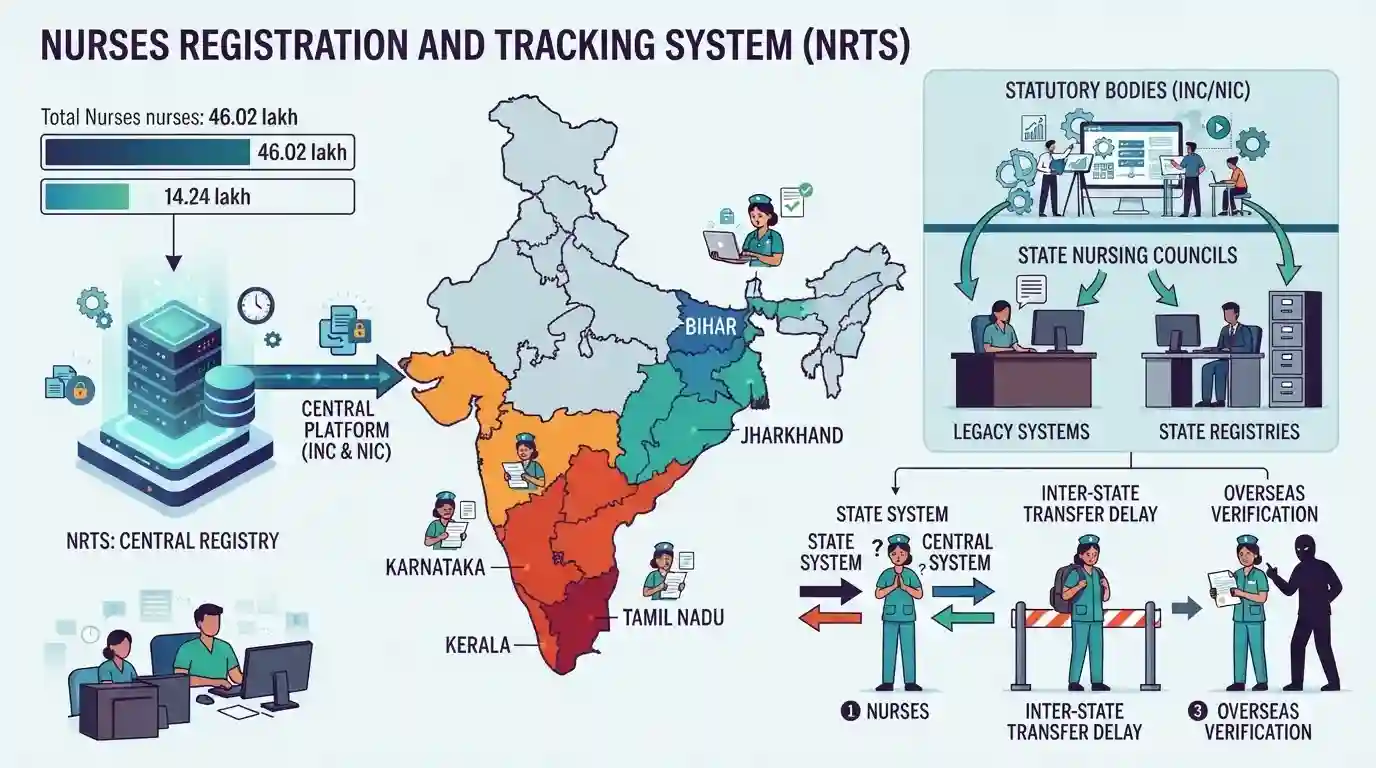
The Nurses Registration and Tracking System (NRTS), a centralized digital registry launched to track and manage India's nursing workforce, is severely hampered by uneven implementation. Out of 46.02 lakh registered nurses across India, only 14.24 lakh have been enrolled on the platform. Major states like Karnataka, Tamil Nadu, and Kerala show significant lag, contrasting with higher adoption rates in states like Bihar and Jharkhand. This gap highlights a federal disconnect: while the platform was created by the Indian Nursing Council (INC) and National Informatics Centre (NIC), State Nursing Councils are legally responsible for registrations and often bypass the central system for their own legacy platforms. Consequently, nurses suffer from delays in inter-state employment transfers and overseas credential verification, frequently falling victim to intermediaries. The situation exemplifies typical challenges in implementing e-governance systems where state-level compliance and inter-agency coordination fail to match digital infrastructure availability.
মূল বিষয়
- Severe under-enrolment: Only ~31% (14.24 lakh out of 46.02 lakh) of India's registered nursing personnel are currently enrolled in the NRTS digital registry, launched over 7 years ago.
- Uneven State adoption: States with massive nursing workforces like Karnataka, Kerala, Tamil Nadu, and Andhra Pradesh are heavily lagging, while states like Bihar and Jharkhand have achieved near-total enrolment.
- Federal coordination gaps: Under the law, State Nursing Councils hold registration responsibilities, and many continue using legacy standalone systems rather than routing through the centralized NRTS platform.
- Career impact on nurses: Non-enrolment delays inter-state transfers (No Objection Certificates) and overseas credential verification, forcing nurses to rely on exploitative middlemen for paperwork.
- E-governance design vs reality: Despite being built by INC and NIC to ensure an online, transparent, and time-bound mechanism with a National Unique Identity (NUID), NRTS adoption suffers from lack of operational discipline and state-level compliance.
গুরুত্বপূর্ণ শব্দ
Nurses Registration and Tracking System (NRTS)

A centralized digital registry developed by the Indian Nursing Council and NIC to maintain a live database of India's nursing workforce using Aadhaar-based biometric authentication.
UPSC context
GS Paper II: Governance & Health; tests e-governance implementation challenges and digital public infrastructure management in the social sector.
National Unique Identity (NUID)
A unique 15-digit identification number issued by the Indian Nursing Council to verified nurses, streamlining interstate employment transfers, license renewals, and overseas credential checks.
UPSC context
GS Paper II: Issues relating to Health; tests digital identity integration and standardisation of healthcare professional databases across the country.
Indian Nursing Council (INC)
A national statutory body established under the Indian Nursing Council Act, 1947, responsible for regulating and maintaining uniform standards of nursing education and training.
UPSC context
GS Paper II: Statutory, regulatory and quasi-judicial bodies; tests central-state healthcare regulation and issues in administrative decentralisation.
National Informatics Centre (NIC)
A premier technology organisation under the Ministry of Electronics and Information Technology that designs, hosts, and supports India's core e-governance software and digital public systems.
UPSC context
GS Paper III: IT & Computers; tests the role of central technical agencies in building national-scale digital government infrastructure.
State Nursing Registration Councils
State-level autonomous statutory bodies legally responsible for primary registration, licensing, and professional regulation of nurses within their respective state boundaries.
UPSC context
GS Paper II: Federal structure and devolution of powers; tests cooperative federalism and implementation friction in dual-layered administrative registries.
প্রিলিমস ফাঁদ
The Indian Nursing Council holds sole legal authority for the primary registration of nurses across India.
Primary registration powers legally belong to State Nursing Registration Councils. Central bodies merely aggregate this data into national registries, causing the federal coordination gap.
সংযুক্ত স্থির ধারণা
What are the key provisions of the NNMC Act, 2023?
- Repeals old law: It repeals the archaic Indian Nursing Council Act, 1947, modernizing the regulatory framework for nursing professionals.
- Autonomous Boards: Structures oversight into three boards: UG/PG Education, Assessment and Rating, and Ethics and Registration.
- Centralized Register: Mandates the creation of a 'National Nursing and Midwifery Register' (NNMR) to synchronize credentials nationwide.
How is medical regulation distributed under the 7th Schedule?
- State List: 'Public health and sanitation; hospitals and dispensaries' are exclusively State subjects (Entry 6).
- Concurrent List: 'Legal, medical and other professions' fall under the Concurrent List (Entry 26), enabling overlapping central and state regulations.
আন্তঃবিষয় প্যাটার্ন
E-Governance vs. Federal Friction
Similar to NRTS, national digital initiatives (like UDISE+ for education) often struggle when states insist on using their parallel legacy databases, highlighting Concurrent List friction.
The Database Readiness Paradox
Southern states excel in nursing workforce numbers but lag in NRTS adoption, proving that physical capacity does not automatically translate to e-governance and digital database readiness.

Expect a GS-2 question linking national e-governance failures directly to federal jurisdiction friction in Concurrent List subjects.
সংযুক্ত PYQ · 2
সংযুক্ত PYQ · 2
- 2023MainsGS2
e-governance, as a critical tool of governance, has ushered in effectiveness, transparency and accountability in governments. What inadequacies hamper the enhancement of these features ?
- 2022PrelimsGS1
With reference to Ayushman Bharat Digital Mission, consider the following statements: 1. Private and public hospitals must adopt it. 2. As it aims to achieve universal health coverage, every citizen of India should be part of it ultimately. 3. It has seamless portability across the country. Which of the statements given above is/are correct?
