Centre bans bulk industrial fuel purchases at retail petrol pumps
Source:The Hindu ↗
Why It Matters
This article highlights the economic complexities of fuel pricing mechanisms in India, the trade-off between consumer protection and the financial health of Oil Marketing Companies (OMCs), and the necessity of government intervention to prevent market distortions and hoarding.
Summary
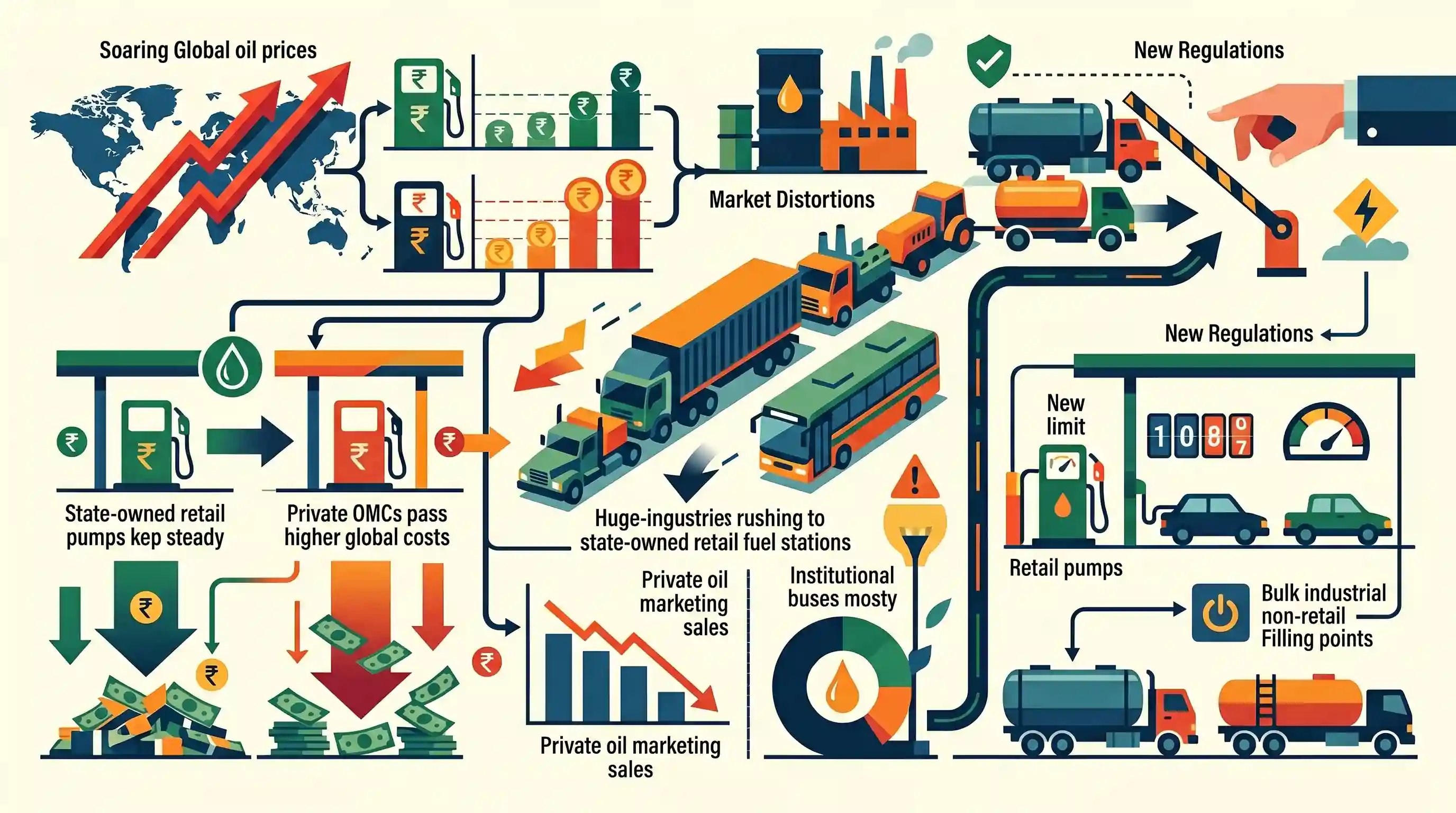
The Indian government has banned bulk industrial, commercial, and institutional consumers from purchasing petrol and diesel at retail fuel pumps to curb hoarding and artificial demand spikes. Retail outlets are now restricted to dispensing a maximum of 200 litres per day per consumer or vehicle. This regulatory measure addresses a massive price distortion where bulk diesel became approximately ₹40 per litre costlier than retail diesel. The gap emerged because state-owned oil marketing companies (OMCs) held retail prices steady to shield consumers from soaring global oil prices, leading to daily losses of nearly ₹500 crore. Meanwhile, private OMCs, which passed on the global price hikes, experienced a 58% plunge in sales as bulk buyers shifted to subsidized retail pumps.
Key Points
- The Indian government has prohibited bulk industrial, commercial, and institutional users from buying petrol and diesel at retail pumps.
- Retail fuel outlets are now restricted to dispensing a maximum of 200 litres per day per consumer or vehicle.
- The restriction aims to curb blatant hoarding and resale, driven by a ₹40 per litre price gap between bulk and retail diesel.
- State-owned OMCs are incurring losses of ₹500 crore daily by absorbing high global prices to keep retail rates low, while private OMCs faced a 58% sales plunge after passing on costs.
- The massive price distortion caused bulk users to shift to retail pumps, creating an extraordinary demand surge.
Important Terms
Oil Marketing Companies (OMCs)

Entities responsible for refining, distributing, and selling petroleum products. Major PSU OMCs in India include IOCL, BPCL, and HPCL, which manage the majority of the nation's fuel retail network.
UPSC context
GS Paper III: Infrastructure (Energy). Tests understanding of PSU roles, downstream petroleum sector, and market competition.
Under-recoveries
The difference between the market-linked cost of fuel and the lower price at which it is sold to consumers, resulting in notional losses for OMCs.
UPSC context
GS Paper III: Economy (Subsidies). Tests knowledge of fiscal burden, fuel pricing distortions, and energy subsidies.
Administered Price Mechanism (APM)
A government-controlled pricing system where rates for essential commodities (like fuel) are fixed by authorities rather than market forces to protect consumers from global price volatility.
UPSC context
GS Paper III: Economy (Pricing Policies). Relevant for history of reforms and current transition toward market-linked pricing.
Energy Security
The continuous availability of energy sources at an affordable price, encompassing reliability, accessibility, and strategic autonomy to shield the economy from global supply shocks.
UPSC context
GS Paper III: Infrastructure/Environment. Key theme for India’s development, self-reliance (Atmanirbharta), and geopolitical strategy.
Market Distortion
A situation where prices do not reflect actual costs due to government intervention or subsidies, leading to inefficient resource allocation and unintended consumer behavior (like bulk buyers using retail pumps).
UPSC context
GS Paper III: Economy. Tests ability to analyze how policy interventions impact supply-demand dynamics and fair competition.
Petroleum and Explosives Safety Organisation (PESO)
A regulatory body under the Ministry of Commerce and Industry that administers safety regulations for explosives, compressed gases, and petroleum products across the supply chain.
UPSC context
GS Paper II: Statutory/Regulatory Bodies. Important for safety protocols in industrial infrastructure and disaster management.
Prelims Trap
Petrol and diesel prices in India are fully deregulated and strictly determined by market forces.
While officially deregulated in 2010/2014, state-owned OMCs frequently absorb global crude price shocks through informal price freezes, creating de-facto regulation and market distortion.
Static Concepts Connected
What is the concept of 'Under-recovery' for Oil Marketing Companies (OMCs)?
- Definition: The notional revenue loss OMCs suffer when they sell fuel to retail consumers below the actual market-linked import parity price.
- Market Impact: It creates severe dual-pricing distortions, erodes OMC profitability, and forces private competitors out of the market when they cannot match subsidized rates.
How does the Essential Commodities Act (ECA), 1955 regulate fuel hoarding?
- Statutory Coverage: Petroleum and petroleum products are legally classified as essential commodities under the Act's schedule.
- Enforcement Powers: It empowers the Centre to issue control orders regulating production, supply, and distribution, allowing for immediate stock limits and penalties on hoarding.
Cross-Topic Patterns
Dual pricing & Private sector crowding out
Informal price caps by PSUs crowd out private players in officially deregulated sectors, mirroring historical challenges seen in the fertilizer and civil aviation markets.
Essential Commodities Act vs Free Markets
The invocation of the ECA to impose stock limits highlights the ongoing tension between essential supply security and India's broader push toward free-market economic reforms.

Expect a GS-3 Mains question on how informal price controls in officially deregulated sectors create dual pricing and distort competition.
Linked PYQs · 2
Linked PYQs · 2
- 2025PrelimsGS1
Consider the following activities : I. Production of crude oil II. Refining, storage and distribution of petroleum III. Marketing and sale of petroleum products IV. Production of natural gas How many of the above activities are regulated by the Petroleum and Natural Gas Regulatory Board in our country?
- 2022MainsGS3
What are the major challenges of Public Distribution System (PDS) in India ? How can it be made effective and transparent ?
