Online Gaming Act 2025 and Crackdown on Betting Platforms
Source:Indian Express ↗
Why It Matters
The Act represents a paradigm shift in India's digital regulation by imposing a blanket ban on real-money gaming and overriding the historic 'skill vs chance' judicial distinction, directly impacting internet governance, consumer protection, and the digital economy.
Summary
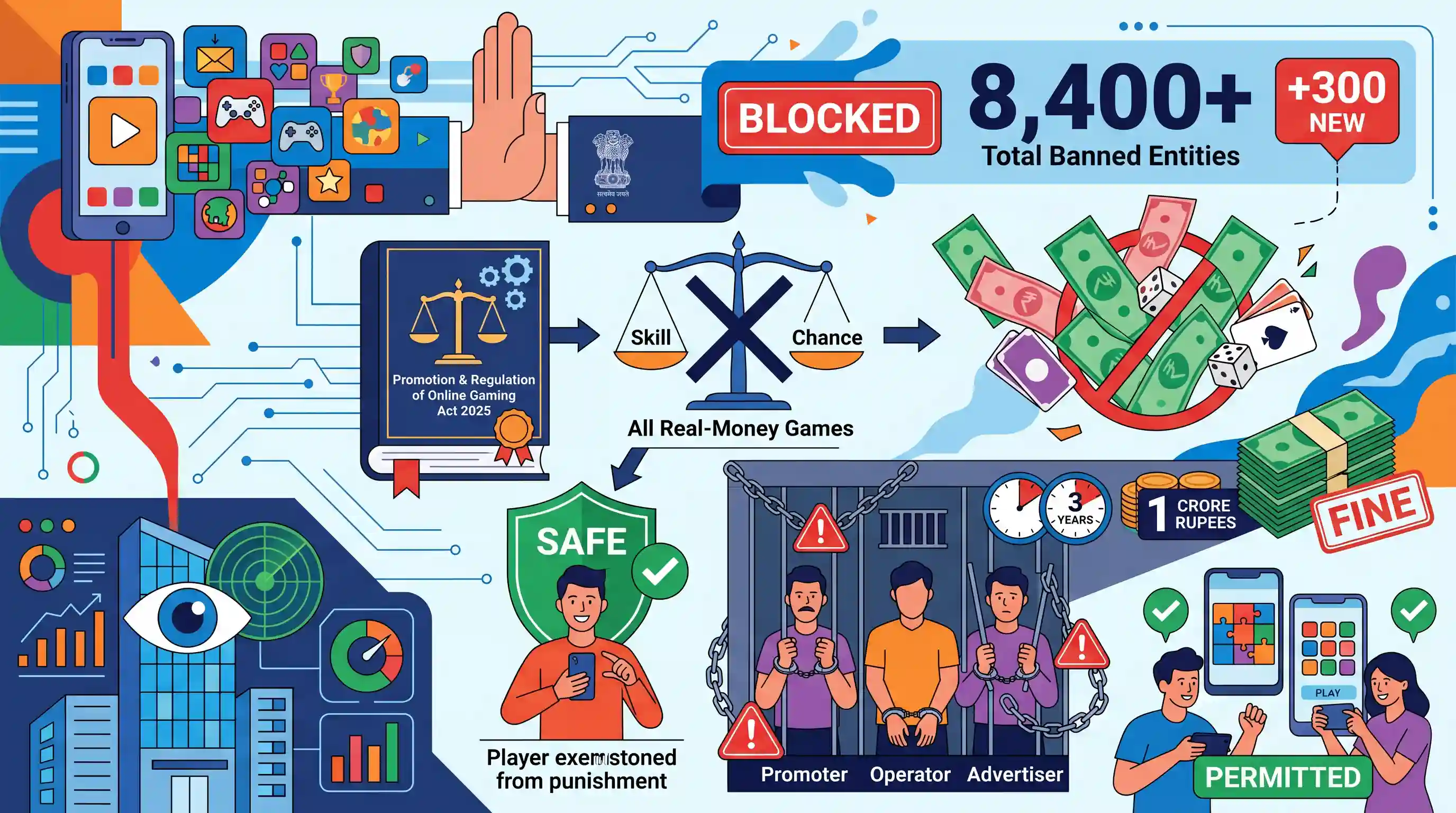
The Indian government has blocked an additional 300 betting and gambling platforms, bringing the total number of banned entities to 8,400. This enforcement is driven by the new Promotion and Regulation of Online Gaming Act, 2025, which completely prohibits all real-money games, eliminating the previous legal distinction between games of skill and chance. While players are exempt from punishment, promoters, operators, and advertisers face stringent penalties, including jail terms up to three years and fines up to Rs 1 crore. A dedicated authority will monitor compliance, but free-to-play games without financial stakes remain permitted.
Key Points
- The Indian government blocked an additional 300 betting and gambling apps, bringing the total number of banned platforms to 8,400.
- The enforcement falls under the newly enacted Promotion and Regulation of Online Gaming Act, 2025, which recently received the President's assent.
- The Act completely prohibits all real-money games, explicitly removing the traditional legal distinction between 'games of skill' and 'games of chance'.
- While players are exempt from punishment, the law imposes stringent penalties on platform operators (up to 3 years in jail and Rs 1 crore fine) and advertisers (up to 2 years in jail and Rs 50 lakh fine).
- A dedicated special authority has been established to monitor compliance, while free-to-play games without financial stakes are explicitly permitted and can be promoted.
Important Terms
Promotion and Regulation of Online Gaming Act, 2025

A landmark 2025 law providing a national framework to ban real-money online games while promoting e-sports. It overrides fragmented state laws and establishes the Online Gaming Authority of India for sector-wide oversight.
UPSC context
GS Paper II/III: Government policies; tests knowledge of the first national framework replacing fragmented state-level gambling regulations.
Online Money Games (OMG)
Digital games where users pay stakes for monetary gain. Under the 2025 Act, these are strictly prohibited regardless of whether the outcome depends on skill or chance, aimed at curbing addiction and fraud.
UPSC context
GS Paper III: Economy/Internal Security; tests understanding of legislative measures to prevent money laundering and financial exploitation.
Online Gaming Authority of India (OGAI)
An inter-ministerial regulatory body under MeitY with quasi-judicial powers to categorize, register, and monitor online games. It ensures platforms comply with national safety standards and issues directions for enforcement.
UPSC context
GS Paper II: Statutory/Regulatory Bodies; relevant for questions on administrative architecture and digital platform governance.
Game of Skill vs. Game of Chance
A traditional legal standard where skill-based games were constitutionally protected businesses, unlike chance-based gambling. The 2025 Act effectively removes this distinction for online money gaming to enable total prohibition.
UPSC context
GS Paper II: Judiciary/Legal Definitions; tests understanding of how legislation can alter constitutional business protections.
E-sports
Competitive video gaming recognized under the 2025 Act as a professional sport. While betting is barred, e-sports are promoted through training academies, allowing registration fees and performance-based prizes.
UPSC context
GS Paper III: Digital Economy; significant for discussions on formalizing the creative economy and distinguishing sports from gambling.
Section 69A of the IT Act
A provision of the Information Technology Act, 2000, that empowers the government to block online content for national security. It is the legal tool used for banning 8,400+ illegal gambling platforms.
UPSC context
GS Paper III: Cyber Security; essential for questions on the state's power to regulate the digital ecosystem.
Prelims Trap
The Act prohibits games of chance but permits real-money games based on a predominance of skill.
The 2025 Act explicitly abolishes the historic "predominance test" (skill vs. chance). It imposes a blanket ban on all real-money games, regardless of the level of skill involved.
Static Concepts Connected
How is legislative jurisdiction over gambling and internet divided in the Seventh Schedule?
- State List: 'Betting and gambling' is strictly a State subject (Entry 34, List II), giving states primary power over physical gambling houses.
- Union List: Telecommunications and Information Technology fall under the Centre's domain (Entry 31, List I) and residuary powers.
- Central Intervention: The Union blocks cross-border and pan-India digital apps by leveraging its IT and telecommunications jurisdiction, overriding fragmented state-level regulations.
What was the historic "predominance test" in Indian gambling jurisprudence?
- Chamarbaugwala Case: In the 1957 Chamarbaugwala case, the Supreme Court ruled that competitions relying substantially on skill are not legally considered 'gambling'.
- Practical Application: This test protected games like Rummy and fantasy sports from state gambling bans if 'skill' predominated over 'chance'.
- Current Status: The 2025 Online Gaming Act explicitly overrides this jurisprudential test for online platforms, banning real-money games universally.
Cross-Topic Patterns
Offshore Gaming and FEMA/PMLA Violations
Banned gambling platforms often operate from offshore havens, creating massive illegal forex outflows and triggering Enforcement Directorate (ED) actions under FEMA and the Prevention of Money Laundering Act (PMLA).
Section 69A and Sovereign Blocking Powers
The Centre's power to mass-block 8,400 apps mirrors the post-2020 crackdown on Chinese apps, utilizing Section 69A of the IT Act (or similar IT provisions) in the interest of public order.
Dark Patterns and Child Protection
The blanket ban aligns with recent CCPA guidelines against 'dark patterns', addressing the digital grooming, psychological addiction, and financial exploitation of minors in the unregulated internet ecosystem.

Expect a prelims question mixing Entry 34 (State List) gambling powers with the Centre's IT blocks and the abolished skill vs. chance test.
Linked PYQs · 3
Linked PYQs · 3
- 2025MainsGS2
The National Commission for Protection of Child Rights has to address the challenges faced by children in the digital era. Examine the existing policies and suggest measures the Commission can initiate to tackle the issue.
- 2024MainsGS3
Social media and encrypting messaging services pose a serious security challenge. What measures have been adopted at various levels to address the security implications of social media? Also suggest any other remedies to address the problem.
- 2020MainsGS3
Discuss different types of cyber crimes and measures required to be taken to fight the menace.
