MERITE Scheme for Technical Education Quality Improvement
Source:The Hindu ↗
Why It Matters
The MERITE scheme represents a significant, World Bank-backed intervention to implement NEP 2020 mandates in technical education. It is directly relevant for GS2 questions on human resource development, education quality, and bridging the gap between academia and industry requirements to harness India's demographic dividend.
Summary
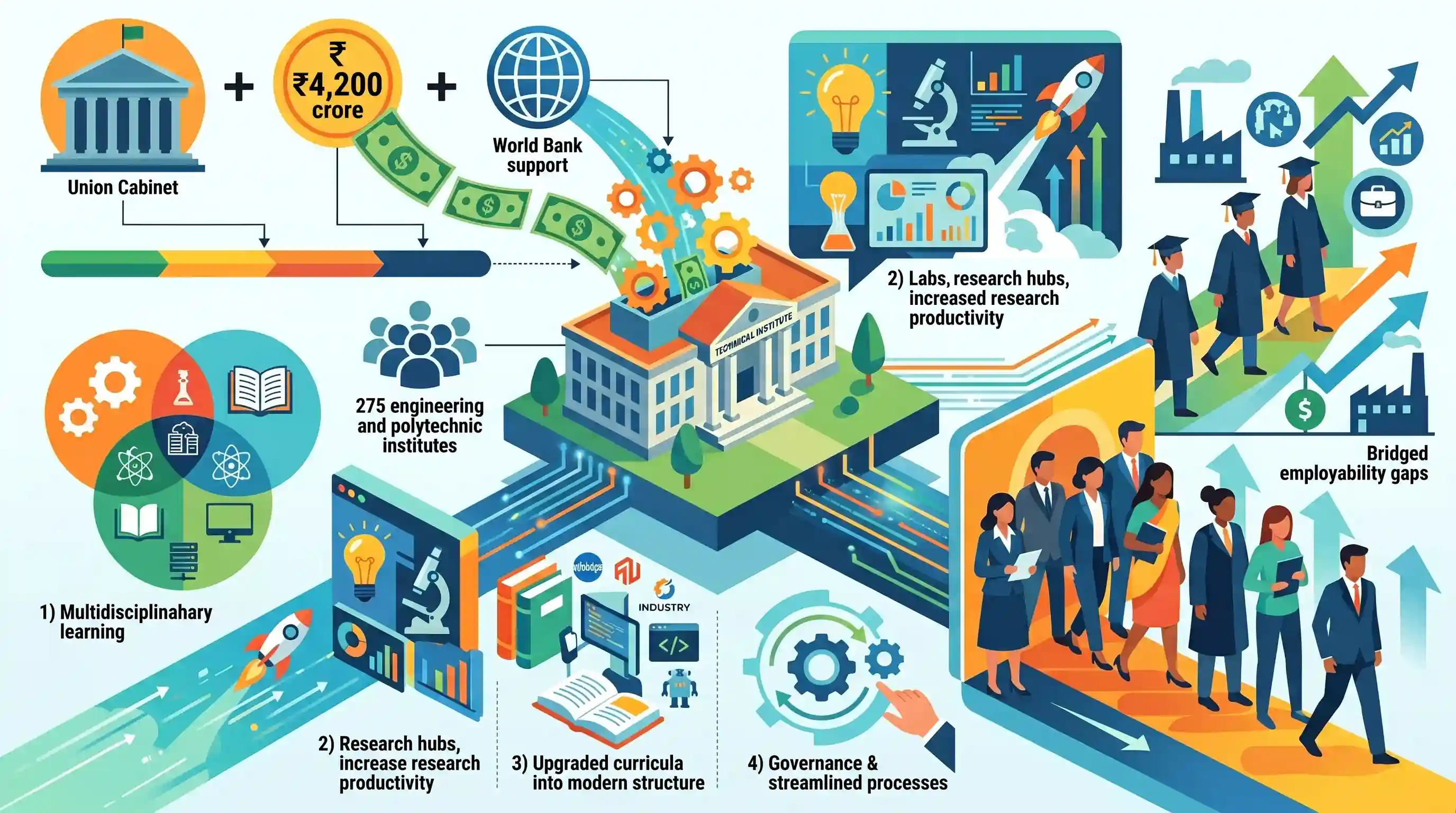
The Union Cabinet has approved the MERITE scheme, a ₹4,200 crore Central Sector initiative supported by the World Bank, to enhance the quality of technical education in India over five years (2025-2030). Targeting 275 engineering and polytechnic institutes, the scheme aligns with the National Education Policy (NEP) 2020 by promoting multidisciplinary learning, establishing research hubs, upgrading curricula, and improving governance. It also aims to bridge employability gaps and groom future academic administrators, particularly women, thereby addressing systemic issues like low research productivity in the technical education sector.
Key Points
- The Union Cabinet approved the MERITE (Multidisciplinary Education and Research Improvement in Technical Education) scheme with a ₹4,200 crore outlay for five years (2025-2030).
- The scheme is a Central Sector initiative, receiving ₹2,100 crore in external assistance from the World Bank.
- It targets 275 technical institutions (175 engineering colleges and 100 polytechnics) to improve quality, equity, and governance in higher education.
- Key interventions include multidisciplinary programs, research hubs, incubation centers, upgraded curricula, and skill/maker labs to enhance employability.
- The initiative emphasizes capacity building for future academic administrators, particularly women faculty, with mentoring by premier institutes like IITs and IIMs.
Important Terms
MERITE Scheme

Multidisciplinary Education and Research Improvement in Technical Education; a ₹4,200 crore Central Sector Scheme (2025-2030) to enhance quality, equity, and governance in 275 engineering and polytechnic institutes.
UPSC context
GS II (Education/Social Justice) and GS III (Innovation/Skill Development). Tests knowledge of schemes improving human capital.
National Education Policy (NEP) 2020
A comprehensive framework to transform India's education system, emphasizing multidisciplinary learning, flexible curricula, and increased research investment, replacing the 1986 policy.
UPSC context
GS II (Issues relating to Education). Fundamental for questions on sectoral reforms and human resource development.
All India Council for Technical Education (AICTE)
A statutory body under the Ministry of Education responsible for proper planning and coordinated development of technical and management education in India.
UPSC context
GS II (Statutory/Regulatory Bodies). Important for understanding the governance framework of higher education.
National Board of Accreditation (NBA)
An autonomous body established to assess the qualitative competence of technical programs (Engineering, Management, etc.) through rigorous outcome-based accreditation standards.
UPSC context
GS II (Governance). Relevant for questions on quality assurance and international benchmarking in education.
World Bank
An international financial institution providing loans and grants to governments of low- and middle-income countries for the purpose of pursuing capital projects and development.
UPSC context
GS III (International Institutions). Tests understanding of external funding in India's developmental and educational sectors.
Union Cabinet
The highest decision-making body of the Indian executive, consisting of the Prime Minister and cabinet-rank ministers, responsible for approving major policy and financial initiatives.
UPSC context
GS II (Executive & Governance). Basic but essential for understanding the mechanism of policy approval and implementation.
Prelims Trap
MERITE is a Centrally Sponsored Scheme jointly funded by the Centre and States.
MERITE is a Central Sector Scheme, meaning the Union government bears the entire domestic funding burden, though 50% is supported by a World Bank loan.
Static Concepts Connected
How does a Central Sector Scheme differ from a Centrally Sponsored Scheme?
- Funding Structure: Central Sector schemes are 100% funded by the Union government. Centrally Sponsored schemes have a shared funding ratio (e.g., 60:40 or 90:10) with State governments.
- Implementation Machinery: Central Sector schemes are implemented directly by Central ministries or agencies. Centrally Sponsored schemes are executed by State government machinery.
What are the core mandates of NEP 2020 for Higher Education?
- Multidisciplinary Institutions: Mandates phasing out standalone technical or medical institutes to create large, multidisciplinary universities by 2040.
- Graded Autonomy: Aims to phase out the affiliation system in 15 years, granting graded academic and administrative autonomy to colleges.
- Research Focus: Establishes a National Research Foundation (NRF) to catalyze, fund, and mentor competitive research across higher education institutions.
Cross-Topic Patterns
Women in STEM & Academic Leadership
MERITE's specific capacity building for women faculty complements schemes like GATI and KIRAN, addressing the 'leaky pipeline' of women advancing into STEM academic administration.
World Bank assisted Education Schemes
Similar to the STARS project (school education) and TEQIP (technical education), MERITE showcases India's continued reliance on multilateral loans (World Bank) for structural education reforms.

Expect a multi-statement question on NEP 2020 implementation evaluating the funding structure (Central Sector + WB) of the MERITE scheme.
Linked PYQs · 5
Linked PYQs · 5
- 2015MainsGS2
The quality of higher education in India requires major improvements to make it internationally competitive. Do you think that the entry of foreign educational institutions would help improve the quality of higher and technical education in the country? Discuss.
- 2020MainsGS2
National Education Policy 2020 is in conformity with the Sustainable Development Goal-4 (2030). It intends to restructure and reorient education system in India. Critically examine the statement.
- 2023MainsGS2
The crucial aspect of development process has been the inadequate attention paid to Human Resource Development in India. Suggest measures that can address this inadequacy.
- 2023MainsGS2
Skill development programmes have succeeded in increasing human resources supply to various sectors. In the context of the statement analyse the linkages between education, skill and employment.
- 2016MainsGS2
Demographic Dividend in India will remain only theoretical unless our manpower becomes more educated, aware, skilled and creative." What measures have been taken by the government to enhance the capacity of our population to be more productive and employable?
