National standards for green ammonia and green methanol production
Source:The Hindu ↗
Why It Matters
Standardizing green hydrogen derivatives provides the necessary regulatory clarity to attract investments and scale up production. It is a vital step toward India's transition to a low-carbon economy and directly addresses UPSC themes on alternative fuels and climate change mitigation strategies.
Summary
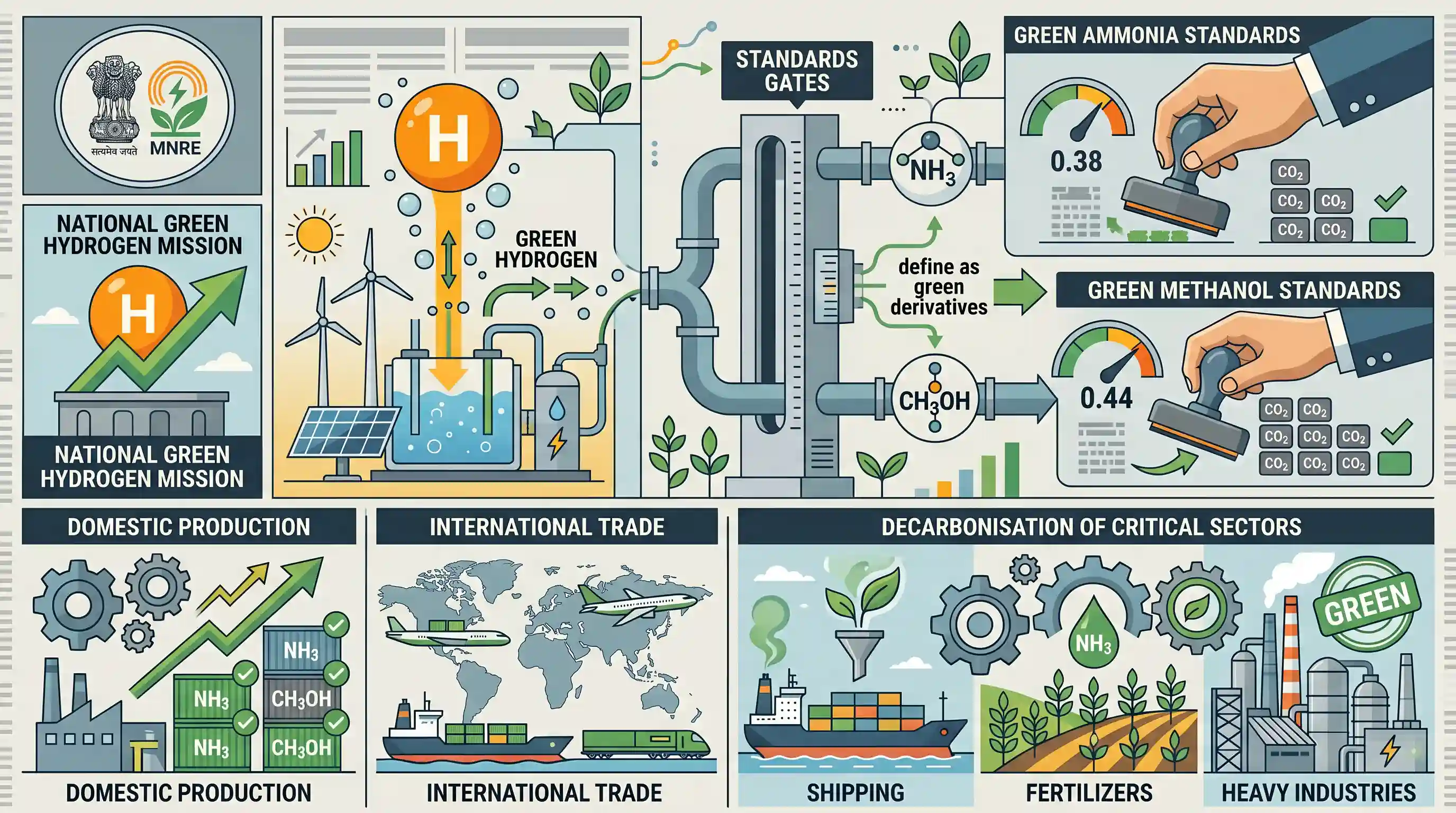
The Union Ministry of New and Renewable Energy (MNRE) has established the first-ever standards for Green Ammonia and Green Methanol under the National Green Hydrogen Mission. Setting strict emission thresholds (0.38 kg CO2 eq/kg for ammonia and 0.44 kg CO2 eq/kg for methanol), the notification clarifies what qualifies as 'green' derivatives of hydrogen. This regulatory certainty aims to boost domestic production, foster international trade, and accelerate the decarbonisation of critical sectors like shipping, fertilizers, and heavy industries.
Key Points
- The Indian government has notified official standards for Green Ammonia and Green Methanol under the National Green Hydrogen Mission to accelerate clean energy trade.
- Green ammonia is defined as having total non-biogenic greenhouse gas emissions not exceeding 0.38 kg CO2 equivalent per kg of ammonia produced.
- Green methanol must have total greenhouse gas emissions not exceeding 0.44 kg CO2 equivalent per kg of methanol.
- Carbon dioxide sourced for green methanol production can come from biogenic sources, Direct Air Capture (DAC), or captured from existing industrial processes.
- These standards are critical for establishing India as a global hub for the production and export of green hydrogen derivatives and supporting the decarbonisation of hard-to-abate sectors.
Important Terms
National Green Hydrogen Mission

A flagship Union Government initiative launched in 2023 to make India a global hub for the production, usage, and export of green hydrogen and its derivatives.
UPSC context
GS Paper 3: Energy, Infrastructure, and Environment. Tests knowledge of India's 2030 targets, energy security, and Net Zero 2070 goals.
Ministry of New and Renewable Energy (MNRE)
The nodal ministry of the Government of India responsible for all matters relating to new and renewable energy, including policy formulation and implementation of the National Green Hydrogen Mission.
UPSC context
GS Paper 2: Government Policies and Interventions. Tests understanding of the institutional framework driving India's energy transition.
Green Ammonia
Ammonia produced exclusively using green hydrogen; India's 2026 standards cap its non-biogenic greenhouse gas emissions at 0.38 kg CO2 equivalent per kg of ammonia.
UPSC context
GS Paper 3: Science and Technology and Environment. Focuses on decarbonising the fertilizer and shipping sectors.
Green Methanol
Methanol synthesized from green hydrogen and CO2; the 2026 standards limit its emissions to 0.44 kg CO2 equivalent per kg of methanol.
UPSC context
GS Paper 3: Industrial Policy and Science. Relevant for clean marine fuels and low-carbon industrial feedstock.
SIGHT Programme
A key sub-component of the National Green Hydrogen Mission providing financial incentives for domestic electrolyser manufacturing and green hydrogen production.
UPSC context
GS Paper 3: Economy and Industry. Tests knowledge of specific incentive mechanisms (PLI-style) for emerging technologies.
Decarbonisation
The process of reducing or eliminating carbon dioxide emissions from human activity, particularly in 'hard-to-abate' industrial sectors like steel, cement, and fertilizers.
UPSC context
GS Paper 3: Environment and Conservation. A core concept in climate change mitigation and sustainable development.
Prelims Trap
"To qualify as 'Green Ammonia', the production process must have absolute zero greenhouse gas emissions."
The standard mandates an emission threshold (e.g., max 0.38 kg CO2 eq/kg for ammonia), meaning emissions are capped, not absolute zero, to accommodate lifecycle assessment realities.
Static Concepts Connected
What is the 'color palette' of hydrogen production?
- Grey / Brown Hydrogen: Produced via steam methane reforming using natural gas or coal, where the resulting CO2 emissions are released directly into the atmosphere.
- Blue Hydrogen: Extracted from natural gas but incorporates Carbon Capture and Storage (CCS) technology to trap greenhouse gases before they escape.
- Green Hydrogen: Generated through the electrolysis of water powered entirely by renewable energy sources like solar or wind, leaving no carbon footprint.
What is the 'Methanol Economy' championed by NITI Aayog?
- Import Substitution: Blending methanol (e.g., M15) in gasoline can drastically reduce crude oil import bills and enhance national energy security.
- Feedstock Flexibility: Methanol can be produced from diverse domestic sources including high-ash coal, municipal solid waste, biomass, and stranded gas.
- Clean Marine Fuel: Acts as a clean-burning liquid fuel substitute for heavy fuel oil in ships and diesel in railways, emitting negligible SOx and NOx.
Cross-Topic Patterns
Decarbonizing the fertilizer sector
Green ammonia bridges renewable energy with agriculture. By replacing natural gas-derived 'grey ammonia' in urea manufacturing, it supports India's import-reduction goals and sustainable farming schemes like PM-PRANAM.
Green maritime shipping and IMO targets
Green methanol is the frontrunner for decarbonizing the shipping industry, closely linking India’s domestic standards with the International Maritime Organization’s (IMO) ambitious 2050 net-zero greenhouse gas emission targets.

Expect a multi-statement question interlinking National Green Hydrogen Mission thresholds with fertilizer/shipping decarbonisation in 2026.
Linked PYQs · 4
Linked PYQs · 4
- 2023PrelimsGS1
With reference to green hydrogen, consider the following statements: 1. It can be used directly as a fuel for internal combustion. 2. It can be blended with natural gas and used as fuel for heat or power generation. 3. It can be used in the hydrogen fuel cell to run vehicles. How many of the above statements are correct?
- 2023PrelimsGS1
Consider the following heavy industries: 1. Fertilizer plants 2. Oil refineries 3. Steel plants Green hydrogen is expected to play a significant role in decarbonizing how many of the above industries?
- 2024PrelimsGS1
Which one of the following is the exhaust pipe emission from Fuel Cell Electric Vehicles, powered by hydrogen ?
- 2022MainsGS3
Do you think India will meet 50 percent of its energy needs from renewable energy by 2030 ? Justify your answer. How will the shift of subsidies from fossil fuels to renewables help achieve the above objective ? Explain.
