Government Deploys Mechanical Sweepers to Tackle Delhi Dust
Source:Indian Express ↗
Why It Matters
Delhi's seasonal toxic air is a recurring urban and public health crisis. The administrative response detailed here provides excellent case-study material for mains answers on environmental governance, center-state cooperation in tackling pollution, and the practical challenges of urban infrastructure and solid waste management.
Summary
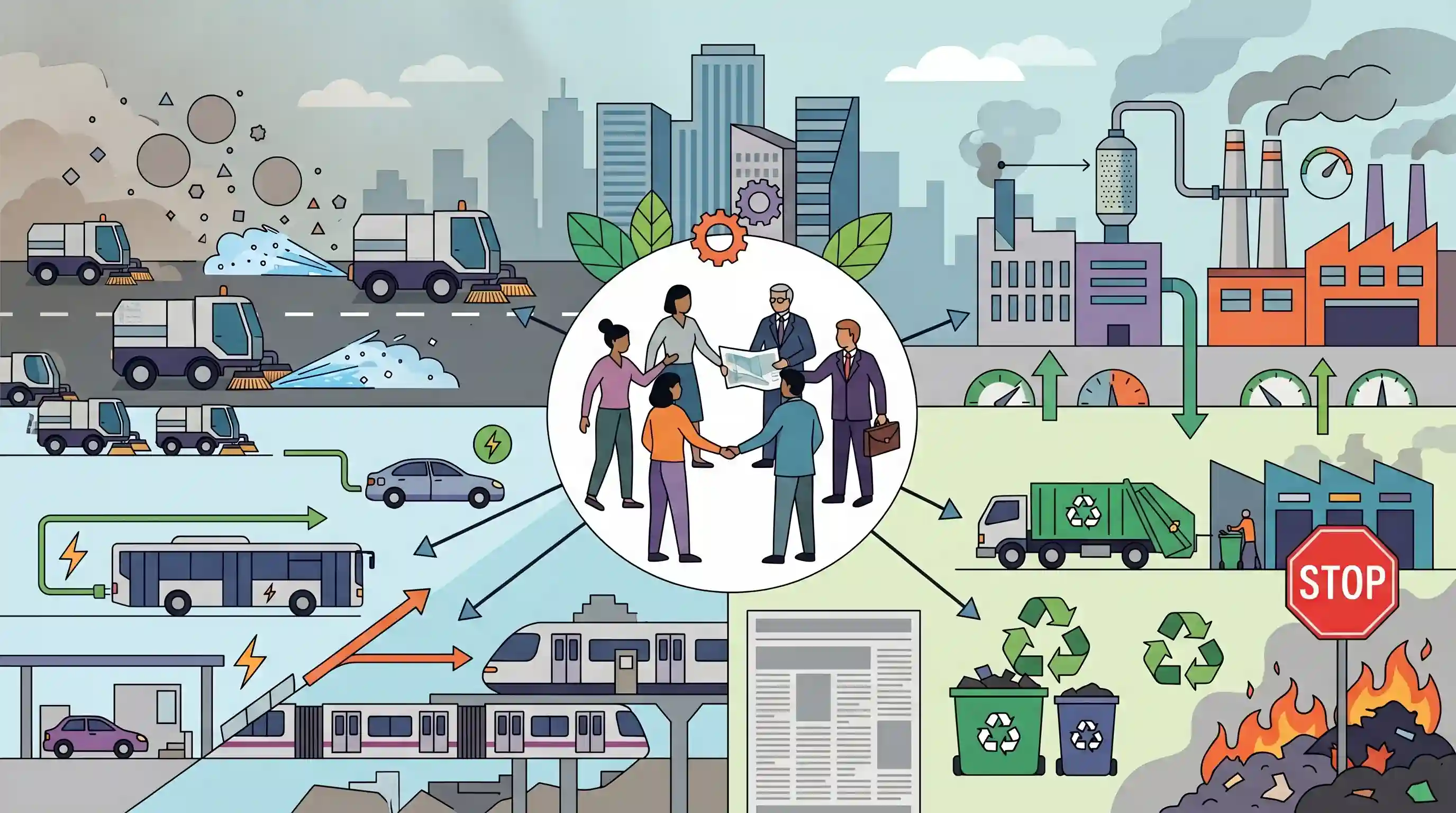
In response to the severe air pollution crisis in Delhi, the Union Environment Ministry and the Delhi government have outlined a coordinated action plan focusing on dust mitigation, urban transport, and waste management. A significant intervention addresses the critical shortage of Mechanical Road Sweeping Machines (MRSMs), requiring the addition of 78 large/medium machines to suppress PM10 and PM2.5 emissions. Beyond road dust, the plan enforces timelines for acquiring electric buses, enhancing Metro connectivity, curbing industrial emissions, and preventing open waste burning, emphasizing a 'Whole of Government, Whole of Society' approach.
Key Points
- Union Environment Minister Bhupender Yadav and Delhi CM Rekha Gupta held a review meeting focusing on urgent interventions to mitigate Delhi-NCR air pollution, particularly targeting road dust.
- To combat the severe shortage of road sweepers, Delhi has been directed to deploy at least 78 large and medium Mechanical Road Sweeping Machines (MRSMs) and 1,000 litter pickers by September 2026.
- Other infrastructural directives involve finalizing electric bus procurement, expanding EV charging infrastructure, completing 15 signal-free corridors, and establishing comprehensive Metro connectivity.
- A strict timeline has been issued for checking industrial pollution, stopping illegal diesel generator usage, halting open waste burning, and commissioning Waste-to-Energy plants.
Important Terms
Commission for Air Quality Management (CAQM)

A statutory body established in 2021 with overarching authority to coordinate air quality management in Delhi-NCR and adjoining states, including Punjab, Haryana, Rajasthan, and Uttar Pradesh.
UPSC context
GS Paper 3: Environment. Tests knowledge of statutory bodies and inter-state coordination for pollution control.
Central Pollution Control Board (CPCB)
A statutory organization established in 1974 that provides technical services to the Environment Ministry, sets environmental standards, and coordinates activities of State Pollution Control Boards.
UPSC context
GS Paper 3: Environment and GS Paper 2: Statutory Bodies. Tests understanding of India's apex pollution regulator.
Union Environment Ministry (MoEFCC)
The nodal agency of the Central Government responsible for planning, promoting, and overseeing the implementation of India's environmental, forestry, and climate change policies.
UPSC context
GS Paper 2: Governance. Tests knowledge of nodal ministries and their roles in policy implementation.
Municipal Corporation of Delhi (MCD)
The primary urban local body in Delhi responsible for civic services, including waste management, sanitation, and ground-level dust mitigation through mechanized sweeping.
UPSC context
GS Paper 2: Urban Local Bodies. Tests understanding of municipal functions in disaster and pollution management.
Central Road Research Institute (CRRI)
A premier research laboratory under CSIR specializing in road engineering and infrastructure, recently tasked with creating standard frameworks for dust-free road redevelopment in the NCR.
UPSC context
GS Paper 3: Infrastructure. Tests knowledge of R&D institutions in solving urban environmental challenges.
School of Planning and Architecture (SPA)
An Institution of National Importance that provides expertise in sustainable urban planning and design, helping to integrate greening and pedestrian-friendly features into dust-mitigation projects.
UPSC context
GS Paper 3: Urbanization and Environment. Tests understanding of interdisciplinary approaches to sustainable city design.
Prelims Trap
"Mechanical road sweepers are deployed primarily to eliminate PM2.5 and gaseous vehicular emissions in urban areas."
Mechanical road sweepers primarily mitigate resuspended road dust, which is the largest source of PM10 (coarse particles), not combustion-driven PM2.5 or noxious gases.
Static Concepts Connected
What are the statutory powers of the Commission for Air Quality Management (CAQM)?
- Statutory backing: Established under the CAQM in NCR and Adjoining Areas Act, 2021, replacing the EPCA.
- Broad jurisdiction: Covers the NCR and "adjoining areas" (Punjab, Haryana, Rajasthan, UP) whose pollution sources impact the NCR.
- Overriding powers: Its orders and directions supersede those of the CPCB and State Pollution Control Boards in case of conflict.
- Enforcement mandate: Empowered to issue binding directions, regulate industries, restrict activities, and impose penalties for non-compliance.
What differentiates the primary sources of PM10 and PM2.5 in urban environments?
- PM10 (Coarse) sources: Mainly generated by mechanical processes like road dust resuspension, construction/demolition activities, and wind-blown soil.
- PM2.5 (Fine) sources: Primarily generated from combustion processes (vehicles, diesel generators, biomass burning) and secondary aerosol formation from gases.
- Health impact difference: PM2.5 is more dangerous as it can penetrate deep into the lungs and enter the bloodstream.
Cross-Topic Patterns
Waste-to-Energy (WtE) vs. Toxic Emissions
While WtE plants reduce open municipal waste burning, they must strictly manage combustion temperatures to prevent toxic Dioxin and Furan emissions, a frequent environmental chemistry theme in UPSC.
Cooperative Federalism in Climate Action
Joint action between the Union Ministry and Delhi Government exemplifies the 'Whole of Government' approach, highlighting how transboundary environmental challenges force cooperative federalism.

CAQM's statutory powers vs CPCB, combined with the source-apportionment of PM10 vs PM2.5, is highly likely in a 2026 prelims question.
Linked PYQs · 4
Linked PYQs · 4
- 2021MainsGS3
Describe the key points of the revised Global Air Quality Guidelines (AQGs) recently released by the World Health Organisation (WHO). How are these different from its last update in 2005? What changes in India's National Clean Air Programme are required to achieve these revised standards?
- 2022MainsGS3
Discuss in detail the photochemical smog emphasizing its formation, effects and mitigation. Explain the 1999 Gothenburg Protocol.
- 2023MainsGS3
The adoption of electric vehicles is rapidly growing worldwide. How do electric vehicles contribute to reducing carbon emissions and what are the key benefits they offer compared to traditional combustion engine vehicles?
- 2018MainsGS3
What are the impediments in disposing the huge quantities of discarded solid wastes which are continuously being generated? How do we remove safely the toxic wastes that have been accumulating in our habitable environment?
