Antitrust Regulation and Big Tech Digital Monopoly Rulings
Source:The Hindu ↗
Why It Matters
This ruling provides critical comparative context for India's regulatory environment. It underscores the challenges posed by Big Tech monopolies and informs the ongoing efforts of the Competition Commission of India (CCI) to prevent the abuse of dominant market positions by multinational corporations.
Summary
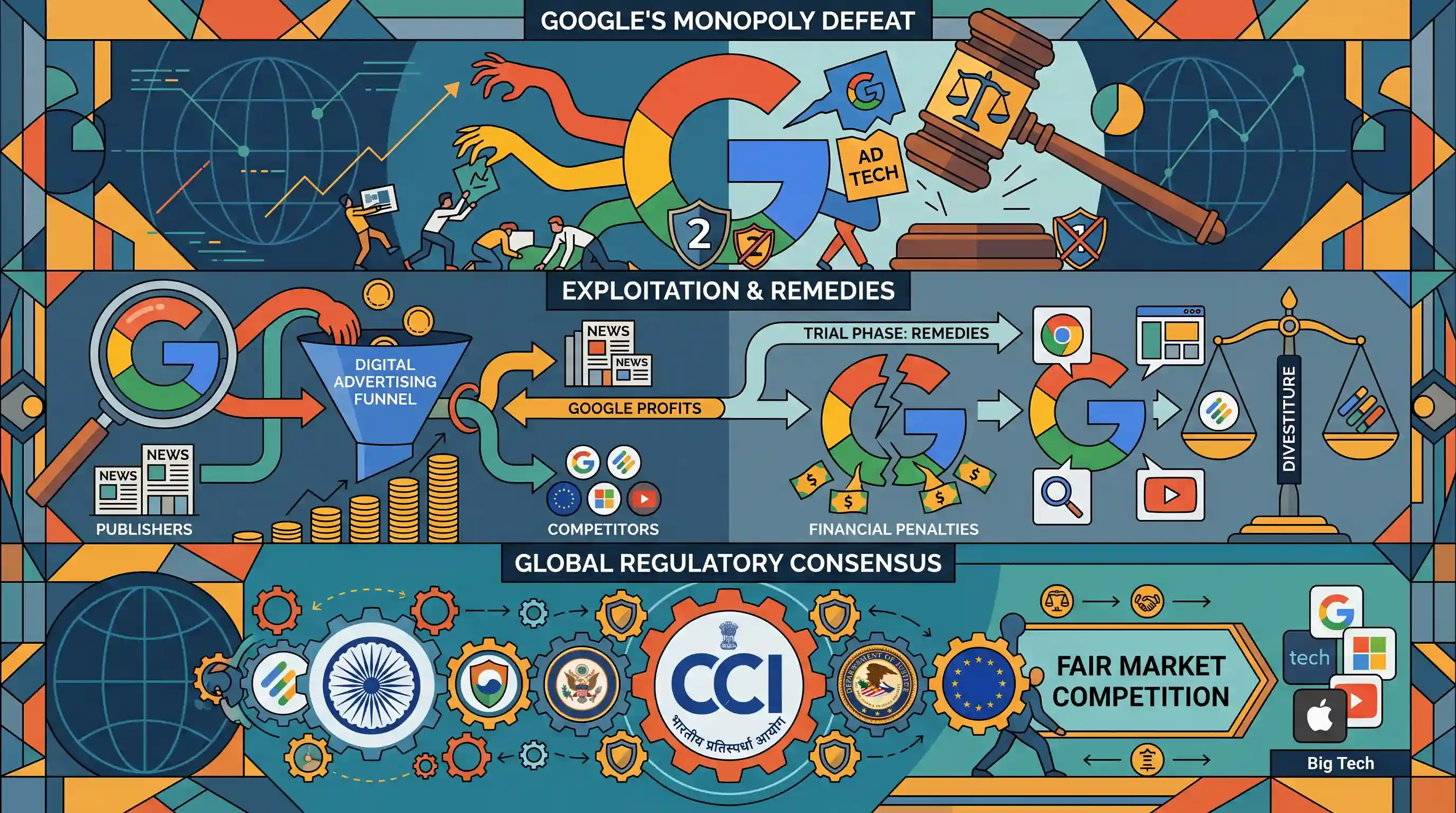
A U.S. federal court has ruled that Google operates an illegal monopoly in the digital advertising market, marking the company's second major anti-trust defeat in less than a year. The ruling found that Google exploited its market dominance to boost profits at the expense of online publishers and competitors. A forthcoming trial phase will determine remedies, which could range from financial penalties to breaking up the company by forcing the sale of assets like Google Ad Manager or the Chrome browser. The decision underscores the growing global regulatory consensus on reigning in Big Tech monopolies and ensuring fair market competition.
Key Points
- A U.S. federal judge declared Google's digital advertising network an illegal monopoly that stifles competition and squeezes online publishers.
- This marks Google's second major anti-trust defeat within a year, following a previous ruling against its search engine dominance.
- The next phase of the trial will determine remedies, which could potentially include forcing Google to divest key assets like its Ad Manager platform or the Chrome browser.
- The ruling amplifies the global regulatory push against Big Tech monopolies, serving as an important precedent for bodies like the Competition Commission of India (CCI) in their efforts to curb anti-competitive practices.
Important Terms
Competition Commission of India (CCI)

A statutory body under the Ministry of Corporate Affairs, established by the Competition Act, 2002, to prevent anti-competitive practices and ensure fair trade in India.
UPSC context
GS Paper 2 & 3; tests understanding of statutory bodies and their role in regulating market behavior and consumer welfare.
Anti-trust Laws
Legal frameworks designed to ensure fair market competition by preventing monopolies, cartels, and predatory business practices; in India, primarily regulated by the Competition Act, 2002.
UPSC context
GS Paper 3 (Indian Economy); relevant for discussions on market efficiency, liberalization, and the regulatory oversight of private enterprises.
Abuse of Dominant Position
Under Section 4 of India’s Competition Act, this occurs when a market-leading firm uses its power to restrict competition, impose unfair prices, or deny market access.
UPSC context
GS Paper 3; critical for analyzing legal challenges in the digital economy and the impact of monopolistic behavior on innovation.
Digital Competition Bill
A proposed Indian law aiming to proactively regulate large technology firms (Systemically Significant Digital Enterprises) to prevent monopolistic behavior before it occurs in digital markets.
UPSC context
GS Paper 3 (Technology/Economy); tests knowledge of emerging legislative efforts to curb the dominance of global tech giants.
Ex-ante Regulation
A proactive regulatory framework that sets preventative rules for firms to follow, contrasting with 'ex-post' regulation, which only intervenes after anti-competitive behavior has occurred.
UPSC context
GS Paper 3; crucial for understanding modern governance strategies tailored for the fast-paced and rapidly consolidating digital economy.
Big Tech
A term for dominant global technology firms (like Google, Amazon, Meta) that hold significant influence over digital infrastructure, data, and market competition.
UPSC context
GS Paper 3 (IT & Economy); relates to global governance, data sovereignty, and the challenges of regulating transnational corporations.
Prelims Trap
The existing Competition Act, 2002 utilizes an ex-ante framework to preemptively stop Big Tech monopolies.
The 2002 Act relies on an ex-post (reactive) framework. It is the proposed Draft Digital Competition Bill that seeks to introduce an ex-ante (preventative) mechanism.
Static Concepts Connected
What is the mandate and composition of the Competition Commission of India (CCI)?
- Statutory Body: Established under the Competition Act, 2002 (replacing the MRTP Act, 1969) to eliminate anti-competitive practices and ensure fair markets.
- Core Mandate: To penalize the abuse of dominant position, regulate combinations (mergers/acquisitions), and protect consumer interests.
- Composition: Consists of a Chairperson and not less than 2 and not more than 6 other members, all appointed by the Central Government.
How do 'network effects' and 'market tipping' shape digital economy monopolies?
- Network Effects: An economic phenomenon where a digital platform’s value increases exponentially with every new user, creating massive entry barriers for new startups.
- Market Tipping: The irreversible point where scale and data accumulation permanently alter a market, creating a 'winner-takes-all' monopoly that cannot be broken naturally.
- Structural Remedies: Forcing the divestiture or breakup of corporate assets (like selling off a browser) to artificially restore competition when markets have tipped.
Cross-Topic Patterns
Data Sovereignty & Big Tech Monopolies
The antitrust push against digital ad monopolies directly links to the DPDP Act, as unchecked data harvesting forms the very foundation of this anti-competitive dominance.
Systemically Significant Entities (SSDEs vs D-SIBs)
Much like the RBI identifies 'too-big-to-fail' Domestic Systemically Important Banks (D-SIBs), the Draft Digital Competition Bill designates SSDEs to enforce stricter, pre-emptive market compliance.

Expect a 2026 GS3 Mains question comparing 'ex-ante' vs 'ex-post' regulation for Big Tech, or a Prelims MCQ on SSDE designation.
Linked PYQs · 3
Linked PYQs · 3
- 2023MainsGS2
Discuss the role of the Competition Commission of India in containing the abuse of dominant position by the Multi-National Corporations in India. Refer to the recent decisions.
- 2022PrelimsGS1
With reference to foreign-owned e-commerce firms operating in India, which of the following statements is/are correct? 1. They can sell their own goods in addition to offering their platforms as market-places. 2. The degree to which they can own big sellers on their platforms is limited. Select the correct answer using the code given below:
- 2023MainsGS3
What is the status of digitalization in the Indian economy? Examine the problems faced in this regard and suggest improvements.
