Google Search AI Mode and Digital Ecosystem Impact
Source:The Hindu ↗
Why It Matters
The transformation of search engines via Generative AI has profound implications for the global digital economy, user privacy, and intellectual property. It underscores the urgent need for regulatory frameworks (like the CCI in India) to address Big Tech monopolies, algorithmic transparency, and the livelihood of digital content creators.
Summary
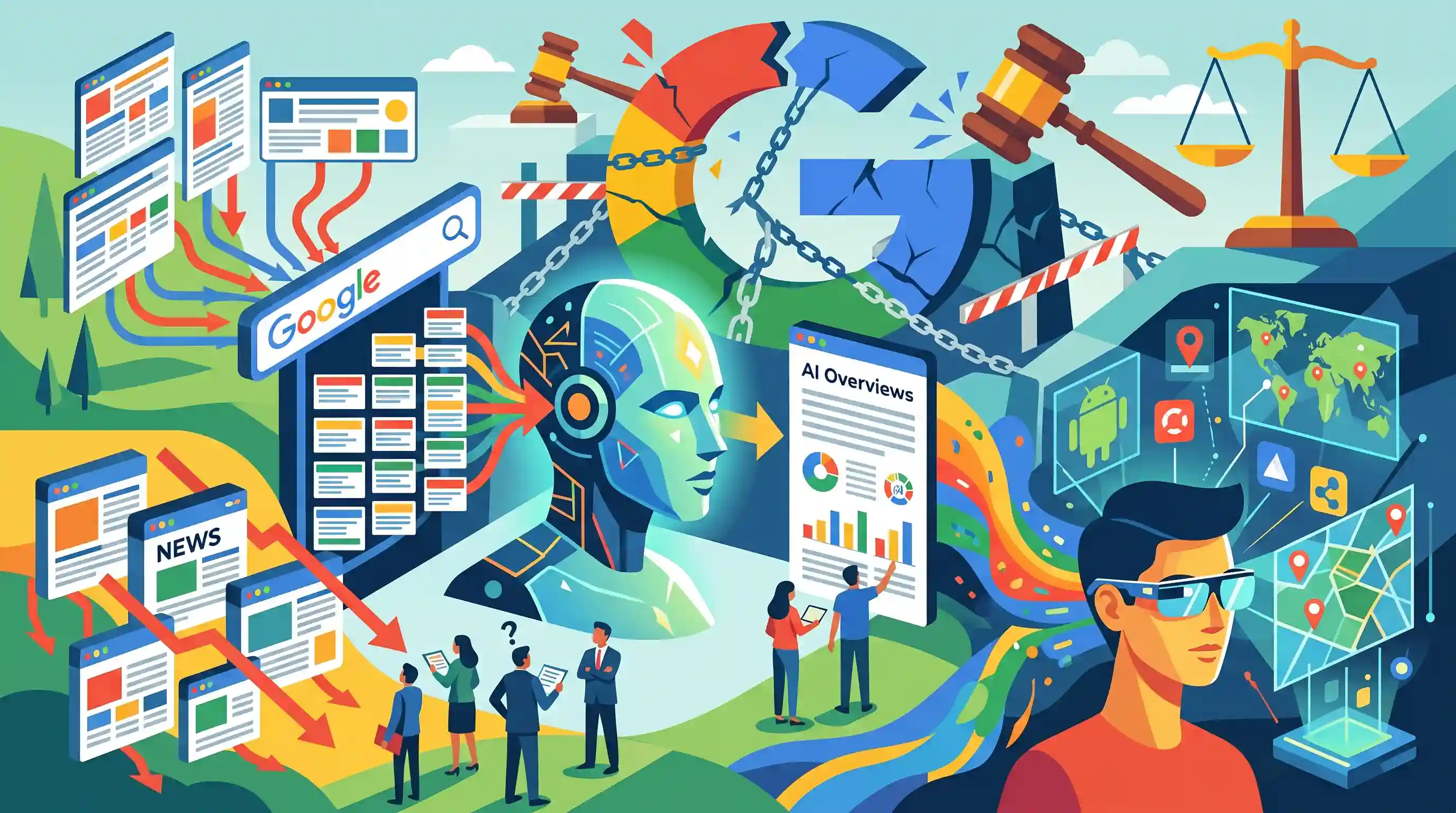
Google has introduced a conversational 'AI mode' powered by its Gemini 2.5 generative AI model, fundamentally transforming the traditional search experience by providing direct 'AI overviews' instead of links. This shift raises significant concerns about the digital ecosystem, as search optimization firms report a drop in web traffic and click-through rates for publishers. Alongside this software evolution, Google is expanding its hardware footprint by re-entering the wearable technology space with Android XR-powered smart glasses. These aggressive technological advancements come amidst intense antitrust scrutiny, following a recent ruling declaring Google's search dominance an illegal monopoly.
Key Points
- Google has launched an 'AI mode' for search in the United States, powered by the Gemini 2.5 generative AI model, which provides conversational 'AI overviews' instead of traditional links.
- The shift toward AI summaries is altering the digital ecosystem; data from BrightEdge indicates a 30% decline in click-through rates for searches that feature AI overviews, impacting web publishers.
- Alphabet Inc. continues to maintain significant market dominance, though it faces severe antitrust scrutiny, including a US federal judge's ruling that its search engine constitutes an illegal monopoly.
- Google announced plans to re-enter the wearable technology market by developing smart glasses powered by Android XR, in partnership with eyewear brands Gentle Monster and Warby Parker.
- Upcoming AI capabilities include 'Project Mariner,' an AI agent designed to autonomously perform web tasks like booking tickets, and 'Deep Search' for executing complex queries.
Important Terms
Gemini 2.5

Google's frontier generative AI model (2025) designed with 'thinking' capabilities, featuring advanced reasoning, native multimodality, and a massive context window for processing vast datasets.
UPSC context
GS Paper 3: Science & Tech. Tests knowledge of emerging AI architectures like 'reasoning models' and their impact on the digital economy.
Project Mariner
An experimental AI agent by Google DeepMind capable of autonomously navigating web browsers to perform multi-step tasks like online shopping, form-filling, and information retrieval.
UPSC context
GS Paper 3: Science & Tech. Relevant for 'Agentic AI'—the transition from chatbots to autonomous software agents that execute real-world tasks.
Android XR
An operating system for Extended Reality (XR) devices, developed by Google and Samsung, designed to power smart glasses and headsets with integrated generative AI.
UPSC context
GS Paper 3: Science & Tech. Concerns IT and wearable technology, specifically the convergence of AI with Augmented Reality (AR) hardware.
Deep Search
A high-intensity AI research tool within Google Search that issues hundreds of queries and synthesizes information into comprehensive, cited reports.
UPSC context
GS Paper 3: Science & Tech. Highlights the evolution of information retrieval and its potential to disrupt traditional web-traffic and publishing models.
Antitrust Monopoly Ruling
A 2024-2025 landmark U.S. judicial ruling declaring Google's search dominance an illegal monopoly, leading to potential structural changes in how Big Tech operates.
UPSC context
GS Paper 3: Economy / GS Paper 2: Governance. Crucial for understanding global regulatory trends against platform dominance and competition law.
AI Mode
A paradigm shift in Google Search where users interact with a conversational AI interface (Gemini) to get direct answers rather than a list of blue links.
UPSC context
GS Paper 3: Digital Economy. Tests understanding of the 'zero-click' search trend and its impact on digital content creators and SEO.
Prelims Trap
Project Mariner is an upcoming deep space exploration mission by NASA.
Project Mariner is actually an upcoming 'Agentic AI' software agent developed by Google to autonomously perform web tasks, not a space mission.
Static Concepts Connected
What distinguishes Agentic AI from standard Generative AI?
- Generative AI: Responds to user prompts to create text, audio, or images, requiring step-by-step human guidance.
- Agentic AI: Operates autonomously to plan and execute complex, multi-step goals (like booking a flight) without continuous human intervention.
How does Ex-ante regulation differ from Ex-post regulation in digital markets?
- Ex-post (Current): Regulators (like CCI) investigate and penalize anti-competitive behavior only after the abuse of dominance has occurred.
- Ex-ante (Proposed): Sets proactive rules for Systemically Significant Digital Enterprises (SSDEs) to prevent monopolistic practices before they happen.
Cross-Topic Patterns
Zero-Click Searches and IP Rights
AI-generated summaries that bypass source links threaten publisher revenues, linking AI tech directly to copyright and intellectual property rights syllabus areas.
Global Antitrust vs. Big Tech
US rulings against Google's search monopoly parallel India's push for the Digital Competition Bill to rein in Systemically Significant Digital Enterprises (SSDEs).

Agentic AI vs GenAI, or linking 'Zero-click' tech to IP copyright frameworks, is highly likely as a 2026 Prelims tech question.
Linked PYQs · 4
Linked PYQs · 4
- 2023MainsGS3
Introduce the concept of Artificial Intelligence (AI). How does Al help clinical diagnosis? Do you perceive any threat to privacy of the individual in the use of Al in healthcare?
- 2023MainsGS2
Discuss the role of the Competition Commission of India in containing the abuse of dominant position by the Multi-National Corporations in India. Refer to the recent decisions.
- 2019PrelimsGS1
In the context of digital technologies for entertainment, consider the following statements: 1. In Augmented Reality (AR), a simulated environment is created and the physical world is completely shut out. 2. In Virtual Reality (VR), images generated from a computer are projected onto real-life objects or surroundings. 3. AR allows individuals to be present in the world and improves the experience using the camera of smart-phone or PC. 4. VR closes the world, and transposes an individual, providing complete immersion experience. Which of the statements given above is/are correct?
- 2019PrelimsGS1
In the context of wearable technology, which of the following tasks is/are accomplished by wearable devices? 1. Location identification of a person 2. Sleep monitoring of a person 3. Assisting the hearing impaired person Select the correct answer using the code given below.
