Google Announces Major Data Centre Investment in Andhra Pradesh
Source:The Hindu ↗
Why It Matters
Data centres are the physical foundation of the digital economy. Their expansion highlights critical issues in India's infrastructure development, particularly the immense electricity requirements they impose. Balancing this energy demand with renewable energy commitments is a vital topic spanning digital growth, foreign investment, and environmental sustainability in GS3.
Summary
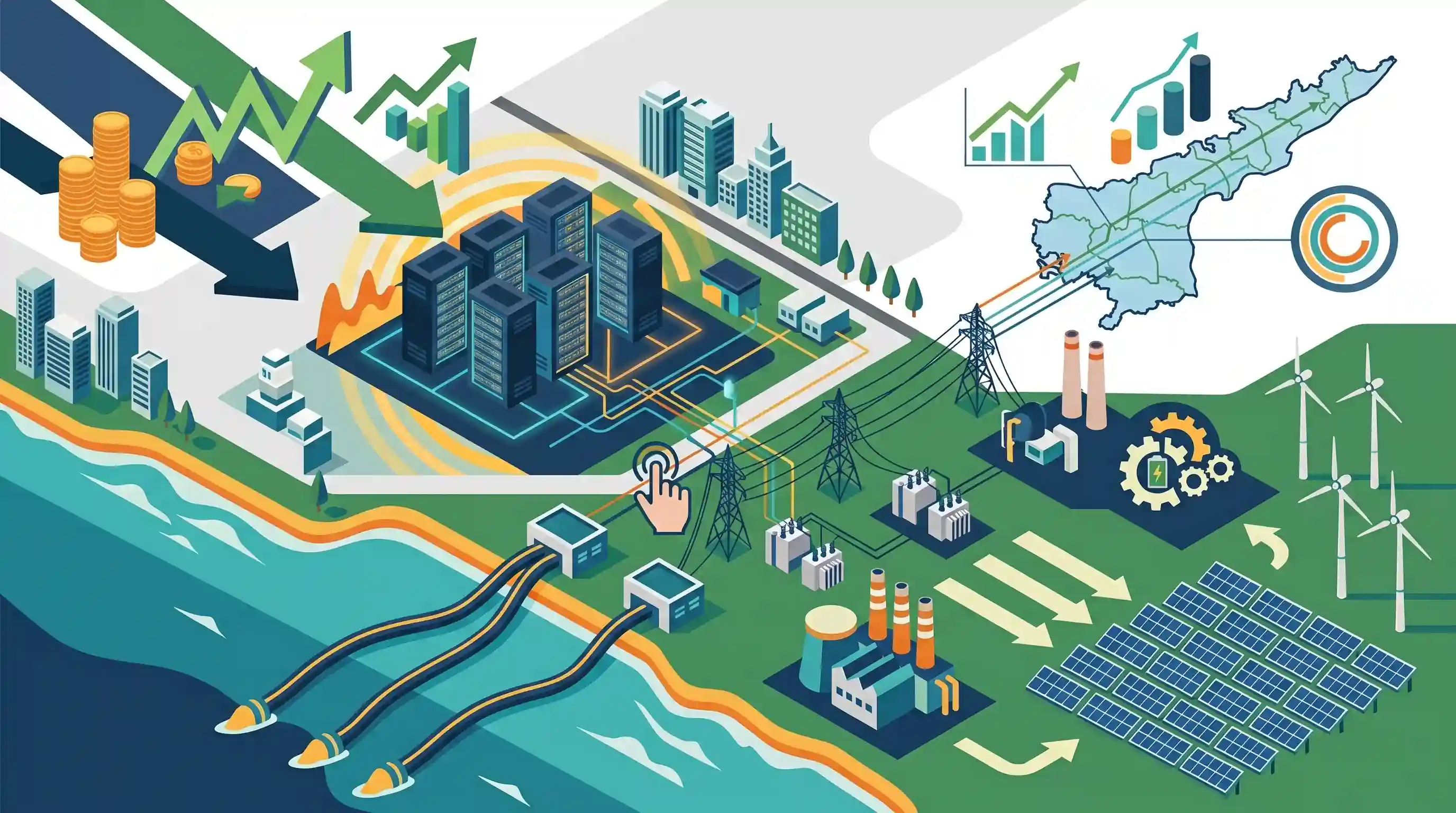
Google announced a massive $6 billion investment to develop a 1-gigawatt data centre and power infrastructure in Visakhapatnam, Andhra Pradesh. Recognizing the immense energy requirements of modern data centres, the company will allocate about $2 billion of this sum toward renewable energy generation. The state government is actively fostering this digital ecosystem with a broader goal of establishing 6 GW of data centre capacity within five years. Additionally, plans are underway to secure three underwater cable landing stations in Visakhapatnam. This development underscores the intersection of digital infrastructure expansion, foreign direct investment, and the critical need to balance high-volume electricity demands through a mix of renewable sources and reliable coal-fired baseload power.
Key Points
- Google is investing $6 billion to build a 1-gigawatt data centre and associated power infrastructure in Visakhapatnam, Andhra Pradesh.
- A significant portion ($2 billion) of the investment will be directed towards establishing renewable energy capacity to meet the high power demands of the facility.
- Andhra Pradesh is targeting the creation of 6 GW of data centre capacity over the next five years as part of a major digital push.
- The state is also pursuing three cable landing stations in Visakhapatnam to build an underwater cable network potentially twice the size of Mumbai's network.
- To ensure uninterrupted round-the-clock power, the data centre's energy infrastructure will rely on a mix of green energy and conventional coal-fired power for baseload reliability.
Important Terms
Foreign Direct Investment (FDI)

Long-term investment by a foreign entity into domestic business interests, involving significant management control, technology transfer, and capital inflow into productive assets like infrastructure.
UPSC context
GS Paper 3: Indian Economy; tests understanding of capital inflows, non-debt financial resources, and economic growth drivers.
Data Centre
Centralized physical facilities housing IT infrastructure (servers, storage, networking) used to store and process data, now granted 'infrastructure status' to facilitate credit flow.
UPSC context
GS Paper 3: Science & Tech / Infrastructure; tests knowledge of digital public infrastructure (DPI) and data localization.
Submarine Cable Landing Station
Coastal facilities where undersea fiber-optic cables — which carry over 99% of international data — connect to a country's terrestrial telecommunications network.
UPSC context
GS Paper 3: Infrastructure / Security; tests strategic importance of global connectivity and vulnerability of undersea digital backbones.
Baseload Power
The minimum level of electrical demand on a grid that must be met by unvarying power plants (usually coal or nuclear) operating 24/7.
UPSC context
GS Paper 3: Energy; tests the challenge of balancing intermittent renewables with reliable, continuous power for high-intensity industrial loads.
Energy Security
The uninterrupted availability of energy sources at an affordable price, requiring a stable energy mix and resilient grid infrastructure to support economic growth.
UPSC context
GS Paper 3: Energy / Environment; tests ability to integrate renewable targets while maintaining grid stability.
Prelims Trap
"Green data centres in India operate entirely on 100% renewable energy."
Despite massive renewable investments, uninterrupted 24x7 operation for data centres currently necessitates reliance on conventional coal-fired power for grid baseload reliability.
Static Concepts Connected
What is a Cable Landing Station (CLS) and its strategic significance?
- Definition: A facility where submarine communication cables make landfall, connecting international internet traffic to domestic telecommunication backbones.
- Single-Point-of-Failure: Geographic concentration of these stations (e.g., 95% in Mumbai) creates severe vulnerabilities to maritime sabotage, tsunamis/cyclones, or cyber warfare.
- Regulation: The Telecom Regulatory Authority of India (TRAI) regulates access to CLS to ensure fair competition and national security compliance.
What is the regulatory and policy framework for Data Centres in India?
- FDI Limit: 100% Foreign Direct Investment (FDI) is permitted under the automatic route for setting up data centres.
- Policy Vacuum: India lacks a finalized National Data Centre Policy (2020 draft remains unadopted); the sector currently relies on fragmented state-level incentives.
- Infrastructure Status: Data centres were accorded 'Infrastructure' status in 2022, enabling developers to access long-term institutional credit at lower interest rates.
Cross-Topic Patterns
Data Localisation + Grid Security
The DPDP Act's push for local data storage accelerates domestic data centre creation, inherently increasing India's reliance on coal for the 24x7 baseload power required by these massive facilities.
Cyber Sabotage + Geography
Diversifying Cable Landing Stations to Visakhapatnam mitigates the extreme strategic vulnerability of Mumbai handling 95% of India's submarine internet traffic against natural disasters or cyber-physical sabotage.

Expect a multi-statement Prelims question linking digital infrastructure's energy footprint, coal baseload needs, and CLS vulnerabilities.
Linked PYQs · 3
Linked PYQs · 3
- 2023MainsGS3
What is the status of digitalization in the Indian economy? Examine the problems faced in this regard and suggest improvements.
- 2015MainsGS3
Discuss the advantages and security implications of cloud hosting of servers vis-a-vis in-house machine-based hosting for government businesses.
- 2022MainsGS3
Do you think India will meet 50 percent of its energy needs from renewable energy by 2030 ? Justify your answer. How will the shift of subsidies from fossil fuels to renewables help achieve the above objective ? Explain.
