Quantum Computing Scalability and Environmental Radiation Limits
Source:The Hindu ↗
Why It Matters
Quantum computing is a revolutionary technology with strategic implications for cryptography, drug discovery, and artificial intelligence. Understanding the technical bottlenecks, such as decoherence and error correction, is important for UPSC candidates to grasp the realistic timeline and challenges of quantum supremacy.
Summary
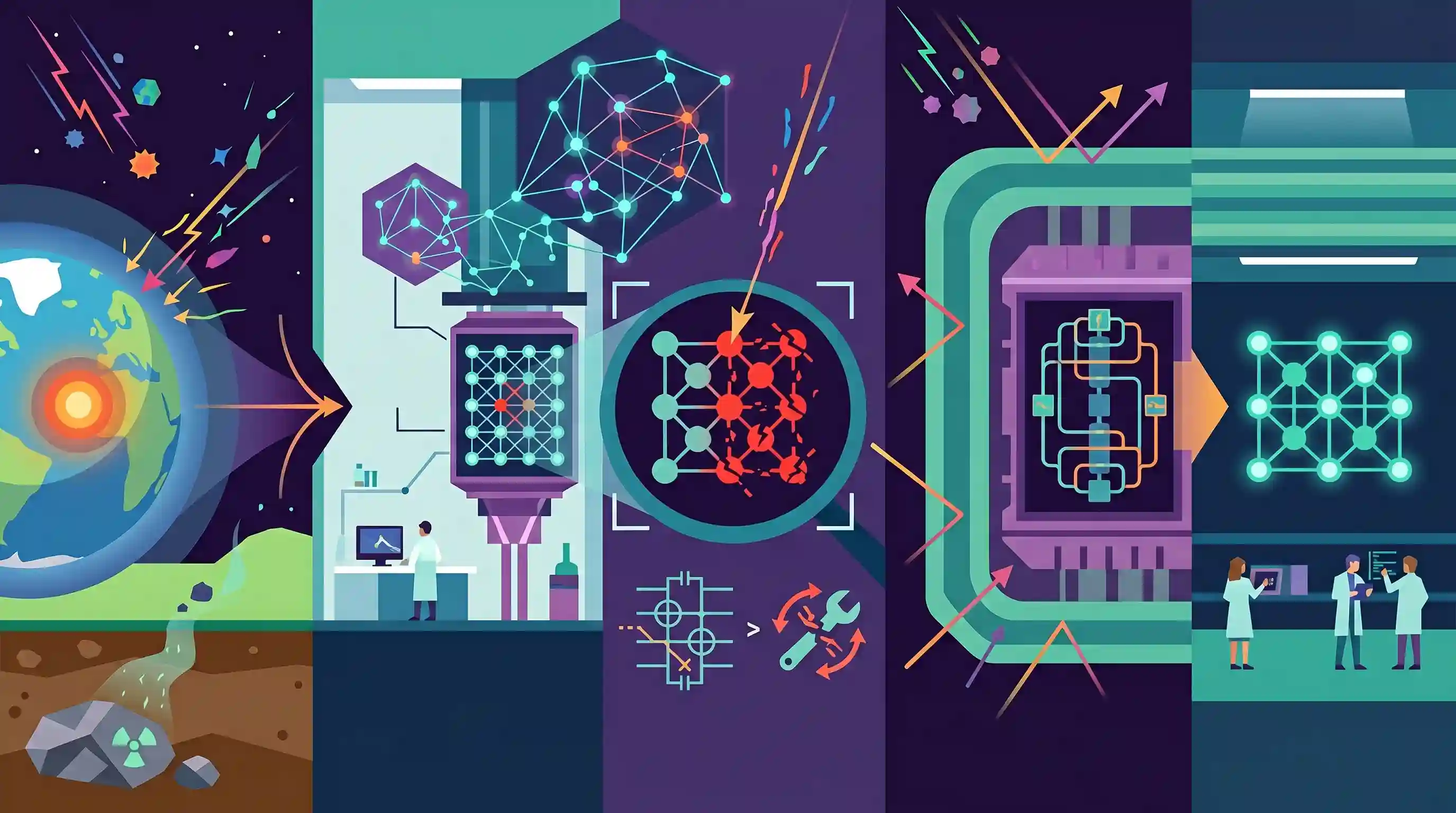
Researchers at Google have identified that environmental radiation, such as cosmic rays and trace radioactivity, poses a significant hurdle to scaling quantum computing. When radiation strikes a quantum processor, it can trigger correlated errors by simultaneously disrupting multiple qubits and causing decoherence. Because standard quantum error correction techniques are designed to handle isolated errors, these correlated disruptions present a major challenge. The findings underscore the need for advanced radiation shielding and novel error-correcting codes to maintain stable quantum states and achieve fault-tolerant quantum computers.
Key Points
- Quantum computers rely on qubits, which maintain fragile quantum states (superposition and entanglement) that are highly sensitive to environmental interference (decoherence).
- Researchers at Google discovered that background radiation, such as cosmic rays and trace radioactivity, can strike quantum chips and cause simultaneous errors across multiple qubits.
- Current quantum error correction codes are primarily designed to fix isolated, independent errors and struggle to mitigate these correlated multi-qubit disruptions.
- Achieving fault-tolerant, scalable quantum computing will require the development of specialized radiation shielding or novel error-correcting architectures.
Important Terms
Quantum Computing

A type of computing that uses quantum mechanics principles—specifically superposition and entanglement—to perform complex calculations exponentially faster than classical computers for certain tasks.
UPSC context
GS Paper III (Science & Technology); critical for understanding emerging technologies, strategic autonomy, and the National Quantum Mission.
Qubit (Quantum Bit)
The fundamental unit of quantum information. Unlike a classical bit (0 or 1), a qubit can represent 0, 1, or both simultaneously due to quantum superposition.
UPSC context
Directly tested in UPSC Prelims 2022; foundational concept for understanding advancements in computing.
Decoherence
The process where a quantum system loses its fragile state (coherence) because of interactions with the external environment, such as heat, vibration, or radiation.
UPSC context
GS Paper III S&T; identifies the primary technical barrier to making quantum computers practical and scalable.
Quantum Error Correction (QEC)
A set of techniques used to protect quantum information from errors caused by decoherence and noise, typically by encoding information across multiple physical qubits.
UPSC context
GS Paper III S&T; essential for the transition from experimental to reliable "utility-scale" quantum processors.
Fault-tolerant Quantum Computing
A quantum computer that can continue operating correctly even when its internal components fail or experience errors, achieved through robust error correction methods.
UPSC context
GS Paper III S&T; represents the final engineering milestone for practical applications in cryptography and drug discovery.
National Quantum Mission (NQM)
An Indian government initiative launched in 2023 to nurture and scale up scientific and industrial R&D in quantum technology across computing, communication, and sensing.
UPSC context
GS Paper III; key policy framework for India's technological sovereignty and scientific achievements.
Prelims Trap
"Quantum entanglement ensures qubits remain stable and immune to environmental interference like background radiation."
Entanglement does not provide immunity; environmental factors like cosmic rays cause "decoherence," instantly breaking the fragile quantum states of entangled qubits.
Static Concepts Connected
What are the foundational phenomena enabling Quantum Computing?
- Superposition: The ability of qubits to exist as 0, 1, or both simultaneously, enabling massive parallel processing capabilities.
- Entanglement: Linked quantum states where altering one particle instantly changes the other, regardless of the physical distance between them.
- Decoherence: The rapid loss of fragile quantum states due to environmental noise (heat, radiation), necessitating extreme cooling and error-correction.
What are Cosmic Rays and how do they impact terrestrial technology?
- Origin: High-energy protons and atomic nuclei moving through space at nearly the speed of light, originating from the sun or outside the solar system.
- Magnetic Shielding: Earth's magnetic field and atmosphere deflect or absorb most cosmic rays, creating showers of secondary particles that reach the surface.
- Technological Impact: Secondary particles can strike microchips, causing bit-flips (single-event upsets) in classical computers and correlated multi-qubit errors in quantum processors.
Cross-Topic Patterns
National Quantum Mission + Material Science
India's ₹6,000 crore National Quantum Mission's goal of scaling physical qubits will directly hinge on domestic advances in radiation-shielding material science and fault-tolerant architectures.
Cosmic Rays + Terrestrial Semiconductors
Just as cosmic rays induce soft errors in traditional semiconductors, they now present a physical limit to quantum scaling, linking space-weather phenomena directly to Earth-based IT infrastructure.

Expect Prelims 2026 to test 'decoherence' and 'superposition' alongside limiting physical factors like cosmic radiation in a single MCQ.
Linked PYQs · 2
Linked PYQs · 2
- 2022PrelimsGS1
Which one of the following is the context in which the term "qubit" is mentioned ?
- 2025PrelimsGS1
Consider the following statements: I. It is expected that Majorana 1 chip will enable quantum computing. II. Majorana 1 chip has been introduced by Amazon Web Services (AWS). III. Deep learning is a subset of machine learning. Which of the statements given above are correct?
