Visakhapatnam Data Center Environmental and Wildlife Conflict
Source:republic-world ↗
ఇది ఎందుకు ముఖ్యం
It highlights the emerging ecological challenges of the digital age, demonstrating the profound local environmental and resource constraints (like water scarcity and wildlife disruption) associated with large-scale tech infrastructure development.
సారాంశం
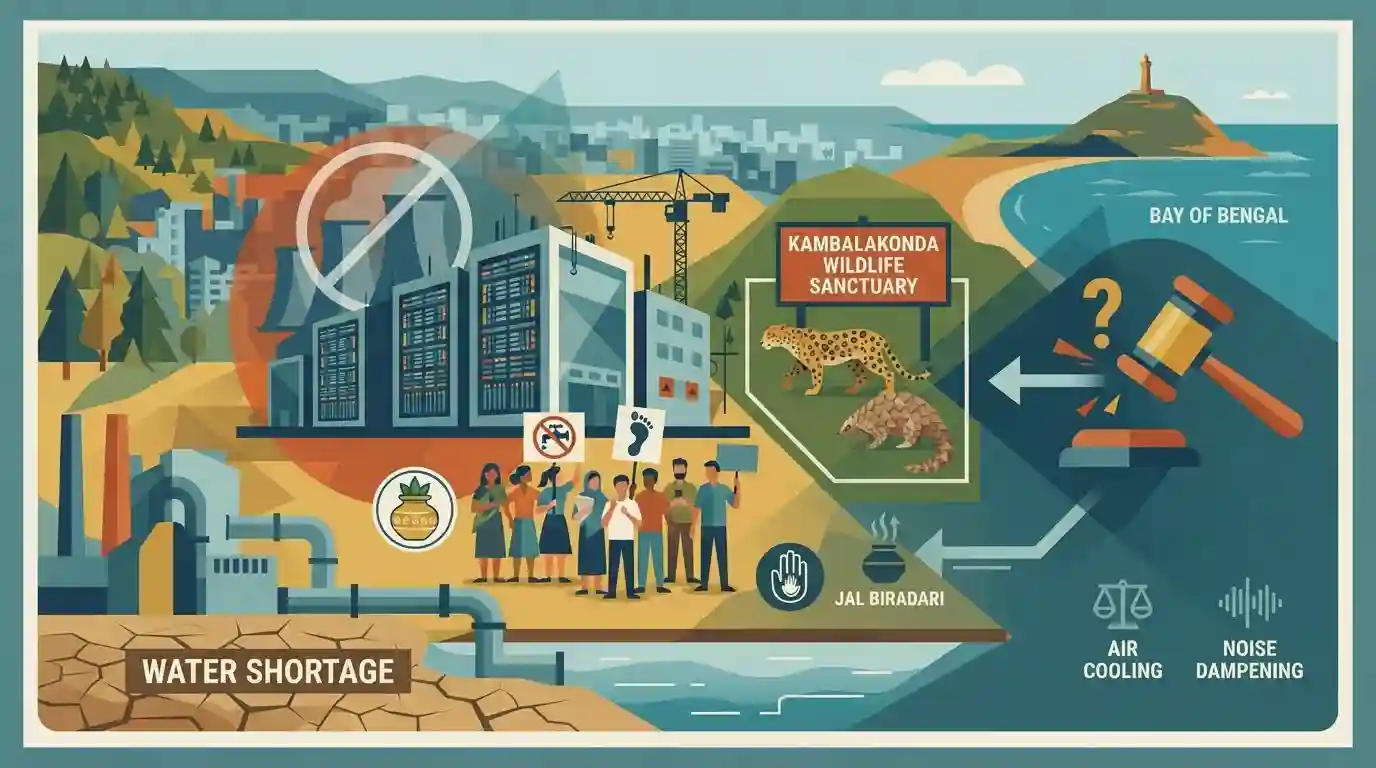
Google's ambitious $15 billion data centre project in Visakhapatnam, Andhra Pradesh, being built in partnership with the Adani Group, is encountering fierce resistance from residents and environmental activists. Local groups, including Jal Biradari and Green Visakha, argue the facility will exacerbate the city's existing severe water shortages. Additional concerns have been raised regarding the project's proximity to the Kambalakonda Wildlife Sanctuary, threatening local fauna like leopards and pangolins. Consequently, organizations like the Human Rights Forum have filed legal challenges with the National Green Tribunal, questioning the environmental clearances granted to the project, while Google maintains it will utilize air-cooling and noise-dampening technologies to minimize its ecological footprint.
ముఖ్య అంశాలు
- Google is developing a $15 billion data centre in Visakhapatnam in partnership with the Adani Group, sparking severe local protests over water scarcity and environmental risks.
- Activists from Jal Biradari and Green Visakha are highlighting that the city already faces a 70 million-litre daily water shortfall, making the data centre's water demands unsustainable.
- The project's proximity (860 metres) to the Kambalakonda Wildlife Sanctuary has raised concerns over construction noise and activity disrupting habitats of leopards and pangolins.
- The Human Rights Forum has filed cases in the National Green Tribunal demanding a halt to construction over alleged regulatory and environmental clearance failures.
ముఖ్యమైన పదాలు
National Green Tribunal

A statutory, specialized quasi-judicial body established under the National Green Tribunal Act, 2010, designed to expedite the resolution of disputes related to environmental protection and forest conservation.
UPSC context
GS Paper II (Statutory Bodies) and GS III (Environment). Tests knowledge of environmental governance and dispute resolution mechanisms.
Environmental Impact Assessment
A systematic process under the Environment (Protection) Act, 1986, evaluating the potential socio-economic, ecological, and health impacts of proposed developmental projects prior to granting clearance.
UPSC context
GS Paper III (Environment). Tests understanding of sustainable development, environmental clearances, and mechanisms balancing industrial growth and conservation.
Kambalakonda Wildlife Sanctuary
A forest reserve in Visakhapatnam, Andhra Pradesh, characterized by dry evergreen and tropical deciduous forests, serving as a vital habitat for leopards, pangolins, and rare endemic species.
UPSC context
GS Paper III (Biodiversity). Tests map-based geographical knowledge of protected areas, local flora, fauna, and conservation challenges.
Jal Biradari
A national water conservation advocacy network in India, co-founded by "Waterman of India" Rajendra Singh, aiming to rejuvenate dead rivers, protect local water bodies, and resolve regional water crises.
UPSC context
GS Paper III (Water Resource Management). Tests familiarity with civil society movements, community-led conservation, and water security initiatives.
Human Rights Forum
A civil liberties and human rights organization active in Andhra Pradesh and Telangana, focusing on displacement, marginalized communities, and legal advocacy against destructive developmental projects.
UPSC context
GS Paper II (NGOs & Civil Society). Tests awareness of non-governmental groups, citizen-led advocacy, and grassroots human rights activism.
ప్రిలిమ్స్ ఉచ్చు
The NGT has judicial jurisdiction to hear appeals or civil cases arising out of violations of the Wildlife (Protection) Act, 1972.
Aspirants often confuse NGT's broad environmental remit with universal jurisdiction, forgetting that major wildlife and forest rights acts are legally excluded from its schedule.
అనుసంధానమైన స్థిర భావనలు
Which key environmental acts fall under or are excluded from the National Green Tribunal's jurisdiction?
- Included laws: Covers seven laws including the Water Act (1974), Air Act (1981), Forest Conservation Act (1980), and Environment Protection Act (1986).
- Excluded laws: Crucially excludes the Wildlife (Protection) Act, 1972 and the Forest Rights Act, 2006 from its schedule of jurisdiction.
- Nature of powers: Acts as a civil court with powers to award compensation for environmental damages, but cannot try criminal offences under excluded acts.
What regulatory clearances govern developmental activities inside or near protected ecological zones?
- ESZ notification: Notified by MoEFCC under the Environment (Protection) Act, 1986, to act as transition zones around National Parks and Wildlife Sanctuaries.
- Default buffer: If an Eco-Sensitive Zone is not officially notified, a default 10 km radius is applied around the protected area boundary.
- NBWL clearance: Projects requiring environmental clearance within these zones must obtain clearance from the Standing Committee of the National Board for Wildlife (NBWL).
అంతర-అంశ నమూనాలు
AI Infrastructure vs. Ecological Carrying Capacity
Examines how the physical resource demands of AI cooling systems clash directly with local climate adaptation goals and municipal water budgets under the National Water Mission.
Eastern Ghats Fragmentation and Schedule-I Corridors
Industrial expansion in Visakhapatnam highlights the conservation neglect of the Eastern Ghats compared to Western Ghats, threatening critical corridors of Endangered pangolins.

Questions testing NGT's legislative exclusions (WPA 1972) alongside ESZ/NBWL clearance mandates are highly likely for 2026.
అనుసంధాన PYQలు · 3
అనుసంధాన PYQలు · 3
- 2024APPSC_PRELIMSGS1
Consider the following states of India : I. Punjab II. Odisha III. Haryana IV. Tamil Nadu Which of the above states have relatively high level of groundwater utilization?
- 2004APPSC_PRELIMSGS1
The Kambalakonda Reserve Forest in A. P. has been declared by the Union Government a Wildlife Sanctuary. Where is it located?
- 2023APPSC_PRELIMSGS1
Which of the following statements is/are correct about the National Green Tribunal? I. It was set up under the National Green Tribunal Act, 2010 II. NGT is bound by the procedure laid down under the Code of Civil Procedure, 1908. III. NGT has six places of sitting throughout the country. Choose the correct answer using the codes given below:
