Big Tech AI Innovation Pivot and Geopolitical Dominance Goals
Source:Indian Express ↗
Why It Matters
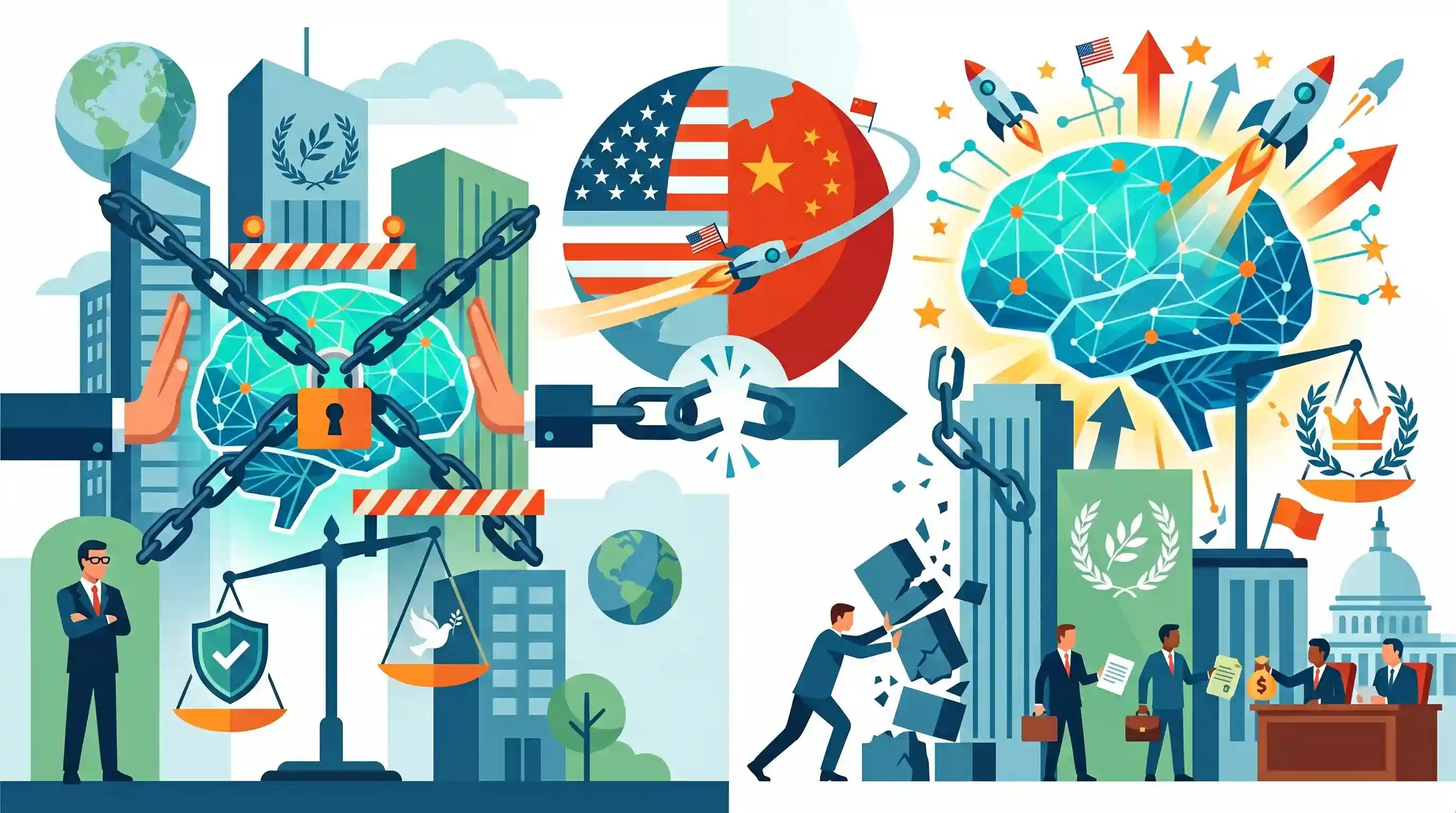
The debate between AI innovation and regulation is a critical governance challenge. The shifting stance of Big Tech away from safety toward speed due to geopolitical competition with China impacts global AI standards, raising significant ethical and security concerns relevant for GS2 (IR), GS3 (S&T policy), and GS4 (Corporate Ethics).
Summary
Leading US tech companies such as Google and OpenAI are undergoing a significant strategic pivot regarding artificial intelligence. Previously vocal about the existential risks of AI and the need for strict regulatory guardrails, these firms are now actively championing rapid innovation and deregulation. This shift is primarily driven by the geopolitical imperative to ensure the United States maintains its technological dominance over rivals, particularly China. Accompanied by aggressive lobbying to align with a deregulatory political climate, this transition highlights the ongoing conflict between prioritizing ethical safety in AI development and the pressures of global technological supremacy.
Key Points
- Major US AI companies like Google and OpenAI have shifted their public stance from highlighting the existential risks of AI to advocating for deregulation and rapid innovation.
- The primary motivation for this pivot is the geopolitical race to maintain American technological dominance and prevent China from gaining an edge in artificial intelligence.
- This shift is accompanied by increased corporate lobbying efforts intended to align with a more deregulatory US government agenda.
- The changing narrative underscores the tension between ensuring ethical AI safety through government guardrails and the pressure of global market competitiveness.
Important Terms
Artificial Intelligence (AI)

Technological systems capable of performing tasks requiring human intelligence, such as reasoning, learning, and decision-making.
UPSC context
GS Paper 3 (Science & Technology); essential for understanding disruptive technologies and socio-economic transformation.
AI Regulation
Policy frameworks (e.g., EU AI Act, IndiaAI Mission) designed to manage risks like bias and privacy while fostering safe innovation.
UPSC context
GS Paper 2 (Governance); tests the balance between state oversight and technological advancement.
Geopolitics of Technology
The intersection of scientific innovation and global power dynamics, where technological leadership defines national security and influence.
UPSC context
GS Paper 2 (International Relations); focuses on US-China rivalry and India's strategic autonomy in tech.
AI Ethics
Moral principles guiding AI development to ensure fairness, transparency, and accountability, preventing misuse or systemic bias.
UPSC context
GS Paper 4 (Ethics); addresses the moral dilemmas and human-centric values in automated decision-making.
Big Tech
A handful of dominant technology giants (e.g., Google, OpenAI) that wield significant market, social, and political influence.
UPSC context
GS Paper 3 (Economy); concerns antitrust issues, market monopolies, and digital sovereignty.
Deregulation
The reduction or removal of government power in a particular industry, often aimed at encouraging competition and rapid innovation.
UPSC context
GS Paper 2/3 (Polity/Economy); explores the trade-off between economic growth and public safety standards.
Prelims Trap
"The Bletchley Declaration is a legally binding international UN treaty regulating the deployment of Frontier AI."
It is a voluntary, cooperative international statement signed at the UK AI Safety Summit, not a legally binding treaty enforced by the UN.
Static Concepts Connected
What is the "Dual-Use Dilemma" in emerging technologies?
- Dual-Use Definition: Technologies like Artificial Intelligence or synthetic biology that possess both highly beneficial civilian applications and the potential for military or malicious use.
- Regulatory Challenge: Policymakers must balance fostering continuous market-driven innovation for economic growth against erecting strict ethical guardrails to prevent weaponization or privacy erosion.
What are the core principles of the EU Artificial Intelligence Act?
- Risk-Based Framework: It implements a four-tier classification system for AI, ranging from 'minimal risk' to 'unacceptable risk' (which is outright banned, like social scoring).
- Extraterritorial Reach: The Act applies to any global entity whose AI system outputs or services are utilized within the European Union, functioning as a global standard-setter.
Cross-Topic Patterns
AI supremacy and Techno-Nationalism
AI deregulation driven by the US-China rivalry mirrors the semiconductor war (US CHIPS Act), shifting advanced technology from a 'global commons' to a zero-sum geopolitical weapon.
Big Tech monopolies vs Antitrust Regulators
The retreat from ethical safety guardrails strengthens existing data monopolies, increasing the burden on statutory bodies like the Competition Commission of India (CCI) to prevent market abuse.

Expect a GS-2/GS-3 question comparing the EU’s strict AI Act with the US market-driven approach and its implications for India's AI Mission.
Linked PYQs · 4
Linked PYQs · 4
- 2023MainsGS3
Introduce the concept of Artificial Intelligence (AI). How does Al help clinical diagnosis? Do you perceive any threat to privacy of the individual in the use of Al in healthcare?
- 2021MainsGS2
“The USA is facing an existential threat in the form of a China, that is much more challenging than the erstwhile Soviet Union.” Explain.
- 2024MainsGS4
ABC Incorporated is a technological company named which is the second largest worldwide, situated in the Third World. You are the Chief Executive Officer and the majority shareholder of this company. The fast technological improvements have raised worries among environmental activists, regulatory authorities, and the general public over the sustainability of this scenario. You confront substantial issues about the business's environmental footprint. In 2023, your organization had a significant increase of 48% in greenhouse gas emissions compared to the levels recorded in 2019. The significant rise in energy consumption is mainly due to the surging energy requirements of your data centers, fuelled by the exponential expansion of Artificial Intelligence (AI). AI-powered services need much more computational resources and electrical energy compared to conventional online activities, notwithstanding their notable gains. The technology's proliferation has led to a growing concern over the environmental repercussions, resulting in an increase in warnings. Al models, especially those used in extensive machine learning and data processing, exhibit much greater energy consumption than conventional computer tasks, with an exponential increase. Although there is already a commitment and goal to achieve net zero emissions by 2030, the challenge of lowering emissions seems overwhelming as the integration of Al continues to increase. To achieve this goal, substantial investments in renewable energy use would be necessary. The difficulty is exacerbated by the competitive environment of the technology sector, where rapid innovation is essential for preserving market standing and shareholders' worth. To achieve a balance between innovation, profitability and sustainability, a strategic move is necessary that is in line with both, business objectives and ethical obligations. (a) What is your immediate response to the challenges posed in the above case? (b) Discuss the ethical issues involved in the above case. (c) Your company has been identified to be penalized by technological giants. What logical and ethical arguments will you put forth to convince about its necessity? (d) Being a conscience being, what measures would you adopt to maintain balance between AI innovation and environmental footprint?
- 2020PrelimsGS1
With the present state of development, Artificial Intelligence can effectively do which of the following? 1. Bring down electricity consumption in industrial units 2. Create meaningful short stories and songs 3. Disease diagnosis 4. Text-to-Speech Conversion 5. Wireless transmission of electrical energy Select the correct answer using the code given below:
