Digital Twin Technology in Delhi Electricity Distribution Grid
Source:Indian Express ↗
Why It Matters
Demonstrates the practical application of emerging technologies (Digital Twin, GIS) in traditional infrastructure management, providing a concrete example for GS3 answers on tech in infrastructure and highlighting the dual-edged nature of digital critical infrastructure regarding cybersecurity.
Summary
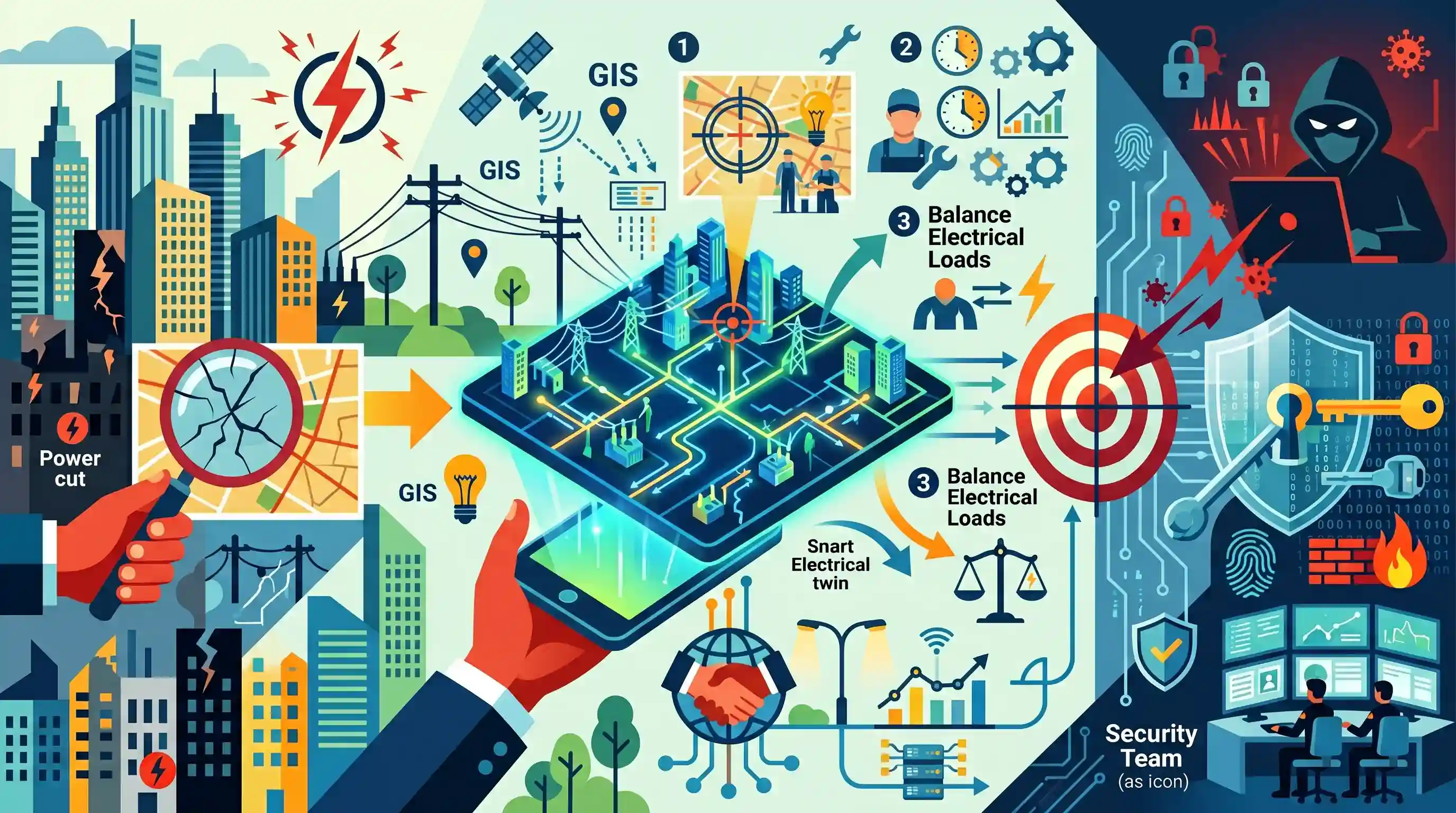
To combat power cuts and improve efficiency, Delhi's power distribution network is being mapped into a 'virtual replica' or Digital Twin, functioning much like Google Maps for electricity. By integrating Geographic Information System (GIS) data with real-time grid monitoring, discoms can swiftly pinpoint faults, conduct predictive maintenance, and balance electrical loads. This initiative represents a significant step in the Smart Cities framework, utilizing e-governance and digital technology to enhance public service delivery. However, the centralization and digitization of such critical infrastructure also amplify vulnerabilities, making robust cybersecurity protocols essential to protect against sophisticated cyber threats.
Key Points
- Delhi is deploying a 'virtual replica' or Digital Twin of its electricity distribution network to monitor and manage power supply in real time.
- This GIS-based visualization acts as a 'Google Maps for electricity,' detailing transformers, sub-stations, and consumer nodes for precise fault detection.
- The technology enables predictive maintenance, reduces downtime, and optimizes load balancing, directly enhancing urban public service delivery.
- Digitizing critical infrastructure like the power grid underscores the need for stringent cybersecurity measures to defend against potential cross-border cyber attacks.
Important Terms
Digital Twin Technology

A dynamic virtual replica of a physical object or system that uses real-time data from sensors and IoT to simulate, monitor, and optimize performance.
UPSC context
GS Paper 3 (Science & Technology); tests awareness of emerging Fourth Industrial Revolution technologies in public infrastructure management.
DISCOMs
Electric power distribution companies responsible for the final stage of electricity delivery to consumers, forming the last-mile interface in the power sector value chain.
UPSC context
GS Paper 3 (Infrastructure/Energy); tests understanding of power sector reforms, financial health (AT&C losses), and energy security.
Smart Cities Mission
An urban renewal program launched in 2015 to develop citizen-friendly, sustainable cities by integrating ICT-based "smart solutions" like digital monitoring of public utilities.
UPSC context
GS Paper 1 (Urbanization) & GS Paper 2 (Governance); tests knowledge of major urban development schemes and e-governance applications.
Geographic Information System (GIS)
A computer-based framework for capturing, managing, and analyzing spatial data by overlaying multiple layers of geographic information to support decision-making.
UPSC context
GS Paper 3 (Science & Tech); tests application of geospatial technology in infrastructure, disaster management, and resource planning.
Critical Information Infrastructure (CII)
IT resources under the IT Act, 2000, whose destruction would have a debilitating impact on national security, economy, public health, or safety.
UPSC context
GS Paper 3 (Cybersecurity/Internal Security); tests awareness of protecting vital digital assets and nodal agencies like NCIIPC.
e-Governance
The application of Information and Communication Technology (ICT) to simplify and enhance the delivery of government services to citizens and improve administrative efficiency.
UPSC context
GS Paper 2 (Governance); tests models, successes, and limitations of digital transformation in public service delivery.
Prelims Trap
"A 'Digital Twin' is a static 3D computer-generated model used for designing infrastructure."
It is not static. A true Digital Twin is dynamic, continuously receiving real-time data from IoT sensors on the physical asset to simulate and predict behavior.
Static Concepts Connected
What constitutes 'Critical Information Infrastructure' (CII) in India?
- Definition: Infrastructure whose destruction or incapacitation would debilitatingly impact national security, economy, or public health.
- Nodal Agency: NCIIPC (National Critical Information Infrastructure Protection Centre), established under the IT Act 2000, is the designated nodal agency.
- Key Sectors: Power & Energy, Banking/Finance, Telecom, Transport, Government, and Strategic/Public Enterprises.
What is the difference between GIS and a Digital Twin?
- GIS: Captures, analyzes, and presents spatial or geographic data. It maps exactly *where* physical assets are located.
- Digital Twin: Combines spatial data (GIS) with real-time IoT sensor data to simulate *how* the system behaves dynamically, allowing for predictive maintenance.
Cross-Topic Patterns
Digital Grids & Renewable Integration
Managing the intermittency of India's target 500 GW non-fossil capacity requires smart, predictive grids to dynamically balance renewable loads in real-time.
Cyber Warfare on Power Assets
E-governance digitization scales public efficiency but increases vulnerability to attacks, echoing the 2020 malware cyber-attack on Mumbai’s power grid by suspected foreign state actors.

Expect a multi-statement prelims question combining 'Digital Twin' tech applications with India's Critical Information Infrastructure (CII).
Linked PYQs · 3
Linked PYQs · 3
- 2016MainsGS1
With a brief background of quality of urban life in India, introduce the objectives and strategy of the 'Smart City Programme'.
- 2024MainsGS2
e-governance is not just about the routine application of digital technology in service delivery process. It is as much about multifarious interactions for ensuring transparency and accountability. In this context evaluate the role of the 'Interactive Service Model' of e-governance.
- 2021MainsGS3
Keeping in view India's internal security, analyse the impact of cross-border cyber attacks. Also discuss defensive measures against these sophisticated attacks.
