Google Initiative to Support Enterprise Scaling for Indian Startups
Source:Indian Express ↗
Why It Matters
Highlights the growing integration of AI in India's economy and healthcare, pointing to the need for computational infrastructure (Global AI Hub) and the practical applications of AI in clinical diagnosis (MedGemma at AIIMS), which directly align with GS3 S&T syllabus.
Summary
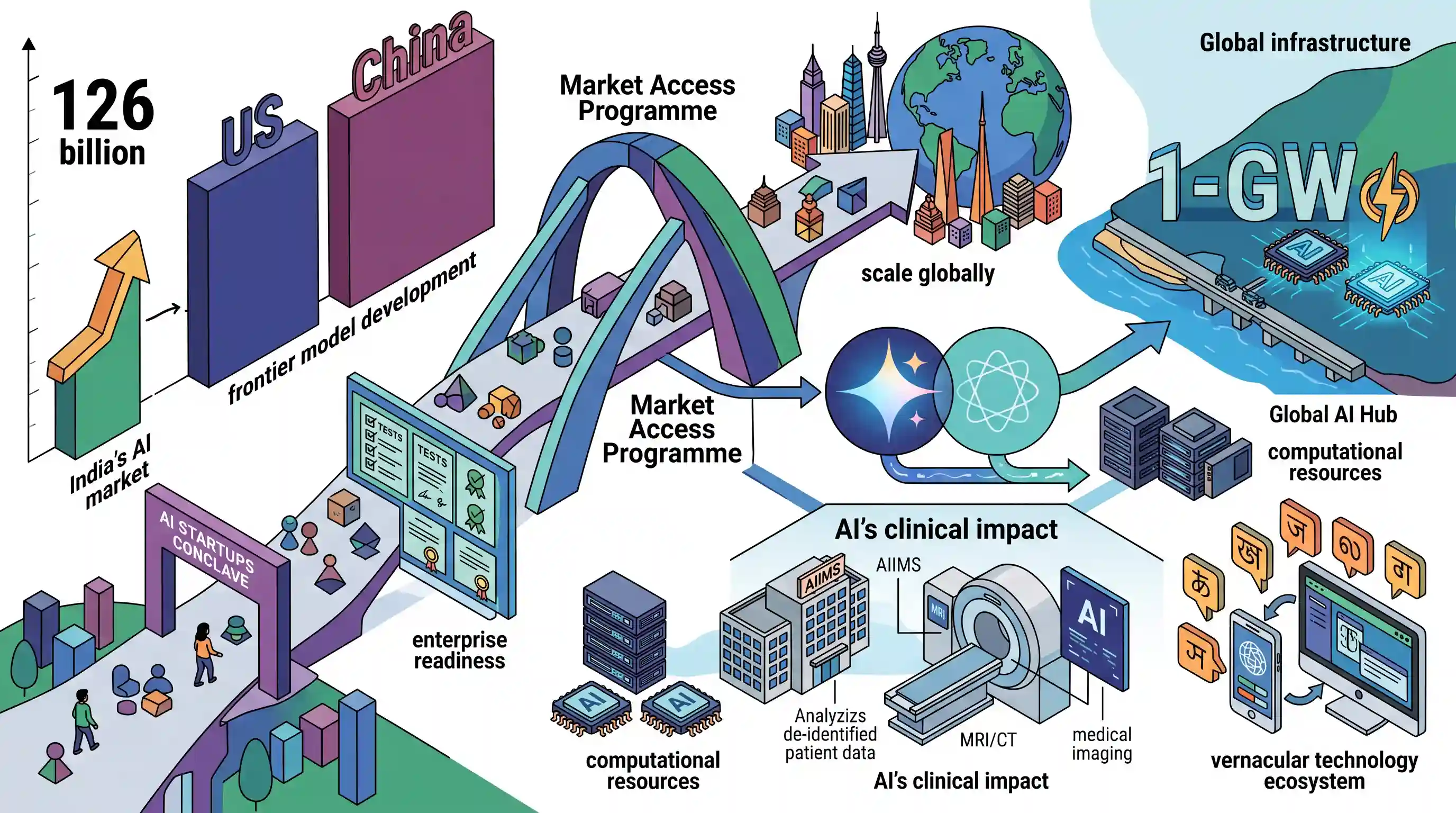
Google has launched the Market Access Programme at the AI Startups Conclave in New Delhi to help Indian AI startups scale globally for enterprise adoption. While India's AI market is projected to reach $126 billion by 2030, it currently lags the US and China in frontier model development. Google's initiative aims to support startups by providing access to its Gemini and Gemma AI models, computational resources, and a planned 1-gigawatt Global AI Hub in Visakhapatnam. The event also highlighted AI's clinical impact, notably AIIMS's use of Google's MedGemma model for medical imaging, underscoring AI's growing footprint in India's healthcare and vernacular technology ecosystems.
Key Points
- Google launched the 'Market Access Programme' to help Indian AI startups scale for enterprise adoption globally using its distribution network.
- India's AI market is projected to reach $126 billion by 2030, with over 47% of enterprises moving AI pilots into production, despite lagging in frontier model development.
- Google highlighted its healthcare AI applications, noting that AIIMS utilizes the MedGemma model for high-dimensional medical imaging like CT scans and MRIs.
- To bolster infrastructure, Google is planning a 1-gigawatt 'Global AI Hub' in Visakhapatnam to serve as an anchor for the local AI economy.
- The initiative emphasizes reducing infrastructure costs for founders by providing computational 'public rails' and supports the development of Indic language models.
Important Terms
Google Market Access Programme

A Google initiative launched to assist Indian AI startups in scaling globally by providing enterprise-readiness training, sales expertise, and access to Google’s network of CIOs and CXOs.
UPSC context
GS3: S&T and Economy; tests knowledge of private-sector initiatives fostering indigenous technology and global competitiveness.
Global AI Hub (Visakhapatnam)
A 1-gigawatt hyperscale data center facility in Andhra Pradesh, part of Google’s $15 billion investment to anchor India’s AI infrastructure and support high-performance computing needs.
UPSC context
GS3: Infrastructure and S&T; relevant to digital public infrastructure and foreign direct investment in technology.
MedGemma
Google’s specialized open-source AI models (based on Gemma) designed for medical imaging and text comprehension, used by AIIMS to develop India-specific clinical diagnostic tools.
UPSC context
GS2: Health and GS3: S&T; important for applications of AI in improving healthcare diagnostics and delivery.
Frontier Models
Highly advanced, large-scale AI models (like Gemini) that push performance boundaries, exhibit emergent reasoning capabilities, and require massive computational power to develop.
UPSC context
GS3: S&T; tests understanding of cutting-edge AI developments and the technological divide between nations.
AI Futures Fund
A global Google DeepMind initiative that provides early-stage AI startups with capital, compute credits, and model access; in India, it operates through a partnership with Accel.
UPSC context
GS3: Economy and S&T; relevant to startup funding ecosystems and international technological collaborations.
Bharat AI Startups Report 2026
An industry report projecting India’s AI market to reach $126 billion by 2030, highlighting the shift from prototype development to large-scale enterprise production.
UPSC context
GS3: Economy; provides data for essays or answers on India’s industrial growth and digital economy.
Prelims Trap
"The 1-gigawatt 'Global AI Hub' and 'Market Access Programme' are flagship initiatives under the IndiaAI Mission."
These are corporate initiatives driven by Google, not state-led public digital infrastructure projects under MeitY or the official IndiaAI Mission.
Static Concepts Connected
What distinguishes "Frontier Models" from standard AI?
- Foundational base: They are large-scale, highly adaptable models trained on massive, broad datasets rather than being designed for narrow, task-specific functions.
- Cutting-edge capabilities: They represent the most advanced generation of AI, often exceeding the capabilities of existing models in general reasoning, synthesis, and multimodal tasks.
- Resource intensive: Developing them requires immense computational power (clusters of advanced GPUs) and massive capital, an area currently dominated by the US and China.
How is India addressing the AI compute infrastructure gap?
- IndiaAI Mission: The government launched the IndiaAI Mission to establish a sovereign computing ecosystem, aiming to deploy over 10,000 GPUs via public-private partnerships.
- Compute as DPI: The strategy treats AI compute as a Digital Public Infrastructure (DPI), subsidizing access for researchers and startups so they aren't priced out.
- Corporate mega-hubs: Massive data centres are being established by private tech giants to serve as local anchors, requiring localized high-capacity power and cooling systems.
Cross-Topic Patterns
AI Compute + Energy Security
A 1-GW AI Hub demands massive, continuous electricity. This ties AI infrastructure directly to India's energy transition, grid stability, and the environmental footprint of water-intensive data centre cooling.
AI + Public Health Infrastructure
The integration of MedGemma at AIIMS mirrors broader UPSC themes of using frontier technologies (like AI diagnostics) to leapfrog structural doctor-patient ratio deficits in India's public health infrastructure.

A 2026 tech question will likely test the difference between sovereign foundational models and fine-tuning corporate APIs like Gemini.
Linked PYQs · 2
Linked PYQs · 2
- 2023MainsGS3
Introduce the concept of Artificial Intelligence (AI). How does Al help clinical diagnosis? Do you perceive any threat to privacy of the individual in the use of Al in healthcare?
- 2020PrelimsGS1
With the present state of development, Artificial Intelligence can effectively do which of the following? 1. Bring down electricity consumption in industrial units 2. Create meaningful short stories and songs 3. Disease diagnosis 4. Text-to-Speech Conversion 5. Wireless transmission of electrical energy Select the correct answer using the code given below:
