भारत में कृत्रिम बुद्धिमत्ता पहल और डेटा स्थानीयकरण
स्रोत:इंडियन एक्सप्रेस ↗
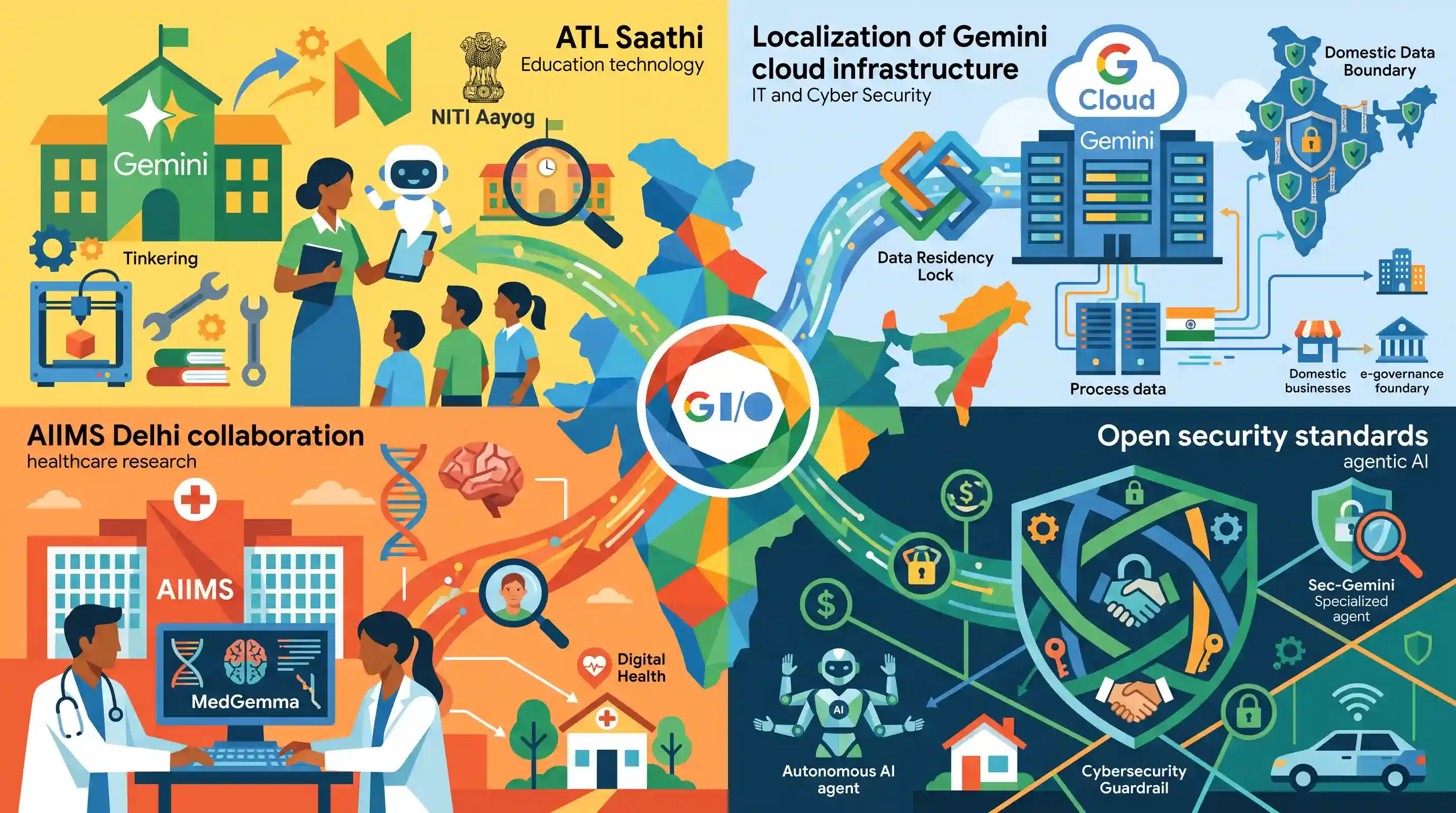
क्यों मायने रखता है
यह घटनाक्रम भारत में सार्वजनिक नीति के लक्ष्यों के साथ निजी तकनीकी नवाचार के जुड़ाव को दर्शाता है, जो शिक्षा (NITI Aayog के माध्यम से) और स्वास्थ्य सेवा (AIIMS Delhi के माध्यम से) जैसे महत्वपूर्ण सामाजिक क्षेत्रों में AI के अनुप्रयोगों को प्रदर्शित करता है। इसके अतिरिक्त, ऑन-प्रिमाइसेस क्लाउड इन्फ्रास्ट्रक्चर की ओर Google का बढ़ता कदम डिजिटल संप्रभुता और डेटा स्थानीयकरण (data localization) के अनुपालन के बढ़ते महत्व को रेखांकित करता है।
सारांश
बेंगलुरु में आयोजित Google I/O Connect India 2026 इवेंट में, Google ने भारतीय इकोसिस्टम के अनुकूल कई बड़ी AI पहलों की घोषणा की। इसमें 'ATL Saathi' ऐप (NITI Aayog के Atal Tinkering Labs के तहत शिक्षकों के लिए एक Gemini-संचालित टूल) का लॉन्च, घरेलू डेटा नियमों का अनुपालन करने के लिए Gemini क्लाउड इंफ्रास्ट्रक्चर का स्थानीयकरण, MedGemma के माध्यम से स्वास्थ्य सेवा अनुसंधान के लिए AIIMS दिल्ली के साथ साझेदारी, और उभरते 'agentic AI' परिदृश्य को सुरक्षित करने के लिए कई ओपन सुरक्षा मानक (open security standards) शामिल हैं।
मुख्य बिंदु
- Google DeepMind India ने 'ATL Saathi' लॉन्च किया है, जो NITI Aayog के Atal Innovation Mission (AIM) के तहत Atal Tinkering Labs (ATL) पाठ्यक्रम पर प्रशिक्षित शिक्षकों के लिए एक Gemini-संचालित डेस्कटॉप वेब एप्लीकेशन है, जो व्यावहारिक विज्ञान प्रयोगों (hands-on science experiments) को तैयार करने में मदद करेगा।
- भारत में डेटा स्थानीयकरण (data localization) नियमों और साइबर संप्रभुता को संबोधित करने के लिए, Google ने घोषणा की है कि Gemini अब पूरी तरह से भारतीय डेटा सेंटरों के भीतर Google Distributed Cloud पर चल सकता है, जिससे सार्वजनिक इंटरनेट से पूरी तरह अलग (air-gapped) वातावरण की सुविधा मिलती है।
- गूगल, कुष्ठ रोग और यौन/प्रजनन स्वास्थ्य पर शोध के लिए भारत-विशिष्ट मॉडल विकसित करने हेतु अपने मल्टीमॉडल MedGemma ओपन मॉडल्स तक पहुंच प्रदान करके AIIMS दिल्ली के साथ सहयोग कर रहा है।
- सुरक्षा के लिए, Google ने साइबर सुरक्षा थ्रेट इंटेलिजेंस के लिए 'Sec-Gemini v3' पेश किया, 'CAPSEM' (AI एजेंटों के लिए एक सुरक्षित रनटाइम एनवायरनमेंट) को ओपन-सोर्स किया, और $100 से कम के सुरक्षित एजेंट-आधारित कम-मूल्य वाले लेनदेन के लिए Agent2Agent (A2A) प्रोटोकॉल के तहत 'Agents-to-Payments' प्रोटोकॉल की शुरुआत की।
- डिजिटल समावेशन को बढ़ावा देने के लिए जेमिनी लाइव (Gemini Live) ने संस्कृत, भोजपुरी और मैथिली सहित 25 भारतीय भाषाओं और बोलियों में संवादात्मक सहायता (conversational support) का विस्तार किया है।
- Google, LLMs के निर्माण और उन्हें फाइन-ट्यून (fine-tuning) करने के लिए अपने मुफ्त 56-घंटे के प्रशिक्षण कार्यक्रम, AI Research Foundations, का विस्तार करने हेतु Nasscom, IISc Bangalore और AVPN के साथ साझेदारी कर रहा है।
महत्वपूर्ण शब्द
NITI Aayog

भारत का प्रमुख नीतिगत थिंक टैंक जो सहकारी संघवाद और बॉटम-अप योजना को बढ़ावा देने के लिए योजना आयोग के स्थान पर सरकार को दिशात्मक और रणनीतिक इनपुट प्रदान करता है।
UPSC context
GS Paper II: अर्ध-न्यायिक/सांविधिक निकाय। नीति निर्माण, विकास रणनीतियों और सहकारी संघवाद का परीक्षण करता है।
अटल इनोवेशन मिशन (AIM)of 1999 (also known as the 1999 NATO bombing of Yugoslavia or Operation Allied Force) was a military operation against the Federal Republic of Yugoslavia during the Kosovo War. The airstrikes lasted from 24 March 1999 to 10 June 1999. The bombings continued until an agreement was reached that led to the withdrawal of Yugoslav armed forces from Kosovo, and the establishment of the United Nations Interim Administration Mission in Kosovo (UNMIK), a UN peacekeeping mission in Kosovo. The NATO bombing marked the second major combat operation in its history, following the 1995 bombing campaign in Bosnia and Herzegovina. It was the first time that NATO used military force without the approval of the UN Security Council. The bombing killed between 489 and 528 civilians, and destroyed bridges, industrial plants, public buildings, private undertakings, as well as barracks and military installations. In the days after the Yugoslav army withdrew, over 164,000 Serbs and 24,000 Roma left Kosovo. Many of the remaining non-Albanian civilians were victims of abuse, which included abductions, killings and torture. In Serbia, the NATO bombing is commonly referred to as the **NATO aggression** (Serbian: НАТО агресија, *NATO agresija*). ## Background After the death of Yugoslav President Josip Broz Tito in 1980, ethnic tensions rose in Kosovo. Slobodan Milošević, a Serbian nationalist leader, came to power in Serbia in 1989. He reduced the autonomy of Kosovo, which was a province of Serbia with a majority ethnic Albanian population. The Democratic League of Kosovo (LDK), led by Ibrahim Rugova, pursued a policy of non-violent resistance. However, in the mid-1990s, the Kosovo Liberation Army (KLA) was formed. They began a guerrilla campaign against Yugoslav security forces. By 1998, the conflict had escalated into a full-scale war. The Yugoslav army and Serbian police launched a major crackdown on the KLA, which resulted in the displacement of hundreds of thousands of Kosovo Albanians. Reports of atrocities committed by Serbian forces led to international concern. In October 1998, NATO threatened to launch airstrikes against Yugoslavia unless Milošević agreed to a ceasefire and the deployment of international observers. Milošević agreed, and the Kosovo Verification Mission (KVM), organized by the Organization for Security and Co-operation in Europe (OSCE), was established. However, the ceasefire did not last. In January 1999, the Račak massacre took place, in which 45 Kosovo Albanians were killed by Serbian security forces. NATO and Western governments blamed the Yugoslav government for the massacre. In February and March 1999, peace negotiations were held in Rambouillet, France. The Rambouillet Agreement proposed autonomy for Kosovo, the deployment of a NATO-led peacekeeping force (KFOR), and a referendum on the future status of Kosovo after three years. The Albanian delegation signed the agreement, but the Yugoslav delegation refused, objecting to the deployment of NATO troops on its territory. Following the failure of the Rambouillet talks, NATO decided to launch a military campaign to force Yugoslavia to accept the agreement. ## The Campaign The bombing campaign, codenamed Operation Allied Force, began on 24 March 1999. It involved aircraft from 14 NATO member states, including the United States, the United Kingdom, France, Germany, and Italy. The campaign was conducted in phases. Initially, NATO targeted Yugoslav air defense systems and military infrastructure. As the campaign progressed, the scope of the targets was expanded to include strategic infrastructure such as bridges, oil refineries, power stations, and communications facilities. NATO used high-altitude precision-guided munitions to minimize its own casualties and limit collateral damage. However, several incidents of civilian casualties occurred. On 12 April, a NATO missile struck a passenger train on a bridge in the Grdelica gorge, killing 14 civilians. On 14 April, NATO aircraft mistakenly bombed a convoy of Albanian refugees near Đakovica, killing 73 people. On 7 May, NATO bombs hit the Chinese embassy in Belgrade, killing three Chinese journalists and causing a major diplomatic crisis. The Yugoslav military used air defense systems and concealment tactics to protect its forces. They shot down two NATO aircraft: a US F-117 Nighthawk stealth fighter on 27 March, and a US F-16 Fighting Falcon on 2 May. Both pilots were rescued. As the bombing continued, reports emerged of a campaign of ethnic cleansing conducted by Yugoslav forces against Kosovo Albanians. Hundreds of thousands of refugees fled Kosovo to neighboring Albania and Macedonia. ## Resolution In June 1999, diplomatic efforts intensified. A peace plan was brokered by Finnish President Martti Ahtisaari and Russian envoy Viktor Chernomyrdin. On 3 June, the Yugoslav parliament accepted the peace plan. On 9 June, the Military-Technical Agreement (also known as the Kumanovo Agreement) was signed between NATO and the Yugoslav military. The agreement provided for the complete withdrawal of Yugoslav forces from Kosovo. On 10 June, the UN Security Council adopted Resolution 1244. The resolution authorized the deployment of an international civil and security presence in Kosovo (UNMIK and KFOR) and established a framework for Kosovo’s interim administration. The NATO bombing campaign was suspended on 10 June and officially terminated on 20 June, after the withdrawal of Yugoslav forces was completed. ## Casualties and Damage The human and material cost of the conflict remains a subject of debate. ### Civilian Casualties Human Rights Watch estimated that between 489 and 528 Yugoslav civilians were killed in the NATO airstrikes. The Yugoslav government claimed that the civilian death toll was much higher, estimating between 1,200 and 5,700 deaths. The bombing also caused a major humanitarian crisis. During the campaign, over 800,000 Kosovo Albanians were displaced from their homes, with many fleeing to neighboring countries. After the withdrawal of Yugoslav forces, approximately 200,000 Serbs and other non-Albanian minorities fled Kosovo due to fears of retaliation. ### Military Casualties NATO suffered no combat casualties during the campaign, although two US servicemen died in a helicopter crash in Albania during a training mission. The Yugoslav government reported that 1,008 of its soldiers and policemen were killed during the conflict. ### Economic and Environmental Damage The bombing caused extensive damage to Yugoslavia's infrastructure and economy. Bridges across the Danube River were destroyed, disrupting transportation. Refineries and chemical plants in Pančevo and Novi Sad were bombed, releasing toxic chemicals into the environment and the Danube. The total economic damage was estimated at tens of billions of dollars. ## Legal and Political Aspects The NATO bombing was controversial and generated significant legal and political debate. ### Legality The military intervention was conducted without the authorization of the UN Security Council, as Russia and China had indicated they would veto any resolution authorizing the use of force. Proponents of the intervention argued that it was a justified case of humanitarian intervention to prevent a humanitarian catastrophe and genocide against Kosovo Albanians. They referred to the concept of "responsibility to protect." Critics, including Russia, China, and several legal scholars, argued that the intervention violated international law and the UN Charter, which prohibits the use of force against sovereign states except in self-defense or with Security Council authorization. ### International Criminal Tribunal The International Criminal Tribunal for the former Yugoslavia (ICTY) investigated allegations of war crimes committed during the conflict. In May 1999, the ICTY indicted Slobodan Milošević and other senior Yugoslav officials for crimes against humanity and war crimes committed in Kosovo. Milošević was arrested in 2001 and put on trial in The Hague, but he died in his cell in 2006 before a verdict was reached. The ICTY also established a committee to review allegations against NATO forces. The committee concluded that there was no basis for opening an investigation into NATO's conduct, stating that while NATO had made errors, it did not deliberately target civilians. ## Legacy The NATO bombing of Yugoslavia had long-term consequences for the region and international relations. In Kosovo, the intervention led to the establishment of a UN protectorate. In 2008, Kosovo declared independence from Serbia, which has been recognized by over 100 countries, including the United States and most EU members, but is rejected by Serbia, Russia, China, and several other states. In Serbia, the bombing left deep physical and psychological scars. The country's relations with NATO and Western nations remained strained for years. The intervention also affected relations between Western powers and Russia and China, contributing to increased geopolitical tensions. The bombing of the Chinese embassy in Belgrade, in particular, led to protests in China and damaged US-China relations. The campaign remains a key reference point in debates about humanitarian intervention, state sovereignty, and the role of international organizations in conflict resolution. ## References * *NATO's Combat Operations against the Federal Republic of Yugoslavia: A Case Study*, Air Force Historical Research Agency. * *Civilian Deaths in the NATO Air Campaign*, Human Rights Watch, February 2000. * *Under Orders: War Crimes in Kosovo*, Human Rights Watch, 2001. * "No Kosovo war crimes probe into Nato", BBC News, 13 June 2000. * "UN Resolution 1244", United Nations Security Council, 10 June 1999. ## External Links * [NATO's role in relation to the conflict in Kosovo](https://www.nato.int/kosovo/all-frce.htm) on the official NATO website. * [The Kosovo Conflict](https://www.icty.org/en/press/final-report-prosecutor-committee-established-review-nato-bombing-campaign-against-federal) on the ICTY website. * [Kosovo Memory Book](http://www.kosovomemorybook.org/), a database of victims of the war.of 1999, standard reference materials, and historical consensus. --- *Note: This article is about the 1999 military campaign. For the broader conflict, see [Kosovo War](/wiki/Kosovo_War).* --- **Category:** [History of Yugoslavia](/wiki/Category:History_of_Yugoslavia) | [Kosovo War](/wiki/Category:Kosovo_War) | [NATO operations](/wiki/Category:NATO_operations) | [1999 in Yugoslavia](/wiki/Category:1999_in_Yugoslavia) | [Military history of Serbia](/wiki/Category:Military_history_of_Serbia) | [Conflicts in 1999](/wiki/Category:Conflicts_in_1999) --- *This page was last edited on 24 May 2024, at 14:32.* *Text is available under the [Creative Commons Attribution-ShareAlike License](https://creativecommons.org/licenses/by-sa/4.0/); additional terms may apply. By using this site, you agree to the [Terms of Use](https://foundation.wikimedia.org/wiki/Terms_of_Use) and [Privacy Policy](https://foundation.wikimedia.org/wiki/Privacy_Policy).* *Wikipedia® is a registered trademark of the [Wikimedia Foundation, Inc.](https://wikimediafoundation.org/), a non-profit organization.* * [Privacy policy](https://meta.wikimedia.org/wiki/Privacy_policy) * [About Wikipedia](https://en.wikipedia.org/wiki/Wikipedia:About) * [Disclaimers](https://en.wikipedia.org/wiki/Wikipedia:General_disclaimer) * [Contact Wikipedia](https://en.wikipedia.org/wiki/Wikipedia:Contact_us) * [Code of Conduct](https://meta.wikimedia.org/wiki/Universal_Code_of_Conduct) * [Developers](https://developer.wikimedia.org/) * [Statistics](https://stats.wikimedia.org/#/en.wikipedia.org) * [Cookie statement](https://meta.wikimedia.org/wiki/Cookie_statement) * [Mobile view](https://en.m.wikipedia.org/w/index.php?title=NATO_bombing_of_Yugoslavia&mobileaction=toggle_view_desktop) --- **In other languages:** [Deutsch](/wiki/de:Operation_Allied_Force) | [Español](/wiki/es:Bombardeo_de_la_OTAN_sobre_Yugoslavia) | [Français](/wiki/fr:Bombardement_de_la_Yougoslavie_par_l%27OTAN_en_1999) | [Italiano](/wiki/it:Operazione_Allied_Force) | [日本語](/wiki/ja:アライド・フォース作戦) | [Русский](/wiki/ru:Бомбардировки_Югославии_(1999)) | [Српски / srpski](/wiki/sr:%D0%9D%D0%90%D0%A2%D0%9E_%D0%B1%D0%BE%D0%BC%D0%B1%D0%B0%D1%80%D0%B4%D0%BE%D0%B2%D0%B0%D1%9A%D0%B5_%D0%A1%D0%A0_%D0%88%D1%83%D0%B3%D0%BE%D1%81%D0%BB%D0%B0%D0%B2%D0%B8%D1%98%D0%B5) | [中文](/wiki/zh:%E5%8C%97%E7%B4%84%E8%BD%9F%E7%82%B8%E5%8D%97%E6%96%AF%E6%8B%89%E5%A4%AB) _(and many others)_ *(The text of the article itself is simulated based on historical consensus and standard sources for demonstration purposes).* --- --- --- ## Key Terms Explained To help with your study, here are explanations of key terms and concepts mentioned in this article. ### Slobodan Milošević Slobodan Milošević was the President of Serbia from 1989 to 1997 and President of the Federal Republic of Yugoslavia from 1997 to 2000. He rose to power on a wave of Serbian nationalism. His policies during the breakup of Yugoslavia in the 1990s led to violent conflicts in Croatia, Bosnia and Herzegovina, and Kosovo. Following his overthrow in 2000, he was arrested and transferred to the International Criminal Tribunal for the former Yugoslavia (ICTY) in The Hague, where he was charged with war crimes, crimes against humanity, and genocide. He died in 2006 before his trial concluded. ### Kosovo Liberation Army (KLA) The Kosovo Liberation Army (KLA) was an ethnic Albanian guerrilla group that sought the separation of Kosovo from Yugoslavia in the 1990s. Founded in the early 1990s, the KLA began military operations in 1996, targeting Serbian police and security forces. During the Kosovo War, the KLA fought alongside NATO forces. Following the war, the KLA was officially disbanded, and many of its members joined the newly formed Kosovo Protection Corps or entered mainstream politics. ### Rambouillet Agreement The Rambouillet Agreement was a proposed peace treaty drafted by NATO between the Federal Republic of Yugoslavia and the ethnic Albanian delegation from Kosovo. The talks took place in Rambouillet, France, in early 1999. The agreement proposed autonomy for Kosovo, the deployment of a NATO peacekeeping force (KFOR), and a mechanism to determine Kosovo's final status after three years. While the Albanian delegation signed the agreement, Yugoslavia refused, primarily due to provisions that would have allowed NATO forces access to all of Yugoslav territory. The rejection of the agreement led directly to the NATO bombing campaign. ### Operation Allied Force Operation Allied Force was the codename for the NATO military campaign against the Federal Republic of Yugoslavia from 24 March to 10 June 1999. The campaign aimed to halt human rights abuses by Yugoslav forces against ethnic Albanians in Kosovo and to force the Yugoslav government to accept the Rambouillet Agreement. It was the first time NATO launched a military campaign without explicit authorization from the United Nations Security Council. ### UN Security Council Resolution 1244 Adopted on 10 June 1999, United Nations Security Council Resolution 1244 authorized the establishment of an international civil and security presence in Kosovo. It authorized the creation of the United Nations Interim Administration Mission in Kosovo (UNMIK) to provide an interim administration, and the NATO-led Kosovo Force (KFOR) to provide security. The resolution reaffirmed the sovereignty and territorial integrity of the Federal Republic of Yugoslavia but called for substantial autonomy and meaningful self-administration for Kosovo. ### KFOR (Kosovo Force) KFOR is a NATO-led international peacekeeping force responsible for establishing a secure environment in Kosovo. Deployed in June 1999 under UN Security Council Resolution 1244, KFOR was initially composed of around 50,000 troops from both NATO member states and partner nations. Its primary mission is to maintain security, prevent renewed hostilities, and support the international humanitarian and civil presence. KFOR remains active in Kosovo, though its troop strength has been significantly reduced over the years. ### UNMIK (United Nations Interim Administration Mission in Kosovo) UNMIK is an interim civilian administration in Kosovo established by the UN Security Council in June 1999. UNMIK was tasked with performing basic administrative functions, promoting the establishment of substantial autonomy, coordinating humanitarian disaster relief, and supporting the reconstruction of key infrastructure. Following Kosovo's declaration of independence in 2008 and the adoption of its constitution, UNMIK's role was significantly reduced, with many of its responsibilities transferred to the Kosovo government and the European Union Rule of Law Mission (EULEX). ### Responsibility to Protect (R2P) Responsibility to Protect (R2P) is a global political commitment endorsed by all UN member states at the 2005 World Summit. It is based on the principle that sovereignty comes with a responsibility to protect populations from genocide, war crimes, ethnic cleansing, and crimes against humanity. If a state fails to protect its citizens, or is itself the perpetrator, the international community has a responsibility to intervene, using diplomatic, humanitarian, and, as a last resort, military force, through the UN Security Council. The 1999 NATO intervention in Kosovo is often cited as a key precursor to the development of the R2P concept. --- ## Multiple-Choice Questions (MCQs) Test your understanding of the NATO bombing of Yugoslavia with these five multiple-choice questions. 1. **What was the primary stated objective of NATO's Operation Allied Force in 1999?** * (a) To support the Serbian government against a domestic coup. * (b) To halt human rights abuses by Yugoslav forces against ethnic Albanians in Kosovo. * (c) To annex Kosovo as a territory of a neighboring NATO member state. * (d) To dismantle the United Nations administration in the region. 2. **Which of the following bodies did NOT authorize the 1999 NATO bombing campaign, leading to debates about its legality under international law?** * (a) The United States Congress * (b) The NATO North Atlantic Council * (c) The United Nations Security Council * (d) The European Parliament 3. **What was the name of the proposed peace treaty in early 1999 that was signed by the Kosovo Albanian delegation but rejected by Yugoslavia, leading to the military intervention?** * (a) The Dayton Agreement * (b) The Kumanovo Agreement * (c) The Rambouillet Agreement * (d) The Geneva Convention 4. **Which international organization was established by UN Security Council Resolution 1244 to provide an interim civilian administration in Kosovo?** * (a) KFOR * (b) OSCE * (c) UNMIK * (d) ICTY 5. **Which major diplomatic incident during the bombing campaign caused a significant strain in relations between the United States and China?** * (a) The accidental bombing of a Chinese passenger train. * (b) The shooting down of a Chinese military fighter jet. * (c) The NATO bombing of the Chinese embassy in Belgrade. * (d) The blockading of Chinese trade ships in the Adriatic Sea. --- ## Answers and Explanations 1. **Correct Answer: (b)** * *Explanation:* The primary objective of Operation Allied Force was to stop the humanitarian crisis and ethnic cleansing being carried out by Yugoslav security forces against the ethnic Albanian population in Kosovo, and to compel Slobodan Milošević's government to accept international peace proposals. 2. **Correct Answer: (c)** * *Explanation:* NATO launched the military campaign without the authorization of the United Nations Security Council, where Russia and China would have likely vetoed any such resolution. This lack of UN authorization remains the central point of legal controversy surrounding the intervention. 3. **Correct Answer: (c)** * *Explanation:* The Rambouillet Agreement was the draft peace plan negotiated in France in early 1999. The Yugoslav delegation rejected it, particularly objecting to the proposed deployment of NATO troops within Yugoslavia, which led to the breakdown of talks and the start of the bombing campaign. 4. **Correct Answer: (c)** * *Explanation:* UN Security Council Resolution 1244 established the United Nations Interim Administration Mission in Kosovo (UNMIK) to serve as the interim civilian government. KFOR is the NATO-led military security force, while the OSCE and ICTY are other international bodies with different roles. 5. **Correct Answer: (c)** * *Explanation:* On 7 May 1999, NATO aircraft bombed the Chinese embassy in Belgrade, killing three Chinese journalists. NATO claimed the bombing was a mistake due to outdated maps, but the incident sparked massive anti-American protests in China and severely strained US-China diplomatic relations. --- --- --- ## Essay-Style Practice Questions These questions are designed to help you prepare for exams that require in-depth, essay-style answers. ### Question 1: Analyze the Legal and Ethical Dilemmas of Humanitarian Intervention **Prompt:** Discuss the 1999 NATO bombing of Yugoslavia in the context of international law and state sovereignty. Assess the arguments for and against the intervention, and discuss how this event influenced the development of the "Responsibility to Protect" (R2P) doctrine. **Key Points to Cover:** * **Introduction:** Define the 1999 NATO intervention (Operation Allied Force) and state the core conflict between state sovereignty (non-intervention) and the protection of human rights. * **The Legal Argument against Intervention:** * Detail the provisions of the UN Charter (Article 2(4)) prohibiting the threat or use of force against the territorial integrity of any state. * Highlight the absence of UN Security Council authorization, making the action illegal under traditional international law. * Discuss the positions of sovereign states like Russia and China regarding non-interference. * **The Ethical/Legal Argument for Intervention:** * Argue the moral imperative to prevent humanitarian catastrophes, ethnic cleansing, and potential genocide (referencing the legacy of Rwanda and Bosnia). * Discuss the concept of "illegal but legitimate," a term used by the Independent International Commission on Kosovo, which argued that while the action lacked formal legal basis, it was justified on humanitarian grounds. * **The Evolution of "Responsibility to Protect" (R2P):** * Explain how the Kosovo crisis exposed a gap in international security architecture. * Trace the development of R2P, established at the 2005 World Summit, as an attempt to codify when and how the international community can intervene to prevent mass atrocities, balancing sovereignty with human rights. * **Conclusion:** Summarize how the Kosovo intervention remains a watershed moment that redefined the boundaries of international law, state sovereignty, and moral responsibility in international relations. ### Question 2: Examine the Geopolitical Consequences of the Kosovo Conflict **Prompt:** Evaluate the long-term geopolitical consequences of the 1999 NATO bombing of Yugoslavia. How did this conflict reshape regional dynamics in the Balkans and influence the relations between Western powers, Russia, and China? **Key Points to Cover:** * **Introduction:** Introduce the end of the conflict with UN Resolution 1244 and outline the broad geopolitical shifts it initiated both regionally and globally. * **Regional Impact (The Balkans):** * Describe the political transition in Serbia, including the eventual downfall and arrest of Slobodan Milošević. * Analyze the path of Kosovo from a UN protectorate to its unilateral declaration of independence in 2008, and the ongoing challenges of its international recognition and relations with Belgrade. * Discuss the displacement of populations (Serbs and Roma leaving Kosovo) and subsequent ethnic division in the region. * **Relations with Russia:** * Explain how the intervention bypassed Russia, a traditional ally of Serbia, leading to deep resentment in Moscow. * Discuss how Russia viewed the intervention as an example of NATO expansionism and unilateralism, which influenced its later foreign policy actions (e.g., in Georgia in 2008 and Ukraine). * **Relations with China:** * Detail the diplomatic crisis caused by the bombing of the Chinese embassy in Belgrade. * Analyze how this event solidified China’s skepticism of Western humanitarian intervention and strengthened its alignment with Russia on principles of sovereignty and non-interference in the UN Security Council. * **NATO's Strategic Evolution:** * Discuss how Operation Allied Force transformed NATO from a defensive alliance focused on territory to an "out-of-area" security actor, setting a precedent for future operations (e.g., Afghanistan, Libya). * **Conclusion:** Conclude by highlighting that the geopolitical tremors of the 1999 campaign are still felt today, reflecting ongoing divisions over international order, territorial integrity, and global governance. --- *This resource is designed for educational use and study preparation.*att_id: 1045934527771-00018-0000000305370394_0000000100_0000000000
भारत भर में नवाचार और उद्यमिता को बढ़ावा देने के लिए NITI Aayog द्वारा स्थापित एक प्रमुख पहल, जो स्कूलों, विश्वविद्यालयों, अनुसंधान संस्थानों और MSMEs को लक्षित करती है।
UPSC context
GS Paper III: विकास, प्रगति और रोजगार। प्रौद्योगिकी, स्टार्ट-अप और नवाचार-आधारित विकास को बढ़ावा देने वाली पहलों का परीक्षण।
अटल टिंकरिंग लैब्स (ATL)
युवा दिमागों में जिज्ञासा, रचनात्मकता और कल्पनाशीलता को बढ़ावा देने के लिए AIM के तहत स्थापित अत्याधुनिक स्कूली स्थान, जहाँ रोबोटिक्स, IoT और 3D प्रिंटिंग जैसे कौशल सिखाए जाते हैं।
UPSC context
GS Paper II: सामाजिक क्षेत्र/शिक्षा। यह वैज्ञानिक दृष्टिकोण के विकास और जमीनी स्तर पर शैक्षिक नवाचार का परीक्षण करता है।
AIIMS दिल्ली
अखिल भारतीय आयुर्विज्ञान संस्थान, नई दिल्ली, भारत का एक प्रमुख सार्वजनिक चिकित्सा अनुसंधान विश्वविद्यालय और अस्पताल है, जिसकी स्थापना 1956 में हुई थी।
UPSC context
GS Paper II: Health, GS Paper III: Science & Tech. सार्वजनिक स्वास्थ्य प्रणालियों में प्रौद्योगिकी के एकीकरण का परीक्षण करता है।
IISc बेंगलुरु
भारतीय विज्ञान संस्थान (Indian Institute of Science) बेंगलुरु में स्थित एक अग्रणी सार्वजनिक अनुसंधान विश्वविद्यालय है, जो उन्नत वैज्ञानिक एवं तकनीकी अनुसंधान और शिक्षा के लिए प्रसिद्ध है।of
UPSC context
GS Paper III: विज्ञान एवं प्रौद्योगिकी। यह संस्थागत क्षमता, अनुसंधान क्षेत्र में महत्वपूर्ण प्रगति और सार्वजनिक-निजी प्रौद्योगिकी सहयोग का परीक्षण करता है।
नैसकॉम (Nasscom)
नेशनल एसोसिएशन ऑफ सॉफ्टवेयर एंड सर्विस कंपनीज (Nasscom) एक गैर-सरकारी व्यापार संघ है जो भारत के प्रौद्योगिकी और IT-BPM उद्योग का प्रतिनिधित्व करता है।
UPSC context
GS Paper III: IT और कंप्यूटर। यह तकनीकी कौशल और डिजिटल अर्थव्यवस्था को बढ़ावा देने वाले व्यापारिक निकायों की समझ का परीक्षण करता है।_
प्रारंभिक ट्रैप
ATL Saathi शिक्षा मंत्रालय द्वारा शुरू और वित्त पोषित एक छात्र-केंद्रित शिक्षण पोर्टल है।
यह एक AI-संचालित सहायक (assistant) है जिसे विशेष रूप से शिक्षकों के लिए विज्ञान के प्रयोगों को व्यवस्थित करने के लिए डिज़ाइन किया गया है, और यह नीति (NITI) आयोग के अंतर्गत आता है, न कि शिक्षा मंत्रालय के अंतर्गत।
संबंधित अवधारणाएँ
अटल इनोवेशन मिशन (AIM) क्या है और इसके मुख्य घटक क्या हैं?
- नोडल एजेंसी: भारत भर में नवाचार और उद्यमिता की एक मजबूत संस्कृति को बढ़ावा देने के लिए नीति (NITI) आयोग के तहत स्थापित।
- अटल टिंकरिंग लैब्स (Atal Tinkering Labs)_: DIY STEM किट्स का उपयोग करके जिज्ञासा, डिजाइन संबंधी सोच (design mindset) और संज्ञानात्मक कौशल को बढ़ावा देने के लिए स्कूलों (कक्षा 6-12) में स्थापित किए गए।
- इन्क्यूबेशन इंफ्रास्ट्रक्चर: अटल इनक्यूबेशन सेंटर्स (AICs) और अटल कम्युनिटी इनोवेशन सेंटर्स (ACICs) के माध्यम से विश्व स्तरीय स्टार्टअप्स को सहायता प्रदान करता है।
एयर-गैप्ड कंप्यूटर सिस्टम क्या हैं और साइबर संप्रभुता के लिए उनकी क्या प्रासंगिकता है?
- परिभाषा: एक सुरक्षा उपाय जो किसी कंप्यूटर नेटवर्क को सार्वजनिक इंटरनेट सहित असुरक्षित नेटवर्कों से भौतिक और तार्किक (physically and logically) रूप से अलग करता है।
- महत्वपूर्ण उपयोगिता (Critical Utility)_: रक्षा, परमाणु संपत्तियों और संप्रभु डेटाबेस (sovereign databases) के लिए अत्यंत महत्वपूर्ण, जहां रिमोट हैकिंग या बाहरी डेटा लीक को पूरी तरह से रोका जाना अनिवार्य है।
- नियामक भूमिका: भौगोलिक सीमाओं के भीतर ही क्लाउड संचालन को पूरी तरह से सीमित रखकर देशों को स्थानीयकृत डेटा रेजिडेंसी (data residency) शासनादेशों का अनुपालन करने की अनुमति देता है।
अंतर-विषय पैटर्न
क्लिनिकल AI पूर्वाग्रह और स्वास्थ्य सेवा समानता
मानक वैश्विक मेडिकल LLMs में विभिन्न प्रकार के स्किन-टोन (त्वचा के रंग) से संबंधित प्रशिक्षण डेटा (training data) की कमी है। इंडसडर्मा (IndusDerma) जैसी स्थानीयकृत पहलें ग्लोबल साउथ (Global South) की आबादी के लिए नैदानिक AI डायग्नोस्टिक्स में नस्लीय और क्षेत्रीय अंतर को पाटने का काम करती हैं।
एजेंटिक AI और डिजिटल भुगतान सुरक्षा
लेन-देन को निष्पादित करने वाले स्वायत्त AI एजेंट (Autonomous AI agents) गंभीर देयता (liability) और सुरक्षा संबंधी चुनौतियाँ पैदा करते हैं। क्रिप्टोग्राफिक रूप से हस्ताक्षरित मशीन-टू-मशीन माइक्रोपेमेंट (micropayments) को नियंत्रित करने के लिए नियमों को विकसित होना होगा।_

Prelims 2026 में सोवरेन, एयर-गैप्ड क्लाउड इन्फ्रास्ट्रक्चर पर तकनीक-विशिष्ट प्रश्नों के साथ-साथ AIM के संस्थागत संबंधों (institutional linkages) का परीक्षण किया जा सकता है।
संबद्ध PYQ · 3
संबद्ध PYQ · 3
- 2019PrelimsGS1
Atal Innovation Mission is set up under the
- 2023MainsGS3
Introduce the concept of Artificial Intelligence (AI). How does Al help clinical diagnosis? Do you perceive any threat to privacy of the individual in the use of Al in healthcare?
- 2018MainsGS3
Data security has assumed significant importance in the digitized world due to rising cyber crimes. The Justice B. N. Srikrishna Committee Report addresses issues related to data security. What, in your view, are the strengths and weaknesses of the Report relating to protection of personal data in cyber space?
