Visakhapatnam AI Data Centre Environmental and Land Use Protests
Source:india-today ↗
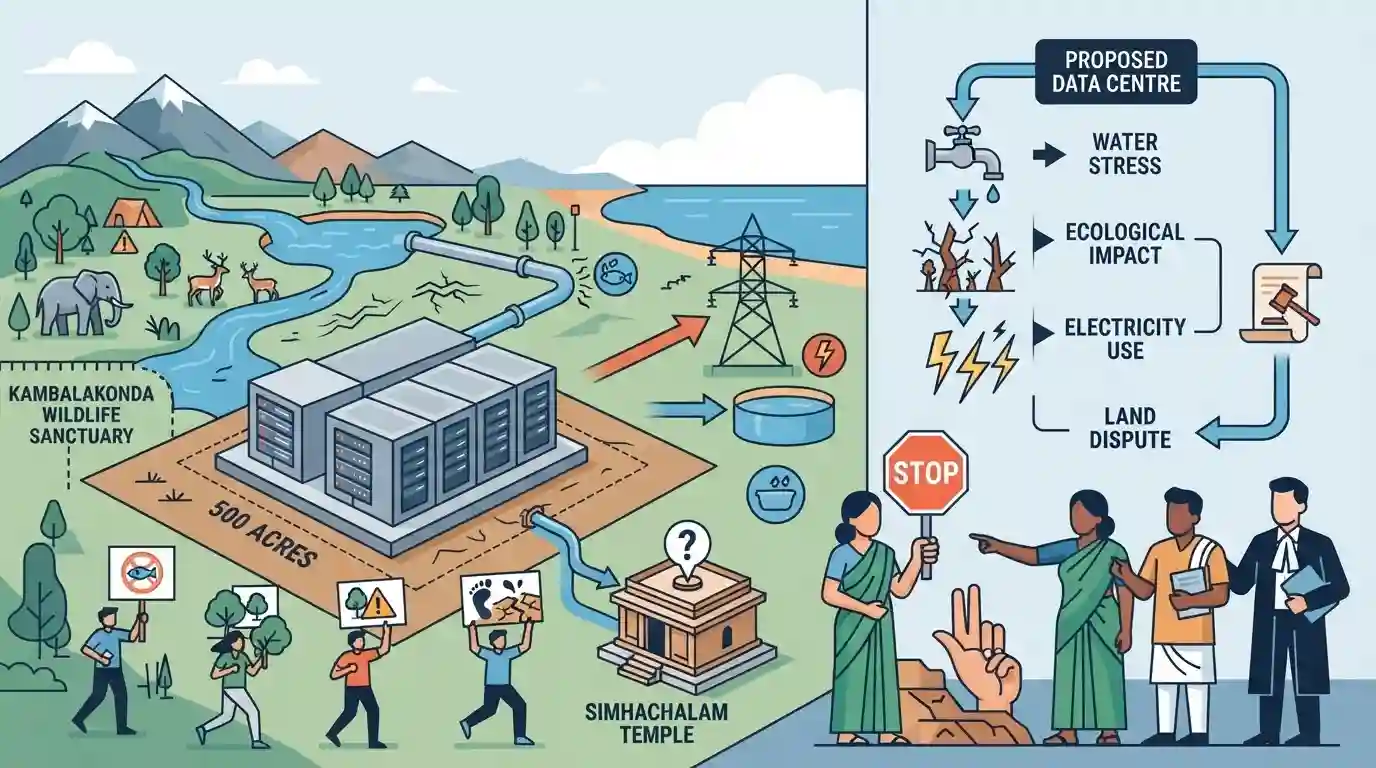
Why It Matters
Highlights the critical environmental trade-offs—such as water scarcity, biodiversity loss, and land conflicts—associated with establishing large-scale digital and AI infrastructure in ecologically sensitive regions like Visakhapatnam.
Summary
Protests have emerged against a proposed Rs 1.2 lakh crore Google-backed AI data centre in Visakhapatnam, Andhra Pradesh. Environmentalists and activists argue the 500-acre project lacks mandatory environmental clearance and threatens local resources. Key concerns include massive water consumption exacerbating regional water stress, high electricity usage, and severe ecological impacts due to its proximity to the Kambalakonda Wildlife Sanctuary and reservoir catchments. Land disputes involving the Simhachalam temple further complicate the development, with legal challenges now pending before the Andhra Pradesh High Court.
Key Points
- A proposed Rs 1.2 lakh crore Google-backed AI data centre spanning over 500 acres is facing intense protests in Visakhapatnam over environmental and land-use concerns.
- Activists allege the massive digital infrastructure project has completely bypassed mandatory Environmental Impact Assessment (EIA) and public hearing processes.
- The facility poses a severe threat to local water security, as AI data centres consume immense volumes of water for cooling, stressing catchments like the Meghadri Gedda reservoir.
- The site's proximity to the ecologically sensitive Kambalakonda Wildlife Sanctuary has raised alarms over biodiversity loss and habitat destruction.
- Contentious land acquisition issues, including the alleged use of land belonging to the Simhachalam temple, have prompted legal action in the Andhra Pradesh High Court.
Important Terms
Environmental Impact Assessment (EIA)

A statutory regulatory process under the Environment (Protection) Act, 1986, evaluating the potential ecological, social, and economic impacts of proposed infrastructure projects before granting them clearance.
UPSC context
Essential for GS3 Environment. It tests the balance between rapid digital infrastructure development and sustainable ecological practices.
Kambalakonda Wildlife Sanctuary
A tropical dry evergreen forest in the Eastern Ghats near Visakhapatnam, Andhra Pradesh. Known for the Indian leopard, it acts as a crucial micro-catchment area protecting the local ecological balance.
UPSC context
Important for Prelims Geography mapping and GS3 Environment (biodiversity conservation versus urban encroachment).
AI Data Centre
Massive server facilities powering global cloud computing and artificial intelligence. They are increasingly contested due to their immense land, electricity, and water cooling requirements, especially in ecologically sensitive regions.
UPSC context
Crucial for GS3 Infrastructure, highlighting the tension between digital economic growth, local resource sustainability, and "digital colonialism."
Jal Biradari
A national network of water-conservation organizations led by Rajendra Singh (Waterman of India). It promotes community-led sustainable water management, reviving traditional water harvesting systems and restoring degraded river basins.
UPSC context
Tests GS2/GS3 topics on civil society intervention, NGO roles, and traditional water security methodologies.
Simhachalam Temple
An 11th-century Visakhapatnam temple dedicated to Varaha Lakshmi Narasimha. It showcases a unique blend of Kalinga and Dravidian architectural styles and received historical patronage from Chola, Eastern Ganga, and Vijayanagara rulers.
UPSC context
Highly relevant for Prelims and GS1 Art & Culture, testing knowledge of regional architectural blends and medieval history.
Prelims Trap
Hyperscale data centres are explicitly listed as Category A projects requiring mandatory public hearings under the EIA Notification 2006.
Under the 2006 notification, data centres often fall under general building/construction categories, allowing them to bypass stringent public hearings mandated for heavy industries.
Static Concepts Connected
What are the key stages of the Environmental Impact Assessment (EIA) process in India?
- Screening: Determining if a proposed project requires an EIA and whether it falls under Category A (national clearance) or Category B (state clearance).
- Scoping: Defining the detailed Terms of Reference (ToR) to evaluate the project's potential environmental impacts.
- Public Consultation: Gathering concerns from locally affected persons, a step often controversially bypassed for construction/IT projects.
- Appraisal: Scrutiny of the EIA report by the Expert Appraisal Committee (EAC) before recommending clearance.
What are the key ecological features of the Kambalakonda Wildlife Sanctuary?
- Forest Type: It features a rare tropical dry evergreen forest, which is unique to the Eastern Ghats and the Coromandel coast.
- Indicator Species: The Indian leopard (Panthera pardus fusca) is recognized as the principal indicator species of this sanctuary.
- Geographical Significance: Located near Visakhapatnam in Andhra Pradesh, it acts as a crucial green lung and catchment area for the city.
Cross-Topic Patterns
Digital infrastructure's water footprint
AI algorithms and hyperscale data centres require immense cooling water, putting India's push for digital tech-hubs in direct conflict with acute urban water stress in cities like Vizag and Chennai.
Competing demands on urban reservoirs
Meghadri Gedda hosts a floating solar plant while providing drinking water. Industrial encroachment near such reservoirs highlights the fragility and competing demands on multi-use urban catchments.

Expect a 2026 Prelims question linking AI's environmental footprint (Water Usage Effectiveness) with urban water stress and EIA loopholes.
Linked PYQs · 4
Linked PYQs · 4
- 2004APPSC_PRELIMSGS1
The Kambalakonda Reserve Forest in A. P. has been declared by the Union Government a Wildlife Sanctuary. Where is it located?
- 2024APPSC_PRELIMSGS1
Match the following : | List-I (Wildlife Sanctuary in Andhra Pradesh) | List-II (Region) | |---|---| | A. Coringa | I. Kurnool | | B. Gundla Brahmeswaram | II. Kadapa | | C. Rollapadu | III. East Godavari | | D. Sri Lankamalleswara | IV. Kurnool and Prakasam | Choose the correct answer using the codes given below : Code: A B C D
- 2023APPSC_PRELIMSGS1
According to the Indian Forest Act, 1927, which of the following is the most appropriate sequence which shows the degree of protection between different forest types ?
- 2024APPSC_PRELIMSGS1
Consider the following Assertion (A) and Reason (R) and choose the correct code: Assertion (A): 'India Stack' has enabled an online, paperless and cashless digital access to various public and private services. This has reduced the cost of conducting e-KYC. Reason (R): India Stack consists of two interconnected layers, and of these, the 'Payment Layer' has reduced the cost of conducting e-KYC. Code:
