Google Unveils Experimental AI Model HOPE for Continual Learning
Source:Indian Express ↗
Why It Matters
Questions on Artificial Intelligence are highly recurrent in UPSC GS3 and Essay papers. Conceptual knowledge of terminologies like 'Catastrophic Forgetting', 'Continual Learning', and 'Artificial General Intelligence (AGI)' helps aspirants write nuanced answers on the limitations of current AI, its future trajectory, and the technological interventions required to mimic human intelligence.
Summary
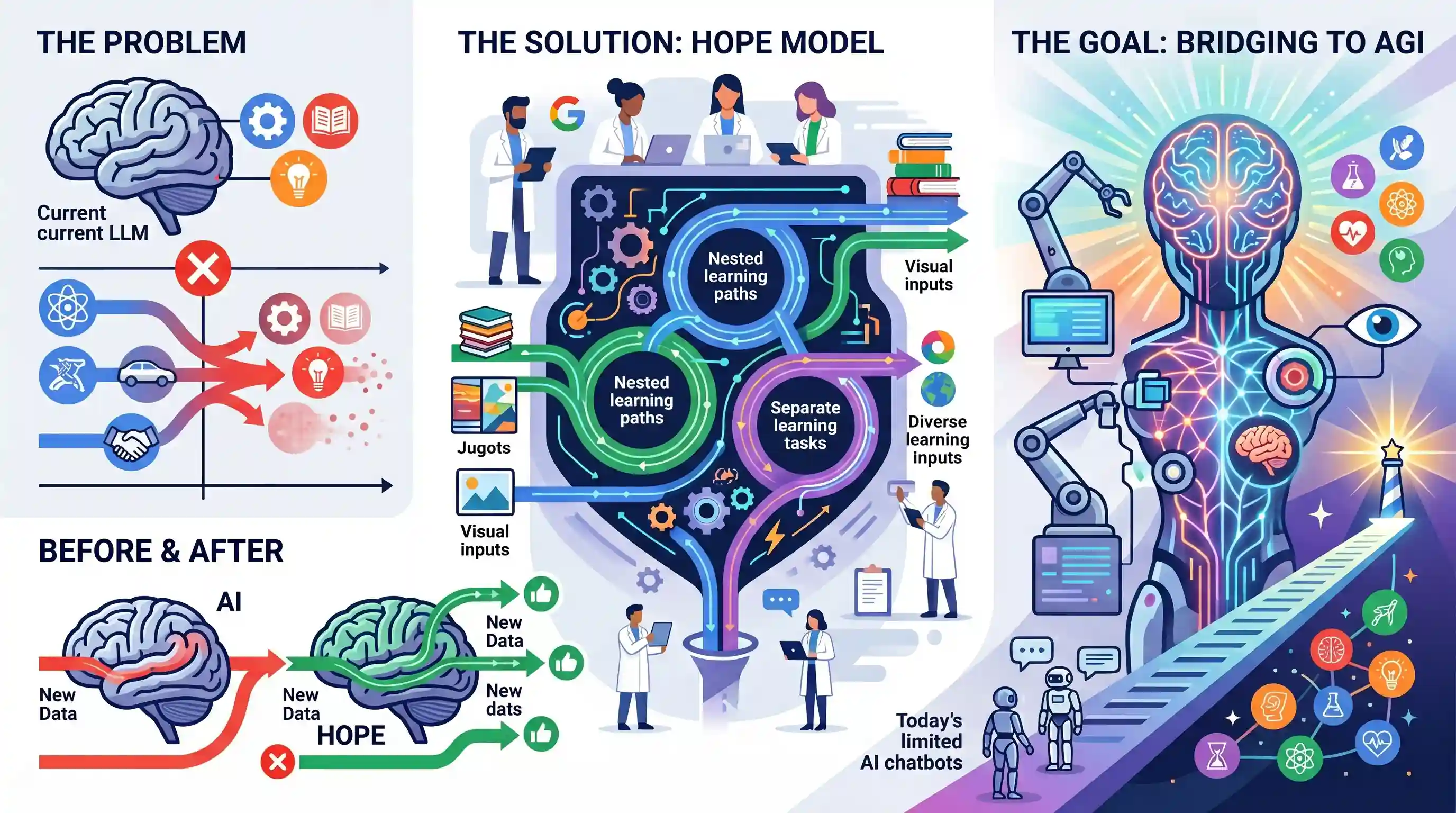
Google researchers have developed a new experimental machine learning model named 'HOPE', which takes a significant step toward solving one of modern AI's biggest hurdles: 'catastrophic forgetting'. Current Large Language Models (LLMs) struggle to learn new information without overwriting existing knowledge. To counter this, HOPE employs a self-modifying architecture based on 'nested learning', optimizing multiple interconnected learning problems simultaneously. By simulating the continual learning capabilities of the human brain, Google aims to bridge the gap between today's AI chatbots and Artificial General Intelligence (AGI).
Key Points
- Google has unveiled an experimental AI model named 'HOPE', aimed at advancing continual learning capabilities in artificial intelligence.
- The model utilizes a novel concept called 'nested learning', which treats an AI model as a system of interconnected, multi-level optimization problems processed simultaneously.
- This architecture addresses 'catastrophic forgetting' (CF), a significant flaw in current Large Language Models (LLMs) where they lose existing knowledge when learning new information.
- Continual learning is widely regarded by experts as a critical missing piece in the pursuit of Artificial General Intelligence (AGI) or human-like intelligence.
- The 'HOPE' model acts as a proof-of-concept, demonstrating higher accuracy and lower perplexity compared to modern LLMs in diverse reasoning tasks.
Important Terms
Artificial General Intelligence (AGI)

A hypothetical form of AI capable of understanding, learning, and applying intelligence to any task a human can, demonstrating cross-domain reasoning and persistent memory beyond specific task-training.
UPSC context
GS Paper III (S&T); tests understanding of AI's future evolution, human-machine parity, and potential disruptive impacts on society and security.
Continual Learning
An AI capability to incrementally acquire knowledge from a continuous stream of new data while preserving previously learned information without requiring costly and time-consuming full retraining.
UPSC context
GS Paper III (S&T); relevant for adaptive systems in healthcare, space exploration, and defense where persistent real-time learning is critical.
Catastrophic Forgetting
A major failure in neural networks where new information updates weight parameters in a way that overwrites and erases existing knowledge, causing the model to lose prior skills.
UPSC context
GS Paper III (S&T); tests knowledge of fundamental bottlenecks in deep learning and the limitations of current static machine learning models.
Nested Learning
An emerging AI architecture that treats a single model as a hierarchy of interconnected, multi-level optimization sub-problems updating at different speeds to mimic biological brain-like retention.
UPSC context
GS Paper III (S&T); focuses on experimental breakthroughs in computational architecture that bridge the gap between narrow AI and general intelligence.
Large Language Models (LLMs)
Advanced AI systems trained on massive text datasets to process and generate human language, forming the backbone of modern chatbots like ChatGPT and Google Gemini.
UPSC context
GS Paper III (S&T); foundational knowledge for topics concerning the digital revolution, automation, and natural language processing applications.
Prelims Trap
"Catastrophic forgetting in AI refers to data loss caused by limited cloud storage or server memory constraints."
It is not a hardware storage issue. It is a fundamental algorithmic flaw in neural networks where learning new data patterns automatically overwrites previously learned parameters.
Static Concepts Connected
What are the three evolutionary stages of Artificial Intelligence?
- Artificial Narrow Intelligence: Current AI systems designed to perform specific, pre-programmed tasks (e.g., Siri, facial recognition, language translation).
- Artificial General Intelligence: A theoretical stage where machines possess generalized, human-like cognitive flexibility to learn and perform any intellectual task.
- Artificial Superintelligence: A hypothetical future stage where AI surpasses human intelligence and capability across all disciplines and domains.
How do Machine Learning, Deep Learning, and LLMs differ conceptually?
- Machine Learning (ML): Algorithms that parse structured data, learn from it, and make informed decisions without explicit programming for every scenario.
- Deep Learning: A subset of ML using multi-layered artificial neural networks, requiring vast unstructured data to mimic human brain learning.
- Large Language Models: Deep learning models trained on massive text datasets to understand, summarize, and generate human language.
Cross-Topic Patterns
AI's compute and carbon footprint
Continual learning models reduce the need to retrain LLMs from scratch, directly mitigating the massive energy and water consumption associated with running modern AI data centers.
AGI, authorship, and IP Rights
As models inch towards AGI, debates around copyright infringement in training data and the patentability of AI-generated inventions under intellectual property laws will intensify.

Expect a Prelims question differentiating Narrow AI vs AGI capabilities, or matching terms like 'catastrophic forgetting' to AI systems.
Linked PYQs · 3
Linked PYQs · 3
- 2023MainsGS3
Introduce the concept of Artificial Intelligence (AI). How does Al help clinical diagnosis? Do you perceive any threat to privacy of the individual in the use of Al in healthcare?
- 2021MainsGS3
Discuss how emerging technologies and globalisation contribute to money laundering. Elaborate measures to tackle the problem of money laundering both at national and international levels.
- 2015MainsGS3
What are the areas of prohibitive labour that can be sustainably managed by robots ? Discuss the initiatives that can propel research in premier research institutes for substantive and gainful innovation.
