Google Direct Subsea Cable Link between India and USA
Source:The Hindu ↗
Why It Matters
The article is highly relevant for GS3 (Infrastructure, Science & Tech) and GS2 (E-Governance, Capacity Building). Subsea cables form the backbone of the global internet, and secure, direct routes reduce India's reliance on vulnerable regional chokepoints, enhancing digital security and sovereignty. The expansive deployment of AI tools in public education (Atal Tinkering Labs) and civil service training (Mission Karmayogi) illustrates the growing role of private-public partnerships in e-governance and administrative capacity building.
Summary
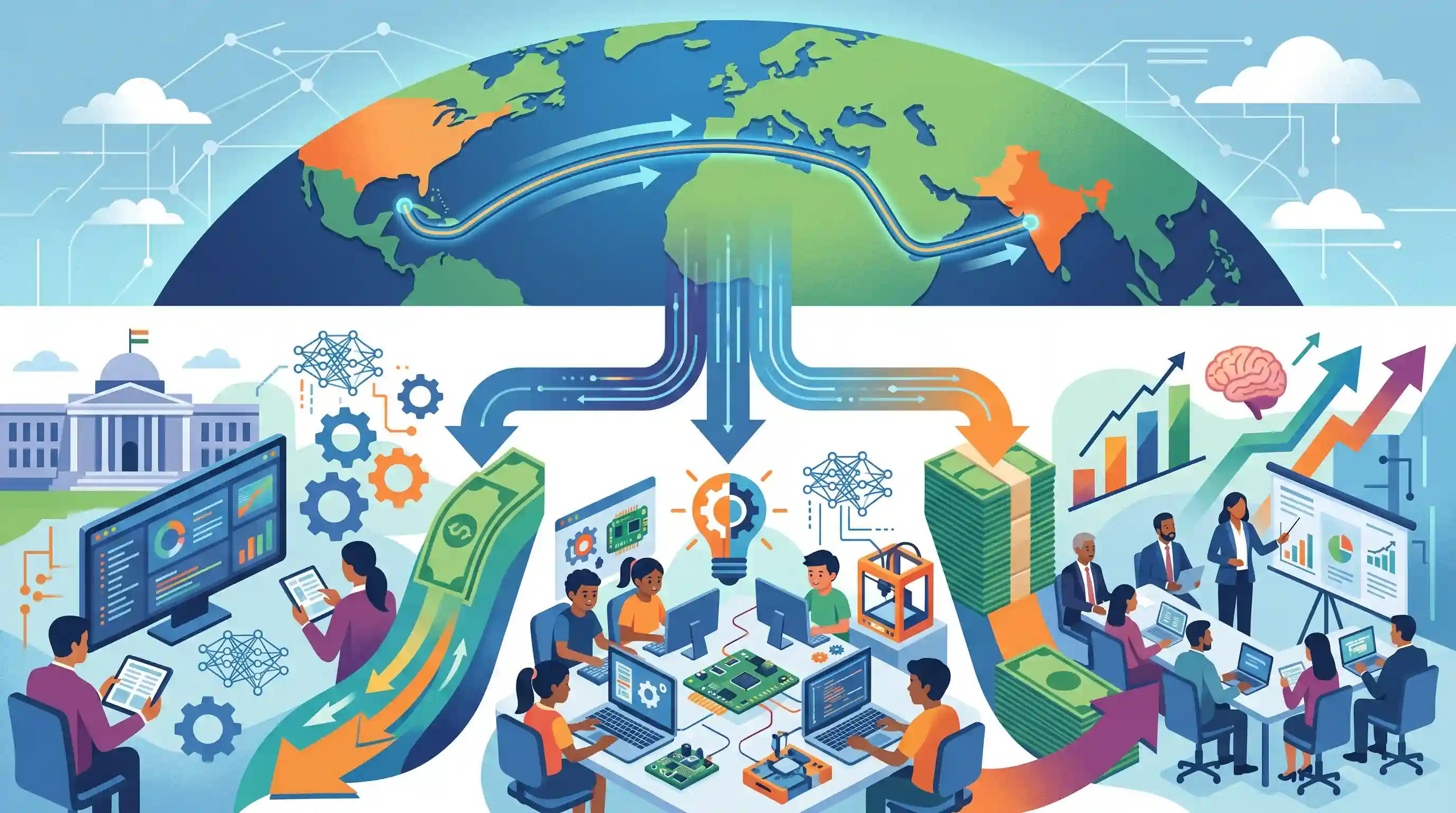
Google has announced a major digital infrastructure and AI capacity-building push in India, headlined by a direct subsea cable linking the U.S. and India. The infrastructure bypasses traditional relay chokepoints like Singapore and West Asia, marking the second such direct link after Meta's Project Waterworth. Concurrently, Google launched a slew of AI initiatives, including a $30 million grant for government-focused AI innovation, integration of AI tools for students in Atal Tinkering Labs, and AI capacity-building partnerships with Karmayogi Bharat for civil servants and the Wadhwani Foundation.
Key Points
- Google announced a direct subsea communications cable connecting India and the U.S., bypassing traditional relay hubs in West Asia and Singapore.
- This initiative follows Meta's similar 'Project Waterworth', highlighting a major push to build resilient, direct digital infrastructure for India.
- Google unveiled a $30 million AI grant for a 'Government Innovation Impact Challenge' targeting non-profits and civic tech initiatives.
- Google DeepMind will integrate AI chatbot assistants for 1.1 crore students across Atal Tinkering Labs to enhance learning.
- New AI-driven capacity-building initiatives were introduced in partnership with Karmayogi Bharat (for civil servants) and the Wadhwani Foundation.
Important Terms
Mission Karmayogi

A flagship national programme to reform Indian civil services by shifting from rule-based to role-based training. It uses the iGOT-Karmayogi platform to provide continuous, AI-enabled capacity building for millions of officials.
UPSC context
GS II (Governance/Civil Services); tests administrative reforms, digital governance, and enhancing state capacity for effective service delivery.
Atal Tinkering Labs
School-level innovation hubs under NITI Aayog's Atal Innovation Mission (AIM). They provide students with tools for STEM/robotics; Google recently partnered to integrate Generative AI (Gemini) into their teaching and curriculum.
UPSC context
GS II/III (Education/Innovation); tests government schemes for human resource development and fostering a scientific temper among youth.
America-India Connect
A Google-led initiative establishing a direct subsea fiber-optic link between the United States and India. It bypasses traditional relay chokepoints like Singapore to enhance data resilience and support global AI traffic.
UPSC context
GS III (Infrastructure/S&T); tests strategic digital infrastructure, critical connectivity routes, and Indo-U.S. technological cooperation.
Project Waterworth
Meta’s 50,000-km subsea cable project designed to connect the U.S., India, Brazil, and South Africa directly. It is the longest 24 fiber-pair system, aimed at supercharging AI and cloud connectivity.
UPSC context
GS III (Infrastructure/Digital Economy); tests the role of private tech giants in building critical global communication networks.
Government Innovation Impact Challenge
A $30 million global funding initiative by Google.org targeting nonprofits and academic institutions. It provides grants and mentorship to develop AI-powered solutions that modernize public services and solve complex societal challenges.
UPSC context
GS II/III (Governance/AI); tests public-private partnerships and the ethical/practical application of AI in public policy.
Wadhwani Foundation
A philanthropic organization that partners with the Capacity Building Commission to train Indian civil servants in emerging technologies. Its 'Wadhwani AI' arm develops scalable solutions for healthcare, agriculture, and education.
UPSC context
GS II (Governance/NGOs); tests the impact of non-state actors and civil society in enhancing government digital literacy.
NITI Aayog
India's premier policy think tank that provides directional and policy inputs. It spearheads the Atal Innovation Mission and national AI strategies to drive economic growth and cooperative federalism.
UPSC context
GS II (Statutory/Regulatory Bodies); tests institutional frameworks for planning, policy implementation, and promoting an innovation ecosystem.
Prelims Trap
"Satellite communication networks now carry the majority of international data traffic, overtaking subsea cables."
Aspirants often overestimate satellite broadband (like Starlink). In reality, over 95% of all international data traffic still relies on submarine fiber-optic cables.
Static Concepts Connected
How does UNCLOS govern the laying of submarine communication cables?
- Freedom to lay: All states enjoy the freedom to lay submarine cables on the continental shelf and the high seas beyond territorial limits.
- Coastal state rights: Coastal states cannot impede cable laying in their EEZ, but can regulate cables entering their territorial sea.
- Protection duties: States are required to adopt domestic laws to punish the deliberate or culpably negligent breaking of submarine cables.
What are the foundational features of Mission Karmayogi (NPCSCB)?
- Role-based shift: Shifts the Indian bureaucracy from a traditional 'rule-based' framework to a competency-driven 'role-based' human resource management system.
- Apex monitoring: Strategic direction is provided by an apex body headed by the Prime Minister (PM's Public Human Resources Council).
- iGOT platform: Utilizes the iGOT-Karmayogi platform to deliver continuous, anytime-anywhere digital training for civil servants.
Cross-Topic Patterns
Geopolitics of Data Chokepoints
Bypassing the Red Sea and West Asia highlights how tech giants are physically reshaping global data routes to avoid traditional maritime vulnerabilities and geopolitical conflicts.
Big Tech & Public Infrastructure
Integrating Google's AI into Mission Karmayogi and Atal Tinkering Labs reflects a growing state reliance on foreign private tech to drive domestic capacity building and digital public infrastructure.

Submarine cables' >95% data share + UNCLOS laying rights + Red Sea chokepoint vulnerabilities likely to form a 2026 Prelims MCQ.
Linked PYQs · 4
Linked PYQs · 4
- 2019PrelimsGS1
Atal Innovation Mission is set up under the
- 2023MainsGS3
Introduce the concept of Artificial Intelligence (AI). How does Al help clinical diagnosis? Do you perceive any threat to privacy of the individual in the use of Al in healthcare?
- 2024MainsGS2
e-governance is not just about the routine application of digital technology in service delivery process. It is as much about multifarious interactions for ensuring transparency and accountability. In this context evaluate the role of the 'Interactive Service Model' of e-governance.
- 2023MainsGS2
e-governance, as a critical tool of governance, has ushered in effectiveness, transparency and accountability in governments. What inadequacies hamper the enhancement of these features ?
