Visakhapatnam Data Centre Allotment and Public Interest Defense
Source:theprint ↗
Why It Matters
It touches upon crucial themes of state industrial policies, economic development, public property allocation without auction, and judicial oversight in administrative actions, which are core to governance and public administration in AP.
Summary
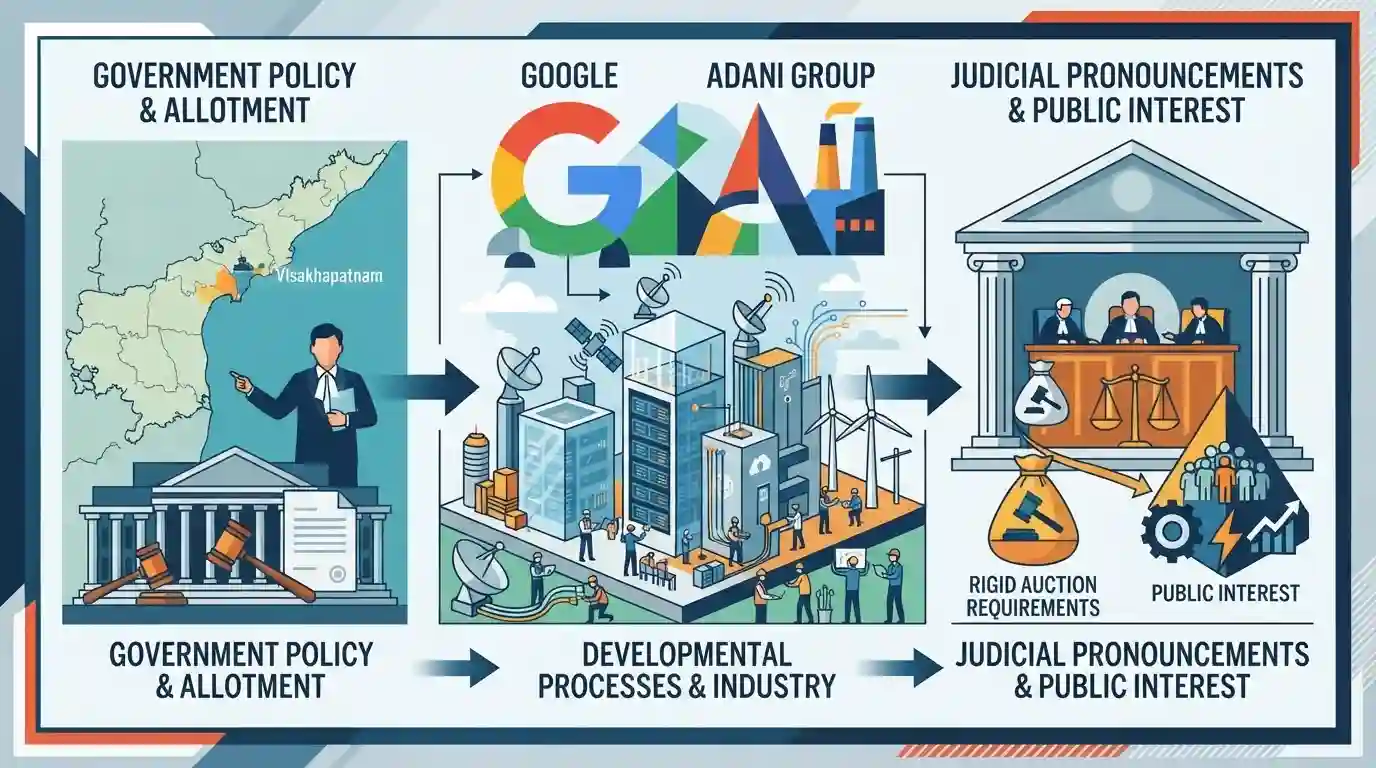
The Andhra Pradesh government defended in court its allotment of land in Visakhapatnam for a massive data centre cluster to major tech and industrial players like Google and the Adani Group without a public auction. The state emphasized 'public interest', highlighting the necessity of attracting strategic high-tech investments, employment generation, and boosting digital infrastructure over rigid auction requirements.
Key Points
- The Andhra Pradesh government defended its decision to allot land for a data centre cluster in Visakhapatnam to companies like Google and Adani without public auction, citing public interest, rapid technological development, and economic growth.
- The case involves legal scrutiny regarding whether government-owned natural resources or land can be allocated without competitive bidding under public trust doctrine or constitutional mandates.
- The state argued that high-tech investments like data centres require speed, specialized infrastructure, and strategic certainty that standard auction processes might stifle, serving a larger socio-economic purpose.
Important Terms
Andhra Pradesh Industrial Infrastructure Corporation (APIIC)

A nodal agency of the Andhra Pradesh government responsible for acquiring, developing, and allotting land for industrial infrastructure projects across the state.
UPSC context
APPSC Group 1/2: Tests knowledge of state-level institutional mechanisms for industrial promotion, land acquisition, and infrastructure development.
Andhra Pradesh Industrial Policy
Strategic state policy framework aimed at attracting investments, building digital infrastructure, and positioning Andhra Pradesh as a leading hub for data centers and artificial intelligence.
UPSC context
APPSC Economy & Policies: Important for questions on state economic development, investment promotion, and sectoral growth policies.
Prelims Trap
Allotment of state-owned land or natural resources without a public auction is unconstitutional under all circumstances.
Aspirants often assume that public authorities can never allocate government land or natural resources without an open auction. However, the Supreme Court has clarified that auctions are not the sole constitutional method when public interest, strategic goals, or non-monetarized socio-economic benefits are involved.
Static Concepts Connected
What is the Public Trust Doctrine in Indian constitutional jurisprudence?
- Origin & Scope: Ancient origin holding certain natural resources (air, water, forests) are meant for public use and cannot be exclusively privatized.
- Judicial Application: Supreme Court of India applied it in M.C. Mehta v. Kamal Nath (1997) to protect ecologically fragile areas from state misuse.
- Trustee Role: Imposes a legal duty on the government to act as a trustee for the people rather than an absolute owner.
What are the key legal parameters governing land acquisition and industrial land allotment in Andhra Pradesh?
- APIIC Role: APIIC acts as the primary agency for land acquisition, infrastructure development, and industrial promotion across the state.
- Policy Framework: Industrial policy frameworks empower governments to offer customized incentive packages and preferential land allotments to anchor investments.
- Endowment Lands: Allotments involving religious endowment lands (e.g., Simhachalam lands) face heightened statutory safeguards and judicial scrutiny.
Cross-Topic Patterns
Public Trust Doctrine vs. Industrial Discretion
Judicial scrutiny of land allotments without auctions highlights the tension between the Public Trust Doctrine and state discretion under Article 14 of the Constitution.
Digital Infrastructure vs. Eco-Sensitive Zone Norms
Mega data centres near sanctuaries test the balance between digital infrastructure goals and eco-sensitive zone (ESZ) regulations under the Wildlife Protection Act.

APPSC may test the Public Trust Doctrine and Supreme Court rulings on natural resource/land allocation without auctions (e.g., 2G case principles).
Linked PYQs · 1
Linked PYQs · 1
- 2024APPSC_PRELIMSGS1
Which of the following statement/statements is/are incorrect regarding the Andhra Pradesh Industrial Policy 2023 - 27? I. To achieve a minimum contribution of 25% by industry in the State GDP II. To provide end-to-end facilitation in 2 weeks III. To envisage ten (10) priorities of accomplishment IV. To focus on becoming a 'Plug and Play State' for investments V. Ensuring land allotment by APIIC within a period of 2 weeks upon receipt of application Select the answer using the codes given below :
