India Trade Diplomacy: Progress on EU FTA and ASEAN Pact Review
Source:The Hindu ↗
Why It Matters
FTAs and investment treaties dictate India's integration into global value chains. Understanding the nuances of negotiations with major blocs like the EU and ASEAN, as well as the impact of protectionist policies (like US reciprocal tariffs), is critical for aspirants analyzing India's economic diplomacy and foreign policy objectives.
Summary
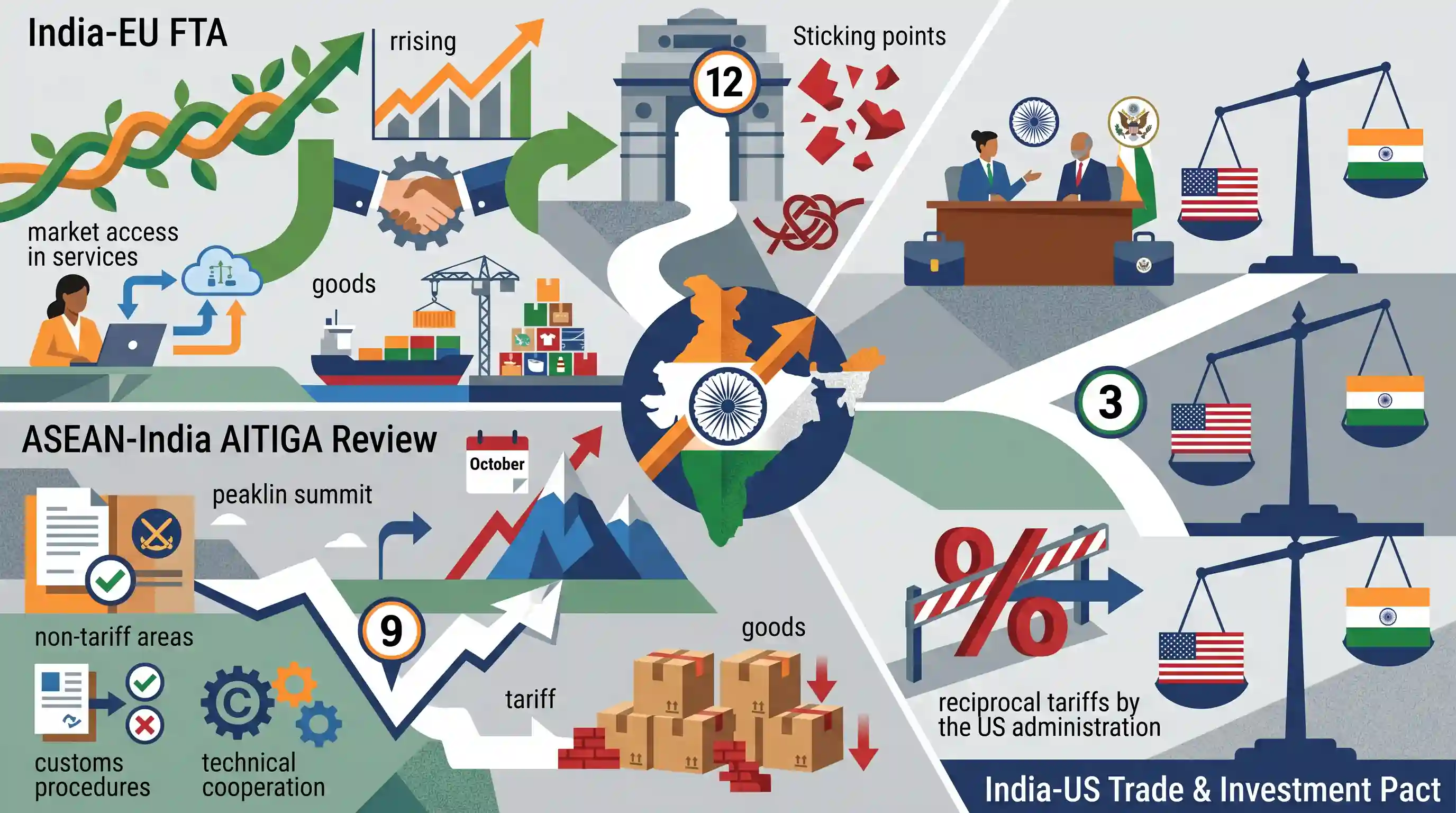
India is concurrently navigating complex trade negotiations with major global partners. The 12th round of the India-EU Free Trade Agreement (FTA) talks saw positive momentum, particularly concerning market access in services and goods, although a few sticking points remain. Conversely, the review of the ASEAN-India Trade in Goods Agreement (AITIGA) has yielded uneven progress across nine rounds, with advancements limited primarily to non-tariff areas such as customs procedures and technical cooperation. Officials hope to finalize the ASEAN review before the October summit. Additionally, Indian officials are in Washington discussing a bilateral trade and investment pact, factoring in potential reciprocal tariffs by the US administration.
Key Points
- India and the European Union have successfully concluded the 12th round of Free Trade Agreement negotiations, making notable progress on market access in both services and non-services sectors.
- Despite 12 rounds of talks, some core divergent issues remain between India and the EU, though officials are working to finalize 6-7 chapters soon.
- The review of the ASEAN-India Trade in Goods Agreement (AITIGA) has seen slower progress across nine rounds, mostly moving forward on non-tariff matters like customs and technical cooperation.
- India aims to conclude the AITIGA review by the upcoming ASEAN-India Summit in October.
- Simultaneously, India and the US are engaged in talks regarding a bilateral trade and investment treaty, with India deploying sectoral specialists amidst concerns over proposed US reciprocal tariffs on iron, steel, and autos.
Important Terms
Free Trade Agreement (FTA)

A comprehensive treaty between two or more countries to reduce or eliminate trade barriers, such as tariffs and quotas, to facilitate the free flow of goods and services.
UPSC context
GS Paper II (International Relations) & III (Economy); tests understanding of trade liberalization and its impact on domestic industry.
ASEAN-India Trade in Goods Agreement (AITIGA)
A 2009 pact between India and the 10-member ASEAN bloc; currently under review to address India's widening trade deficit and market access asymmetries.
UPSC context
GS Paper II; central to India's 'Act East Policy' and regional economic integration challenges.
Bilateral Investment Treaty (BIT)
A legal framework providing protection for foreign investors against discriminatory treatment or expropriation, often negotiated alongside or separately from FTAs to boost investor confidence.
UPSC context
GS Paper III; critical for understanding FDI inflows and legal dispute resolution mechanisms in international trade.
Rules of Origin (RoO)
The criteria used to determine the national source of a product; essential in FTAs to prevent third-party countries (like China) from routing goods through partner nations.
UPSC context
GS Paper III (Economy); tests technical knowledge of trade safeguards and preventing 'treaty shopping' or circumvention.
Reciprocal Tariffs
A trade policy where a country imposes import duties on another nation's goods equivalent to the tariffs that nation imposes on its own exports.
UPSC context
GS Paper II; relevant for studying the 'America First' policy impact on India-US strategic and economic relations.
Non-Tariff Barriers (NTBs)
Regulatory or procedural hurdles to trade, such as sanitary standards, customs delays, or technical specifications, that restrict imports without using direct taxes (tariffs).
UPSC context
GS Paper III; key to analyzing why India's exports often face challenges despite low-tariff agreements.
Prelims Trap
"AITIGA is a comprehensive economic partnership covering goods, services, and bilateral investments between India and ASEAN."
AITIGA (2009) strictly covers physical goods. Trade in services and investments were negotiated separately and signed much later in 2014 to complete the broader ASEAN-India Free Trade Area.
Static Concepts Connected
What is the "Rules of Origin" framework in Free Trade Agreements?
- Core definition: The criteria used to define where a product was made, essential for determining whether it qualifies for preferential tariff treatment under an FTA.
- Preventing trade routing: It prevents third-party nations (e.g., China) from routing their products through an FTA partner country to bypass Indian import duties.
- Value addition norms: Usually requires a minimum threshold of domestic value addition (e.g., 35%) or a change in tariff classification within the exporting country.
What are Non-Tariff Barriers (NTBs) in global trade?
- Mechanism: Trade restrictions that restrict imports or exports through mechanisms other than traditional tariffs, such as quotas, licensing rules, or embargoes.
- SPS Measures: Developed nations frequently use stringent Sanitary and Phytosanitary (SPS) measures to block agricultural exports from developing countries.
- Modern NTB examples: The EU's upcoming Carbon Border Adjustment Mechanism (CBAM) and strict data privacy regulations are modern structural NTBs complicating trade talks.
Cross-Topic Patterns
EU FTAs + Climate Policy (CBAM)
The EU's Carbon Border Adjustment Mechanism (CBAM) acts as a de facto non-tariff barrier, complicating India-EU FTA negotiations by penalizing carbon-intensive Indian exports like steel and aluminum.
Rules of Origin + China dumping
India's push to review the ASEAN AITIGA is heavily driven by the need to block cheap Chinese goods rerouted through Southeast Asia, protecting domestic manufacturing and PLI schemes.

Expect a multi-statement Prelims question comparing 'Rules of Origin' criteria and NTBs across India's recent trade pacts (EFTA, ASEAN).
Linked PYQs · 3
Linked PYQs · 3
- 2018PrelimsGS1
Consider the following countries: 1. Australia 2. Canada 3. China 4. India 5. Japan 6. USA Which of the above are among the 'free-trade partners' of ASEAN?
- 2014MainsGS2
The aim of Information Technology Agreements (ITAs) is to lower all taxes and tariffs on information technology products by signatories to zero. What impact would such agreements have on India's interests?
- 2016MainsGS2
Evaluate the economic and strategic dimensions of India's Look East Policy in the context of the post Cold War international scenario.
